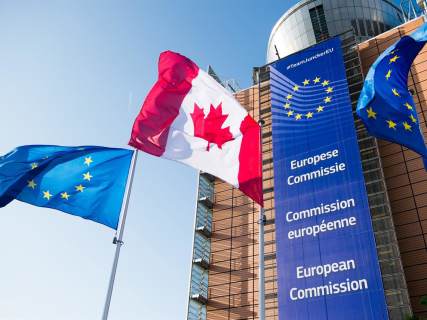

The European Union and Canada have decided this Friday to analyze how to increase sales of Canadian liquefied natural gas (LNG) to Europe and to put in place reserves of critical raw materials that ensure supply to their industries. These measures are part of a new economic alliance with which both partners intend to reduce their dependence on strategic resources and shield themselves against possible supply cuts.
Thus it appears in the joint declaration approved at the close of the summit held in Montreal, where the two sides have committed to carry out a long-term feasibility study on gas shipments to the European market and to study formulas for storing resources considered "essential" both for the civil industrial fabric and for the defense sector.
In particular, Brussels and Ottawa have agreed to analyze new investment options and long-term energy supply contracts to strengthen supply security, without renouncing their climate goals and advancing in parallel in the deployment of sustainable energy sources.
To this end, they will promote a joint study on LNG exports to Europe and will expand their cooperation in electrical grids, battery storage systems and "physical and cyber" protection of energy infrastructures, as detailed in the document.
Both allies have stressed that the expansion of gas exchanges must be adjusted to their respective climate neutrality objectives and to the commitments assumed in the Paris Agreement, while they underscore the importance of promoting "safe and sustainable" energy sources with low carbon emissions.
The declaration likewise provides for maintaining cooperation in nuclear technologies, including the supply of uranium, fuels and services linked to the nuclear cycle, in addition to advancing in the updating of the agreement between Canada and the European Atomic Energy Community (Euratom).
Strategic reserves and investment drive in critical raw materials
In parallel, the EU and Canada have announced that they will evaluate different mechanisms for storing strategic resources in order to mitigate the impact of market volatility and geopolitical tensions on supply to industrial sectors considered priority.
The purpose, according to the text, is to strengthen the "preparedness and security of supply" of raw materials essential for civilian and military activities, through the creation of possible reserves that serve as a cushion against eventual international crises.
To this end, both parties propose to accelerate investments in critical minerals projects on both sides of the Atlantic, from extraction and processing to refining, manufacturing and recycling, with a view to shaping more "secure and sustainable" value chains.
In this framework, Canada and the European Investment Bank (EIB) have closed negotiations on an agreement aimed at facilitating the entry of European capital into Canadian strategic resources, with special attention to critical raw materials.
In addition, Brussels and Ottawa will analyze new investment opportunities in third countries and will seek to strengthen connections between European and Canadian ports to speed up the transport of energy and strategic minerals, as well as reinforce the protection of maritime and submarine infrastructure.