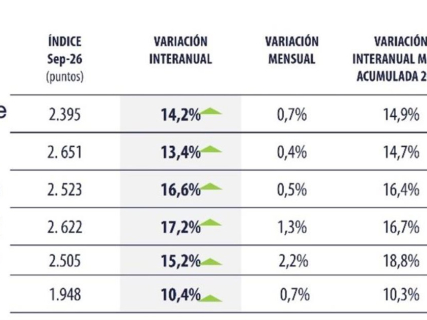

The cost of new and second-hand housing in Spain increased by 0.7% between August and September, raising the year-on-year increase to 14.2%, according to a study prepared by Tinsa.
This advance is 8.8 points above general inflation, but "consolidates the slowdown in the growth rate of residential prices," which has been progressively moderating since the 15.6% reached in June.
The head of research at Tinsa, Cristina Arias, indicated that in September the residential price "has continued to slow its growth rate."
"Still, it registers strong year-on-year rates in all groups, above inflation and exceeding the nominal threshold of 9% established by the European Commission for monitoring potential macroeconomic imbalances," she added.
The third quarter closes with a year-on-year increase of 14.9%
With the definitive data for September, the year-on-year variation for the third quarter of 2026 stands at 14.9%, two-tenths higher than the provisional 14.7% reported in the "IMIE Local Markets" report released on September 30.
"Employment has continued to show good performance, influenced by the extraordinary regularization of immigrants, but the purchasing power of wages continues to decrease in the face of the inflationary spike resulting from the war in the Middle East," Arias pointed out.
The groups "Capitals and large cities" and "Metropolitan areas" recorded the most contained monthly increases (0.4% and 0.5%, respectively), compared to the 2% noted for new and used housing in the "Islands" group. In the last twelve months, the price increase ranges from 10.4% in "Rest of municipalities" to 17.2% in "Mediterranean coast."
"Discounting the effect of inflation, the most pronounced price slowdowns are observed in "Capitals and large cities" and in "Metropolitan areas," areas where the price level limits the purchasing capacity of a growing proportion of the population," the expert noted, who reminded that, although residential sales are moderating due to the greater economic effort and credit restriction in a context of rising interest rates, "the number of sales continues to be at robust levels and above the historical average."
Prices above the 2007 bubble in nominal terms
The average value of new and used housing in Spain is 2.5% above the peaks of the 2007 bubble in nominal terms, although in real terms it remains 32% below. Specifically, the peaks of 2007 have been surpassed in all groups, except in "Mediterranean coast" and "Rest of municipalities".
However, when discounting the effect of inflation, all groups are still below those peaks. The Insular territory is the one that comes closest, with a gap of 13%, while the rest of the areas remain more than 30% away.