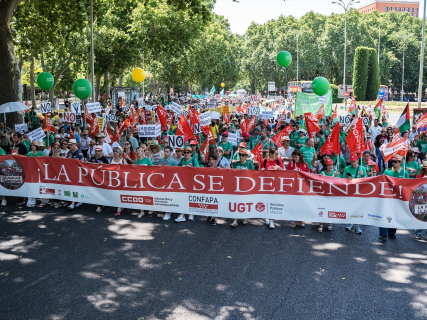
Indefinite strike of teachers in Madrid from this Wednesday: schedules, demonstrations, and demands

The teachers of the Community of Madrid begin this October 14 a strike to demand salary improvements, fewer students per classroom, and a reduction of teaching hours. CCOO and UGT call for indefinite strikes, while CSIF proposes its own calendar of mobilizations.

EuropaPress 7596112 numerosas personas sostienen pancarta lema publica defiende manifestacion

EuropaPress 7596112 numerosas personas sostienen pancarta lema publica defiende manifestacion

Add DEMÓCRATA to Google

Ask FREN

Published

Last updated

3 minutes

Most read

Elecciones 29N · Encuestas

La media de las encuestas

Media a 18 de noviembre de 2026 · 17 institutos

  • PP31,4 %
  • PSOE27,4 %
  • Vox19,0 %
  • Frente Amplio6,1 %
  • ERC2,4 %
  • SALF2,0 %
01020304050ene 2024jul 2024ene 2025jul 2025ene 2026jul 2026

Media del último estudio de cada instituto en 30 días y su evolución semanal desde el 23J. Partidos con al menos un 2 %.

Todas las encuestas

Elecciones generales del 29 de noviembre · Demócrata

The indefinite strike of teachers in the Community of Madrid begins this Wednesday, October 14 in schools and institutes in the region. The unions demand improvements in the working conditions of teachers, a salary increase, and a reduction in the student-to-class ratios, while the Government of Isabel Díaz Ayuso considers their demands "impossible" to meet.

The mobilizations will take place through two parallel calls. On one hand, the strike committee, made up of CCOO and UGT and supported by organizations of families, students, and educational platforms, proposes to maintain the strikes throughout the school year. On the other hand, CSIF has called for three initial days of strike and a schedule of partial strikes that will extend, at least, until December.

The start of the protests will be accompanied by a demonstration this Wednesday at 6:00 PM from Atocha to Puerta del Sol, in addition to concentrations and other mobilizations planned for the coming days.

Schedules and route of the demonstrations

The unions have organized different activities during the first three days of the strike, from October 14 to 16.

Date Time Mobilization
Wednesday, October 14 During the morning Informative pickets and concentrations in neighborhoods and municipalities
Wednesday, October 14 12:00 Concentration at Puerta del Sol
Wednesday, October 14 12:00 CSIF concentration in front of the Ministry of Education
Wednesday, October 14 6:00 PM Demonstration from Atocha to Sol
Thursday, October 15 12:00 Human chain in front of the Ministry of Education
Friday, October 16 12:00 Open assembly in Retiro Park
Friday, October 16 6:00 PM Demonstration from Atocha to Sol

The strike committee maintains that the protests are the result of several years of mobilizations and accuses the Ministry of Education of a lack of negotiating will.

The organizers warn that they will maintain the mobilizations throughout the school year if a new negotiation pathway regarding their demands is not opened.

What the teachers of Madrid demand

Among the main demands of the strike committee is a salary increase of 600 euros per month, with which the teachers aim to reduce the pay differences compared to other autonomous communities.

They also demand to reduce the number of students per classroom and establish the following limits:

Educational stage Requested ratio
Early Childhood Education 13 students
Primary Education 15 students
Secondary Education 20 students
Baccalaureate 23 students
Vocational Training 15 students

The unions also ask to establish specific resources for students with special educational needs.

Another of their priorities is to reduce weekly teaching hours to 17 in Secondary and 22 in Primary. Currently, a process is underway to lower teaching hours to 18 in Secondary, while in Primary the 25 weekly hours are maintained.

These demands are joined by the improvement of staff, more resources for centers of special complexity, the elimination of the current bilingual model, and a climate control plan for schools and institutes.

CSIF calls for partial strikes until December

CSIF has opted for an independent call, with a strike on the days 14, 15, and 16 of October and subsequent partial strikes during the rest of the term.

The strikes are scheduled from 8:00 to 10:00 hours and from 16:00 to 18:00 hours on the following dates:

Month Strike days Schedule
October 20, 22, 26, and 30 08:00-10:00 and 16:00-18:00
November 3, 5, 11, 13, 16, 20, 24, 26, and 30 08:00-10:00 and 16:00-18:00
December 1, 10, 11, 16, and 18 08:00-10:00 and 16:00-18:00

The union explains that this model seeks to maintain pressure on the regional government without the prolongation of the strike causing ongoing economic harm to teachers.

Among its demands, the creation of a capital city supplement that compensates for the high cost of living in Madrid stands out, in addition to the reduction of ratios, salary improvement, and the decrease of bureaucratic burden.

CSIF also requests to recognize as teaching certain functions of tutoring, coordination, and leadership, to strengthen attention to diversity, and to improve educational infrastructures.

The Community of Madrid considers the demands "impossible"

The Minister of Education, Science, and Universities, Mercedes Zarzalejo, rejected this Tuesday the union demands considering them "totally unattainable" and "impossible."

The regional official has questioned the call and has reminded that some of the unions participating in the protests signed the educational framework agreement a year ago.

"This strike is absolutely incomprehensible if it is only related to the educational aspect," Zarzalejo declared, who maintains that the Ministry keeps the dialogue open with the union organizations through the sectoral table.

The autonomous Executive has also conveyed a message of reassurance to families and has assured that minimum services will be guaranteed in educational centers during the strike days.

"We respect the right to strike of all the calling unions and of all the teachers who join it, but we must also guarantee the right to education and also the right to work of all those who do not want to join the strike," the counselor has pointed out.

More key points, information and questions with FREN

AI-GENERATED CONTENT

At what stage is the processing of a possible agreement between the teachers' unions and the Community of Madrid following the start of the strike?

As of October 14, 2026, the negotiation between the teachers' unions and the Government of the Community of Madrid is open but stalled: there is a dialogue table and formal contacts, but there is no record of any preliminary agreement or closed global proposal that has been accepted by the union organizations or formally submitted as an agreement to the official bulletins or the Assembly of Madrid.

1. General situation after the start of the strike

According to information available in the media and from the Community of Madrid itself, the indefinite teachers' strike began with:

  • A strike committee (in which CCOO, UGT, and other teaching organizations participate) that maintains a broad list of demands regarding salaries, ratios, teaching load, staff, bureaucracy, infrastructure, and attention to diversity.
    See, for example, the analysis by Demócrata on the call and its demands: Demócrata article.
  • An indefinite strike call starting October 14, after months of mobilization and without previous rounds of contacts producing a satisfactory text for the parties.

In parallel, the Assembly of Madrid and the Official Bulletin of the Community of Madrid record recent initiatives and agreements linked to the educational field (for example, the reform of the Public Function Law regarding interim staff, PL‑2/2025, or general remuneration agreements for public sector personnel). However, no specific agreement ending the current teaching conflict nor a new sectoral pact derived from this strike is registered as of today.

2. Open formal negotiation channels

The regional Government insists that the conflict is processed through the usual channels of social dialogue in education:

  • The Sectoral Education Table, where Minister Mercedes Zarzalejo has met with unions to, among other matters, open negotiations on the horizontal professional career for teachers —a supplement that could mean up to 350 euros extra per month for teachers, according to the official note of September 22: Community of Madrid press release.
  • The general mechanisms of labor mediation and arbitration of the Community, which the Government itself claims as usual instruments to unblock conflicts, although the available information speaks in general terms, not of a specific file already underway for this strike: note on mediation and arbitration.

In sum, the government side maintains that dialogue remains open at these tables, but this has not yet translated into an agreement text covering the entire strike claim platform.

3. Positions of the parties at the table

From the most recent press coverage, a clash of diagnoses emerges:

  • Government of the Community of Madrid: the minister has publicly described the union demands as “totally unattainable” and “impossible,” recalling that there is already an educational framework agreement in force until 2028 which, according to the Executive, includes reductions in teaching hours and other improvements. She defends continuing negotiations within those frameworks, without assuming for now the full economic and organizational package proposed by the unions.
  • Teachers' unions: accuse the Ministry of lack of negotiating will and demand a change of phase, with a quantified and verifiable offer including:
    • Salary increase (in some cases around 600 euros per month to converge with other communities).
    • Reduction of ratios and teaching hours.
    • Reinforcement of staff and attention to diversity.
    • Air conditioning and improvement of educational infrastructure.

The unions point out that the proposals they have received are partial and scattered (for example, linked only to the professional career or general remuneration measures) and do not constitute a comprehensive agreement justifying calling off the strike.

4. Absence of preliminary agreement and immediate outlook

Neither in the institutional documentation consulted (Assembly of Madrid, BOCM, Government Council agreements on teaching staff) nor in the reference information is identified, as of October 14, 2026, a:

  • Formal preliminary agreement signed between the Ministry of Education and all the unions calling the strike.
  • Closed de-escalation schedule of the conflict linked to a specific package of measures.

The current picture is, therefore, that of a conflict entering its phase of indefinite strike with “low-intensity” negotiation: the administration maintains the offer to continue dialoguing at existing tables and highlights ongoing reforms (such as the professional career), while the unions warn they will prolong the stoppages during the school year if a substantially new proposal is not presented.

In other words: there is a table, but no agreement yet in sight. The next political milestone will depend on whether in upcoming meetings the Community puts on the table an economic and organizational commitment that can be submitted to consultation among teachers and opens the door to suspend or modulate the strike.

Can you detail with figures the main salary and ratio demands put forward by the teachers' strike committee in Madrid? What recent educational agreements has the Assembly of Madrid approved that could indirectly influence this negotiation with teachers? How have similar teachers' strikes been resolved in other communities (for example, Catalonia or the Valencian Community) in 2026, and which elements of those agreements could serve as a reference in Madrid?

What are the powers and functions of the Minister of Education, Science and Universities of the Community of Madrid according to regional legislation?

According to the regional legislation of the Community of Madrid, the powers and functions of the Minister of Education, Science and Universities are determined by combining, on one hand, the general regime of the regional government ministers and, on the other, the rules that delimit the material scope of their department.

1. General framework: functions of any regional minister

Law 1/1983, of December 13, on Government and Administration of the Community of Madrid establishes ministers as senior government and administrative bodies. In the section applicable to all of them (article that lists their specific functions), it is established that the holder of a ministry:

  • Directs and represents their Ministry, assuming direction, management, and inspection in the matters legally attributed to them.
  • Exercises superior inspection over the institutional administration attached to their Ministry (organisms, dependent entities).
  • Proposes to the Government Council the structure or organization of their Ministry.
  • Exercises regulatory power in their material scope, issuing general provisions, circulars, and instructions to develop regulations and organize services.
  • Exercises superior authority over the personnel of the Ministry, without prejudice to the competencies of the Presidency and Economy and Finance in public function matters.
  • Resolves conflicts between authorities and bodies dependent on their Ministry.
  • Resolves in last administrative instance appeals against resolutions of the Ministry's bodies and organisms, when not attributed to a lower authority.
  • Orders expenses of their Ministry's services within authorized credits and requests payment orders from the Treasury.
  • Enters into contracts related to their Ministry's matters, exercising contracting authority powers according to public sector contracting legislation.
  • Decides on disposals of goods and rights assigned to the Ministry within limits set by the Budget Law.
  • Exercises legal actions before courts in the scope of their Ministry and may desist from them, informing the Government Council.
  • Generally assumes any other powers attributed by applicable regulations.

This legal block defines the “core” functions of any minister, including the Minister of Education, Science and Universities.

2. Material delimitation of the department

The specific configuration of their portfolio derives from the President's decrees on Government structure and the Ministry's own structure decrees.

Decree 38/2023, of June 23, by the President of the Community of Madrid, which establishes the number and denomination of Ministries, includes among the Government departments the Ministry of Education, Science and Universities (art. 1.4). Its article 5 specifies that this Ministry assumes the powers held by the former “Vice Presidency, Ministry of Education and Universities,” excluding the functions of Vice Presidency, Government action coordination, and Spokesmanship. Thus, this department concentrates all policies of:

  • Non-university education (early childhood, primary, secondary, baccalaureate, vocational training, and special regime).
  • Universities, public and private, and the Madrid university system as a whole.
  • Artistic education and its specific centers.
  • Scientific research and technological innovation, especially linked to the new digital context.

3. Sectoral competencies according to the Structure Decree

Decree 248/2023, of October 11, by the Government Council, which establishes the organic structure of the Ministry of Education, Science and Universities, specifies and distributes these competencies.

Its article 1 states that the Ministry holder has the general competencies of the corresponding article of Law 1/1983 and, additionally, “the general development, coordination, and control of the execution of Government policies” in the matters of:

  • Education and teachings of general and special regime.
  • Universities and artistic education.
  • Scientific research and technological innovation, “mainly supported by the new digital context.”

From there, the Decree distributes functions among deputy ministers and general directorates, but always “under the direction of the Ministry holder.” In summary, this implies that the minister:

  • Plans, promotes, and coordinates non-university educational policy: academic organization, network of centers, attention to diversity, educational compensation, scholarships and aid, promotion of bilingualism and system quality.
  • Defines the strategy for universities, research, and science: institutional relations with universities and research bodies, evaluation of the university and science system, support for entrepreneurship and innovative companies, coordination with foundations and research institutes (such as IMDEA).
  • Directs the policy on human resources and educational infrastructure: investment programming in centers, planning of non-university teaching staff, educational inspection, and territorial organization of Madrid education.
  • Promotes digital competencies in the educational field and strategic decisions on platforms and digital learning resources.

Overall, the minister exercises both the sectoral political leadership (defining strategies and priorities in education, universities, and science) and the administrative headship of the Ministry (internal organization, personnel, spending, and contracting), within the general framework set by Law 1/1983 and the Government and Ministry structure decrees.

Can you break down in more detail what competencies each Deputy Ministry exercises within the Ministry of Education, Science and Universities? What differences exist between the competencies of the Ministry of Education, Science and Universities and those of the national Ministry of Education? How are the delegations of competencies from the minister to deputy ministers and general directors legally articulated according to Madrid regulations?

What legal requirements must a strike call in the educational sector in the Community of Madrid comply with?

In the Community of Madrid, a strike call in the educational sector is basically governed by the state regulations on the right to strike and by the provisions that set minimum services for each specific call. According to our database, there is no specific “Madrid statute” that replaces this general regulation; what the regional Government does is specify essential services through decrees and agreements published in the BOCM for each educational strike.

1. Basic regulatory framework
  • Article 28.2 of the Spanish Constitution: recognizes workers' right to strike for the defense of their interests.
  • Royal Decree-Law 17/1977, of March 4, on labor relations: regulates the call procedure (who can call, prior notice, content of communication, strike committee, etc.). Articles 3 and 4 are key.
  • Workers' Statute (Royal Legislative Decree 2/2015): recognizes strike as a basic right and contemplates its effects on the labor relationship (contract suspension, etc.).
  • Constitutional Court jurisprudence: has qualified and refined several provisions of Royal Decree-Law 17/1977 and sets criteria on minimum services in essential services.
  • Royal Decree 417/1988, of April 29, and the Order of May 25, 1988, on essential services in non-university public teaching centers, completed by a 1997 Resolution specifying its application.
  • Decrees and agreements of the Government Council of the Community of Madrid published in the BOCM, which set minimum services for each specific educational strike (for example, agreements from 2012 and 2018 and more recent resolutions for teaching and early childhood strikes).
2. Who can call an educational strike
According to Royal Decree-Law 17/1977, article 3, the declaration of strike in Madrid educational centers must be adopted by express agreement in the affected scope (center, sector, community). Those legitimized to call it are:
  • Trade unions with representation in the educational field (for example, CCOO, UGT, ANPE, CSIF, or others in the sector), through their competent bodies.
  • Unitary worker representatives: works council, staff delegates, or teaching and non-teaching staff boards.
  • The workers themselves of the center or affected scope, by secret vote with a simple majority, when promoted by at least a significant part of the staff.
The management of centers or the educational Administration cannot “call” a strike; their role is to organize the service, apply minimum services, and manage administrative consequences.

3. Minimum prior notice and content of the call

Royal Decree-Law 17/1977 requires:

  • Written prior notice to the employer (educational Administration or center owner) and to the labor authority.
  • General term of five calendar days.
  • Term of ten calendar days when the strike affects companies in charge of public services.
Since public education is an essential public service, in practice calls in Madrid education are made with at least ten calendar days' prior notice, to allow the Community to set minimum services and organize centers. This criterion is prudently applied also to strikes affecting chartered centers, due to their impact on the educational service.

The written communication must include at least (art. 3 of Royal Decree-Law 17/1977 and constitutional doctrine):

  • Objectives and demands of the strike.
  • Previous efforts made to try to resolve the conflict.
  • Start date and, if applicable, duration or indefinite character.
  • Personal, functional, and territorial scope (which teaching and non-teaching groups, which levels, which centers or zones).
  • Schedule of stoppages if it is a partial strike.
  • Composition of the strike committee (representatives of workers in the affected scope, up to a legal maximum number of members).
4. Communication to the Madrid educational Administration

In an educational strike in the Community of Madrid, prior notice must be sent at least to:

  • The Ministry competent in Education of the Community of Madrid.
  • The corresponding labor authority.
  • The owners of the affected centers (Community of Madrid itself in public centers; private owners in chartered and private centers).

The communication must be made by a means that leaves proof of date and content (official registry, accepted electronic means, etc.). Mere dissemination in media or social networks does not replace this formal requirement.

5. Minimum services in education

Education is considered an essential service, but constitutional jurisprudence requires that minimum services be limited to what is indispensable to protect other fundamental rights (especially the right to education of underage students) and the safety of people and property.

  • The Government of the Community of Madrid sets minimum services for each specific educational strike by decree or agreement published in the BOCM. There are precedents for strikes in non-university teaching centers and early childhood education that determine, for example, the mandatory presence of a member of the management team per center and a minimum number of teachers according to stages and number of units, as well as guaranteeing certain care services (opening the center, attention to students with special needs, boarding schools, etc.).
  • Personnel designated for minimum services must attend and perform essential tasks. Unjustified non-compliance may entail disciplinary responsibility (civil servant or labor, depending on the link).
6. Limits, prohibitions, and effects for workers

For the strike to be lawful, besides meeting formal requirements, certain material limits set by Royal Decree-Law 17/1977 and jurisprudence must be respected:

  • Prohibition of violence, coercion, or damage to people and property. Pickets may only inform and peacefully persuade.
  • Respect for the freedom to work of those who do not wish to join the strike.
  • Impossibility of imposing, de facto, minimum services higher than those set by the competent authority, or of emptying the right to strike through massive designations.
  • Prohibition of systematically replacing strikers with external personnel to neutralize the strike.

For those who lawfully participate in the strike, the essential legal effect is the suspension of the employment relationship during the stoppage: no salaries or certain economic benefits accrue, but they cannot be sanctioned for merely joining a legally called and communicated strike.

In summary, a strike call in the Madrid educational sector is legally valid if promoted by a legitimized subject, given written prior notice in time (generally ten calendar days), contains the required elements (objectives, efforts, dates, committee, scope), is communicated to the educational Administration and affected employers, and is developed respecting the minimum services that, for each call, the Government of the Community of Madrid sets in a motivated and proportionate manner.

Can you explain with a practical example how a prior notice of an educational strike in Madrid should be drafted to meet all these requirements? What has the Constitutional Court said about minimum services in education and in which cases has it annulled Administration decisions? How do the strike requirements differ for tenured teaching staff, labor personnel, or teachers in chartered schools in the Community of Madrid?

Play

Test your knowledge with FREN!

How much do you know about this topic? Answer the following 3 questions.

What monthly salary increase are Madrid teachers demanding in the indefinite strike?

Question 1 of 3

What is the maximum student-to-classroom ratio requested for Early Childhood Education according to union demands?

Question 2 of 3

Which union has called for partial strikes that will last at least until December?

Question 3 of 3