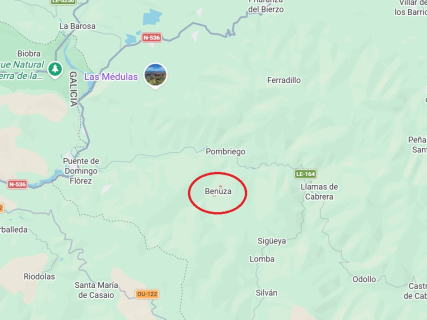
A magnitude 4.2 earthquake with its epicenter in Benuza is felt in León, Galicia, and Asturias.

The National Geographic Institute recorded the tremor at 22:34 on Thursday and located its epicenter east of the León municipality.

terremoto león

terremoto león

Add DEMÓCRATA to Google

Ask FREN

Published

Last updated

1 minute

Most read

Elecciones 29N · Encuestas

La media de las encuestas

Media a 16 de noviembre de 2026 · 17 institutos

  • PP31,5 %
  • PSOE27,2 %
  • Vox18,9 %
  • Frente Amplio6,4 %
  • ERC2,5 %
01020304050ene 2024jul 2024ene 2025jul 2025ene 2026jul 2026

Media del último estudio de cada instituto en 30 días y su evolución semanal desde el 23J. Partidos con al menos un 2 %.

Todas las encuestas

Elecciones generales del 29 de noviembre · Demócrata

A 4.2 magnitude earthquake with epicenter in Benuza (León) was felt during the night of Thursday in different points of Castilla y León, Galicia, and Asturias. The National Geographic Institute (IGN) recorded the seismic movement at 10:34 PM on October 15 and attributed a maximum intensity of IV-V on the European macroseismic scale.

The catalog of the geographic agency locates the epicenter to the east of this León municipality and notes a depth of zero kilometers. The definitive magnitude was established at 4.2, above the initial estimate of 4.0 released after the earthquake.

The IGN record includes perception reports in towns of León, Lugo, Ourense, and Asturias. Among the noted points are Ponferrada, Bembibre, Villafranca del Bierzo, O Barco de Valdeorras, and Lugo.

The first information released after the earthquake indicated that no personal or material incidents had been recorded. However, no definitive official balance in writing has been located that allows for independent confirmation of the extent of possible damages.

More key points, information and questions with FREN

AI-GENERATED CONTENT

What procedures do local and regional authorities follow after an earthquake of this magnitude in Spain?

In Spain, the response after an earthquake is organized through local, regional, and state civil protection plans: damages are assessed, emergency services are mobilized, and coordination is expanded when available resources are insufficient. Magnitude alone does not determine the entire response: victims, damages, and disruption of essential services matter. Since the earthquake or affected community is not identified here, this is the general procedure, not a description of already agreed actions.

1. Initial assessment and plan activation

Authorities gather information about affected people, damaged buildings, access, and supplies. With that assessment, the competent body activates the corresponding plan and adjusts resource mobilization. Law 17/2015 distinguishes territorial, regional, or local plans, and special plans for earthquakes. The 2023 Basic Standard establishes a common framework to integrate those plans and expand the response as severity increases.

2. Municipal action and regional direction

The city council organizes the intervention of its services within the framework provided in its plan and communicates needs to the autonomous community. The local response is integrated into the regional organization, which coordinates the resources and services planned for the emergency. Regional coordination bodies may act as a Operational Coordination Center, as established by the applicable plan.

There is no single valid municipal authority or directing department for all of Spain: each plan specifies who leads, how resources are mobilized, and how administrations relate.

3. Rescue and protection of the population

The priority is to rescue and protect people. Depending on the damage, firefighters and rescue teams, health services, security forces, and technical teams are mobilized. Actions include:

  • Rescue, medical assistance, and urgent psychological and social care.
  • Security measures, evacuation when appropriate, and shelter for those who cannot remain in their homes.
  • Basic supply and initial repair of essential infrastructures.

The Seismic Risk Guideline requires specific procedures for people with disabilities and other vulnerable groups, as well as accessible information. Mobilized volunteers act subordinated to public services.

4. Coordination with the State and reinforcements

When additional means are needed, state support mechanisms are activated. The State Plan for Seismic Risk provides assistance to autonomous communities when requested or when they lack sufficient capacity.

An Integrated Operational Coordination Center —CECOPI— may be established, with regional and state representation. Its establishment does not automatically imply that the State assumes command: this corresponds to the regional body as long as the emergency is not declared of national interest. Information exchange about damages and operations must be maintained even without CECOPI.

5. Damage assessment, recovery, and aid

Technical teams recognize damages and needs to guide the recovery of infrastructures and services. Meanwhile, administrations document consequences and urgent expenses to support aid measures.

City councils and autonomous communities may request the declaration of a zone severely affected by a civil protection emergency, which is agreed upon by the Council of Ministers. The law allows aid for housing and belongings, municipal compensations, infrastructure repair, and other economic measures. These are not automatic or uniform: they depend on what is approved and applicable requirements. This aid declaration is different from the declaration of an emergency of national interest.

What competencies do the civil protection agencies of Castilla y León, Galicia, and Asturias have in seismic emergencies?

In the three communities, civil protection agencies have competencies in prevention, planning, coordination, and response to earthquakes. Direction corresponds to the authority determined by the activated plan: it starts at the local level when its means suffice and passes to the regional level when appropriate. This direction must be distinguished from 112 call handling and the material intervention of firefighters, health workers, and other services.

Castilla y León

Law 4/2007 on Citizen Protection establishes the general framework applicable to natural risks, including earthquakes. The regional administration must develop, approve, implement, and maintain planning and management instruments, set criteria for resource mobilization, and develop the risk catalog and map.

  • Prevention: promote drills, training, self-protection campaigns, and advice to administrations, entities, and citizens.
  • Response: organize regional action and coordinate mobilized services through the corresponding planning instruments.
  • Intervention: fire and rescue services carry out rescues, assistance, and provisional safety measures, including evacuations or traffic restrictions when essential.

Local entities develop their plans within their competencies. The regional territorial plan allows addressing situations of serious collective risk or catastrophe; this general coverage should not be confused with the accredited existence of an independent seismic plan.

Galicia

Law 5/2007 on emergencies assigns the Xunta the superior direction and coordination, regional-level services, and management of emergencies that exceed local means. The Galician Emergency Agency executes regional policy and manages its means and services.

In an emergency, the Agency, through 112 Galicia, evaluates and classifies the risk, establishes the procedure, mobilizes means, and monitors. The local authority adopts immediate measures; when a regional plan is activated, its bodies assume direction and coordination. 112 does not provide material assistance itself.

Galicia has Sismigal, a special plan for earthquakes initially approved in 2009. Its revision received a favorable report in December 2024, then pending subsequent procedures to come into force, according to the Xunta communication. It includes risk analysis, evacuation, accommodation, health assistance, communications, and service restoration. The Galician Civil Protection Commission advises on special plans and approves those of lower scope, according to Decree 101/2016.

Asturias

The regional response is framed in PLATERPA, the territorial plan of the Principality. It includes coordinating resources, assessing damages and needs, organizing protection measures, and requesting reinforcements when regional means are insufficient.

Law 8/2001 specifies the functions of the 112 service: receive and evaluate calls, transmit requests, activate appropriate aid, coordinate interventions, and monitor their development. It expressly distinguishes these tasks from material assistance, which corresponds to each competent service. Its organization was modified by Law 1/2013; it should not be identified simply with the original entity "112 Asturias."

Common limits

The National Geographic Institute detects and analyzes earthquakes but does not direct rescues or evacuations. The State can provide means without automatically assuming command: this passes to the state level when an emergency of national interest is declared, according to Law 17/2015. As explained by Demócrata, the deployment of the UME can support regional direction.

What regulations govern seismic risk management in Spain?

Seismic risk management in Spain is regulated by two complementary blocks: civil protection regulations, which organize prevention and response to earthquakes, and seismic-resistant construction standards, aimed at reducing damages. There is no single law on earthquakes: the state framework is complemented by regional and local planning.

1. General civil protection framework

  • Law 17/2015, of July 9, on the National Civil Protection System. It is the general legal basis. It orders anticipation, prevention, planning, response, and recovery in emergencies; articulates coordination among administrations; and contemplates information and alert instruments. It also regulates the declaration of zones severely affected by emergencies and recovery measures. It can be consulted in the BOE text.
  • Royal Decree 524/2023, of June 20, approving the Basic Civil Protection Standard. Establishes the common framework to identify risks, develop compatible plans among administrations, and coordinate intervention services. It includes criteria on content, implementation, maintenance, and evaluation of plans. It is the current general reference, replacing the previous basic regulation: 2023 Basic Standard.

2. Specific planning against earthquakes

  • Basic Guideline for Civil Protection Planning against Seismic Risk. Approved by Agreement of the Council of Ministers on April 7, 1995, and published by Resolution of May 5, it sets minimum requirements for special plans: hazard and vulnerability analysis, organization, intervention, and coordination. It also requires considering its risk analyses in territorial planning and land use. See the Seismic Guideline.
  • 2004 Amendment. The Agreement of July 16, published by Resolution of September 17, updated the hazard map, areas subject to planning, and municipalities where exposed elements must be cataloged. It is published in the 2004 BOE.
  • State Civil Protection Plan against Seismic Risk. Approved on March 26, 2010, and published by Resolution of March 29, it organizes state resources for emergencies of national interest and support to autonomous communities when required or their capacity is insufficient. It articulates with regional and local action plans: State Plan.

The Guideline also contemplates accessible information, protocols, and specific resources for people with disabilities and other vulnerable groups. In each territory, the regional plan and, when appropriate, the municipal plan must also be reviewed.

3. Prevention through seismic-resistant construction

  • Royal Decree 997/2002, of September 27. Approves the seismic-resistant construction standard: general part and building, called NCSE-02 in its articles. It establishes technical conditions to protect people, reduce losses, and preserve basic services. Its scope includes building projects and works and, where applicable, other constructions without specific regulation. It replaced NCSE-94: building standard.
  • Royal Decree 637/2007, of May 18. Approves the seismic-resistant construction standard: bridges, NCSP-07. It applies to projects and new construction works of bridges on the state road network or the general interest railway network: bridge standard.
  • Royal Decree 314/2006, of March 17. Approves the Technical Building Code, the general framework of structural safety and habitability requirements, complementary to specific seismic regulations: Technical Code.

In summary, for a specific action, emergency planning, location, and type of construction must be combined; complying with a technical standard does not replace civil protection obligations.

Play

Test your knowledge with FREN!

How much do you know about this topic? Answer the following 3 questions.

What was the final magnitude of the earthquake recorded with its epicenter in Benuza?

Question 1 of 3

In which autonomous communities was the earthquake felt according to the warnings collected by the IGN?

Question 2 of 3

What maximum intensity was attributed to the earthquake on the European macroseismic scale?

Question 3 of 3