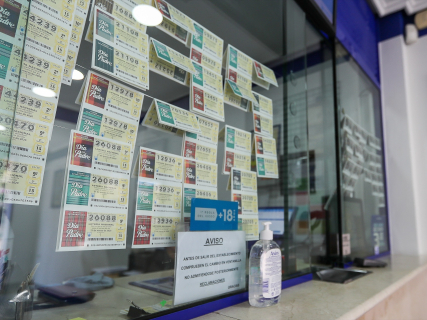
National Lottery today Thursday, October 15: result, numbers and first prize

The weekly draw on Thursdays offers a first prize of 300,000 euros to the series

EuropaPress 3160956 gel desinfectante interior administracion loteria manises cuarto dia

EuropaPress 3160956 gel desinfectante interior administracion loteria manises cuarto dia

Add DEMÓCRATA to Google

Ask FREN

Published

Last updated

1 minute

Most read

National Lottery celebrates today Thursday, October 15, its weekly draw, whose first prize is endowed with 300,000 euros per series.

The draw is scheduled for 21:00 hours, according to the usual schedule published by Lotteries and Bets of the State. Prizes of the second category, approximations, hundreds, endings, and refunds will also be distributed.

The winning numbers remain pending the draw until SELAE publishes the official result.

Result of National Lottery of Thursday, October 15

First prize: pending the draw.

Second prize: pending the draw.

Refunds: pending the draw.

Main prize

The first prize of this ordinary Thursday draw amounts to 300,000 euros per series.

More key points, information and questions with FREN

AI-GENERATED CONTENT

What are the legal requirements to participate in the National Lottery in Spain?

In Spain, participation in the National Lottery is primarily regulated by the state gaming regulations and the conditions set by SELAE (State Society of Lotteries and State Bets). Practically, the legal requirements are few but very clear, focusing mainly on age, legal capacity, and certain professional incompatibilities.

1. Age of majority: essential requirement

The main requirement to participate in the National Lottery is to be of legal age:

  • Minimum age: 18 years. Persons under 18 years old cannot buy or validate lottery tickets or shares of the National Lottery, neither at physical points nor through electronic channels.
  • This prohibition also extends to prize collection: a minor cannot present themselves as the prize holder. If a ticket is in the name of a minor, in practice an adult (parent, guardian, etc.) will act on their behalf, but legally the game is restricted to adults.

2. Legal capacity and specific prohibitions

Besides age, gaming regulations require that the person has legal capacity to perform ordinary asset management acts:

  • Persons with limited legal capacity (by court ruling, for example) may have restricted participation if they cannot validly enter into contracts or dispose of money without representation.
  • Certain groups are legally excluded from participating in games organized by SELAE, mainly for integrity reasons and conflict of interest prevention. Generally, the following cannot play:
    • Directors and employees of SELAE when established by their internal codes or specific regulations.
    • Persons who, due to their role in control, inspection, or supervision of the game, could influence or have privileged access to relevant information.

These incompatibilities aim to ensure that those who design, supervise, or control the game do not participate as players.

3. Nationality and residence

Spanish nationality is not required to play the National Lottery. The requirements are:

  • Spanish nationality is not necessary: foreigners present in Spain who legally acquire a ticket can participate.
  • Residence is not essential: what matters is that the ticket was acquired through an authorized point of sale or channel (lottery administration, official website, or official apps).

A foreigner who wins a prize must comply with the same tax obligations as any other winner, with tax treatment possibly varying according to their residency status for tax purposes.

4. Purchase at physical administration

When buying a ticket at a lottery administration:

  • Showing an ID is not required for usual purchase amounts, but the administration cannot sell to minors. In case of doubt about age, they may request an identification document.
  • The key legal requirement is that the ticket is official and issued by SELAE; that is, acquired at an authorized point of sale, with authentic numbering and security features.

5. Online participation

To play the National Lottery online (official website or app):

  • It is mandatory to register with real data (name, surname, DNI/NIE or equivalent document).
  • The system performs checks to verify legal age and prevent participation of persons included in exclusion files (e.g., self-excluded players).
  • Anti-money laundering rules also apply at certain thresholds for deposits and prize collections, which may require enhanced identification.

6. Ticket ownership and prize distribution

Legally, the participant is considered to be the ticket holder (the possessor or, in case of deposit in financial entities, the registered owner):

  • If a group of friends or family shares a ticket, it is advisable to have written proof (or at least messages) of participation percentages, but before SELAE the holder is the one who presents the ticket.
  • For prizes of certain amounts, identification of beneficiaries is required when collecting, linking to tax and anti-money laundering obligations.

7. Prohibition of unauthorized channels

Another practical requirement is that participation is always through legal channels:

  • Only tickets issued by SELAE and sold at official administrations or authorized electronic channels are valid.
  • Fraudulent resale, counterfeiting, or purchase from unauthorized intermediaries may leave the buyer without legal protection and no right to prize.

In summary, to legally participate in the National Lottery in Spain, it is enough to be over 18 years old, have ordinary legal capacity, not belong to expressly excluded groups, and acquire the ticket through an official channel. The rest of the obligations focus on identification and taxation in case of prize.

What taxes apply to National Lottery prizes and from what amount? What happens legally if a group shares a winning ticket and there is disagreement about the distribution? What are the legal differences between the National Lottery and other SELAE games like Primitiva or Euromillions?

Which body regulates and supervises the National Lottery and what are its competencies?

The General Directorate for the Regulation of Gambling (DGOJ), dependent on the Ministry of Social Rights, Consumer Affairs and Agenda 2030, is the state body responsible for regulating and supervising gambling, including the National Lottery. It should be distinguished from the State Society of Lotteries and State Bets (SELAE), linked to the Ministry of Finance, which organizes and markets the draws. Therefore, supervising compliance with regulations and managing the lottery are different functions.

Competencies of the DGOJ

The general framework is the Law 13/2011, on gambling regulation. Within this framework and the specific regime of state lotteries, the functions of the DGOJ include:

  • Normative regulation: developing and applying state-level gambling regulations. This function does not mean it alone approves all rules: legislative and regulatory bodies also intervene.
  • Authorization and control: exercising competencies over activities and operators subject to state legislation, with the particularities of the reserved regime for lotteries. This regime should not be confused with private gambling licensing.
  • Inspection: verifying compliance with administrative, economic, technical, IT, and documentary obligations of operators under its supervision.
  • Integrity and security: ensuring that the activity is conducted with transparency, reliability, and guarantees for participants, and controlling compliance with required conditions.
  • Protection of participants: supervising responsible gambling obligations, protection of minors, and prevention of participation by persons prohibited from playing, according to applicable rules for each channel.
  • Sanctioning power: processing procedures for breaches and imposing sanctions within its competence. SELAE's public nature does not exclude it from supervision.
  • Coordination: cooperating with other administrations and bodies in state gambling policy and activity control.

What SELAE does

SELAE is the operator of the National Lottery, not the general regulator of the sector. As explained by Demócrata on the commercialization regime, the operation of state lotteries is reserved for legally designated operators; it is not an activity any company can freely organize.

Its tasks are mainly operational and commercial: organizing and executing draws, issuing and marketing tickets, managing the official sales network and digital channels, publishing results, and arranging prize payments. It also sets the operating conditions of its commercial network and its relationship with lottery administrations, within the applicable legal framework.

The difference has a practical consequence: an issue about the sale of a ticket, result verification, or prize management initially corresponds to the operator's scope; monitoring legal obligations belongs to the supervisory scope.

Other public controls

Supervision is not limited to the DGOJ. The Ministry of Finance exercises functions related to the public operator's oversight, while the Court of Auditors audits its economic-financial management.

An example is the parliamentary resolution of May 2025, published in July, on SELAE prize control. It urged improvements in identifying recipients, payment documentation, fraud detection, and communications to the executive service for anti-money laundering. These are complementary controls, not substitutes for gambling supervision.

In summary: the DGOJ supervises regulatory compliance; SELAE operates the National Lottery; and Finance and the Court of Auditors intervene in their respective oversight and auditing areas.

Which regulation establishes the prize distribution in the National Lottery?

The regulation that establishes the percentage allocated to prizes in the National Lottery is Law 83/1963, of July 8, which amended article 6 of the General Lottery Instruction, approved by Decree of March 23, 1956. It sets a 70% of the total amount of tickets for each draw for prizes and the remaining 30% in favor of the Treasury. It is important to distinguish this general distribution from the allocation among prize categories and from the taxes paid by the winner.

1. The main regulation: Law 83/1963

Law 83/1963, on increasing the percentage of the amount to be distributed in National Lottery prizes, gives article 6 this wording:

"The amount to be distributed in prizes shall consist of seventy percent of the total amount of tickets of each draw, with the remaining thirty percent in favor of the Treasury. This percentage may only be altered by virtue of a law that expressly and specifically sets new rates."

Therefore, the legal reference is the amount of ticket issuance, not a formula based on actual sales. Also, the provision requires a law to modify these percentages: a commercial decision by the organizer or a ministerial order is not enough.

The law raised the previous percentage, from 69.09% to 70%. Its second article tasked the Minister of Finance with setting by ministerial order when the new percentages would apply; this power referred to implementation timing, not modification.

2. The specific distribution of each draw

Article 6 determines the overall prize fund but does not by itself contain the list of first prizes, approximations, endings, and refunds of each draw. To know that specific distribution, one must refer to the program of the corresponding draw, within the framework of the General Lottery Instruction.

The program's relevance also appears in Royal Decree 208/2004, of February 6. Its article three, modifying Royal Decree 773/1989, provides that the control board shall record that operations have been carried out according to current regulations and the respective draw program.

3. It should not be confused with other games

Royal Decree 419/1991, of March 27, regulates the distribution of revenue and prizes of certain state games. However, its article 2 expressly excludes the National Lottery, which is governed by its specific rules.

Consequently, the minimum 55% of revenue provided there for other games does not replace the 70% of the National Lottery. Nor should the 30% mentioned in Law 83/1963 be interpreted as a tax deducted from the winner: it belongs to the general distribution of the issuance.

4. Taxes on the prize are another matter

For individual taxpayers of the Personal Income Tax (IRPF), the thirty-third additional provision of Law 35/2006 regulates a special tax: the first 40,000 euros per winning ticket, fraction, or coupon are exempt, and the excess is taxed at 20%.

If the ticket is shared, both the exemption and the taxable base are proportionally distributed among its holders. This tax regime determines how much the winner finally receives but does not modify the percentage initially allocated to prizes by the regulations.

Play

Test your knowledge with FREN!

How much do you know about this topic? Answer the following 3 questions.

What was the winning number for the first prize in the National Lottery on October 15, 2026?

Question 1 of 3

What numbers were the refunds in the National Lottery this Thursday, October 15?

Question 2 of 3

What number won the second prize in the National Lottery on October 15, 2026?

Question 3 of 3