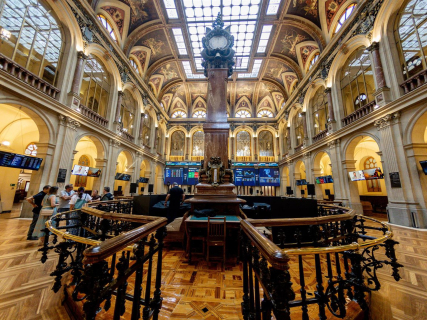

The Ibex 35 was moving in the mid-session of this Monday with a slight increase of 0.17%, placing itself at 20,076.20 points, practically at the same level with which the stock market day started.
Investors remain very attentive to the situation in the Middle East after the United States (US) and Iran exchanged attacks for the first time in a month, a rise in tensions that is driving up the price of crude oil again after the declines recorded the previous week.
In recent days, the US has carried out an offensive on the Iranian island of Larek, in the strategic Strait of Hormuz, in the Persian Gulf, as part of its economic pressure campaign on Tehran.
According to the Qatari television Al Jazeera, which cites a US official under anonymity, Washington would have attacked two rocket launchers of the Revolutionary Guard located in Larek and prepared to place naval mines in the Strait of Hormuz, according to this source.
"Our forces have completed the demining of the international shipping routes of the Strait of Hormuz," this source has pointed out, before warning that they are monitoring the area and are "ready" to "protect the free commercial transit through the Strait of Hormuz."
Hours later, the Central Command (Centcom) of the US Armed Forces, responsible for coordinating US military operations in the Middle East, claimed a "limited and precise action" against "mining units of the Islamic Revolutionary Guard that represented an imminent threat," and described as "absolutely false" that this operation could be considered an "act of aggression."
Last week, when announcing an agreement with Oman to manage traffic in this strategic passage, Iranian authorities defended that the pact includes the closure of this route, which the United States claims to control. This was indicated to the Axios portal by two US officials, who emphasized that about 10 million barrels of oil transit through this route daily.
In parallel, the US Army reported this Sunday that it has diverted more than 80 commercial vessels, in addition to immobilizing three boats and boarding two others, as part of the naval blockade it maintains over the ports and coast of Iran.
The weekend was also marked by the agreement of the United States to take "majority control" of one fifth of Venezuela's oil reserves, an operation aimed at doubling U.S. reserves and lowering the cost of fuels in the North American country.
"As we have already mentioned on other occasions, Venezuelan facilities require significant renovation to operate efficiently again, as well as the development of new plants. This requires time, which is precisely running out for Trump ahead of the midterm elections in November," says XTB analyst, Javier Cabrera.
In this scenario, the Brent barrel, a reference in Europe, was up 3.29% in the mid-session of the Old Continent's stock exchanges, reaching 91 dollars, while the West Texas Intermediate (WTI), a reference in the U.S., rose 3.26%, to 86.12 dollars per barrel.
On the macroeconomic front, this Monday's session is accompanied by several data in Europe, including the preliminary estimate of Germany's CPI for August and Spain's current account balance for the month of June.
Markets continue to absorb that the president of the Federal Reserve (Fed), Kevin Warsh, pointed out last week in Jackson Hole the possibility of a forthcoming interest rate hike.
On this point, the chief economist for the United States at AllianceBernstein, Eric Winograd, explained that "if Warsh wants to unite the committee, steer it towards changes in how monetary policy is conducted, or even simply present a unified position when assessing the economy and determining how the Fed should react, he will have to do it much better behind closed doors than he has done publicly. If he fails to do so, it will increase the risk of the Fed fragmenting, and that is a recipe for a higher risk premium across all markets."
As for the Spanish stock market, the most notable rising stocks at mid-session were Repsol (+2.56%), Cellnex (+0.72%), Puig (+0.71%), and Acerinox (+0.67%). On the downside, Solaria led the declines (-1.06%), ahead of IAG (-1.02%), Grifols (-0.96%), Colonial (-0.93%), and Sacyr (-0.70%).
The rest of the major European indices showed a mixed behavior: London's FTSE 100 advanced by 0.29%, Paris's Cac 40 practically remained unchanged (+0.03%), Frankfurt's Dax fell by 0.61%, Milan's FTSE MIB gained 0.33%, and the Euro Stoxx 50 decreased by 0.22%.
In fixed income, the yield of the Spanish 10-year bond was at 3.746%, placing the risk premium —the differential against the German bond at the same reference— at 44.93 basis points.
In the foreign exchange market, the euro appreciated by 0.10% against the dollar, reaching an exchange rate of 1.1597 "greenbacks".