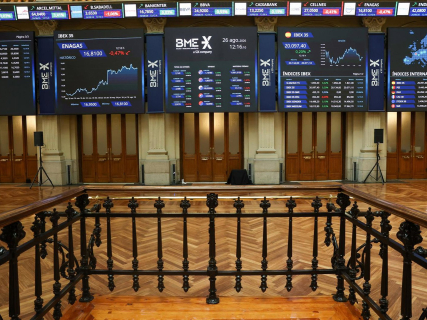

The Ibex 35 has concluded the session this Monday with an increase of 1.33%, up to 19,285.80 points, on a day conditioned by the celebration of the Day of Hispanity.
Investors remain attentive to the evolution of the conflict in the Middle East and its possible effects on energy prices and inflation, as well as to the situation of France's sovereign debt and the mid-term elections in the United States.
"This political and geopolitical context makes it difficult for central banks, as they are forced to balance the risk of an economic slowdown induced by the energy shock, seeking to control still persistent inflationary pressures," point out analysts from Renta 4.
During the weekend, the Houthi militias of Yemen have claimed responsibility for the latest attacks against the airports of Riyadh and Dammam, in Saudi Arabia, as well as against the infrastructure of the state oil company Aramco, in response to the "massacres" of the Saudi aviation on Yemeni territory.
In retaliation, the international coalition for Yemen led by Saudi Arabia has bombed this Monday positions of the Houthi rebels in the province of Taiz, in the southwest of the country, where they had made advances in recent days.
In parallel, the leader of Iran's Supreme National Security Council, Mohsen Rezai, stated this Sunday that the United States has accepted part of the seven demands raised by Tehran to reopen the Strait of Hormuz, although overall their response remains "inadequate."
"The United States has agreed to some of Iran's seven conditions, but we consider their response to be inadequate," Rezai pointed out in a message published on social media. The Iranian official also warned that "Iranian diplomacy has changed and there will be no return to the 'statu quo ante'."
In this scenario, the barrel of Brent, a reference in Europe, rose by 1.94% at the close of the stock exchanges of the Old Continent, up to 105.75 dollars, while West Texas Intermediate (WTI), a reference in the United States, increased by 2.03%, up to 93.71 dollars per barrel.
On the international stage, it has been announced that economists Robert E. Hall and Michael Woodford have been awarded the Nobel Prize in Economics in 2026 for their contributions to new macroeconomic models that have significantly improved the ability to implement "an effective stabilization policy" of economic activity.
Within the Spanish park, the most notable rising values have been Indra (+3.87%), Acciona Energía (+3.77%), Cellnex (+2.89%) and Naturgy (+2.09%). On the downside, Acerinox has led the declines (-2.21%), ahead of Repsol (-1.05%), Telefónica (-1.01%) and ArcelorMittal (-0.73%).
The rest of the major European stock exchanges also concluded with gains: London's FTSE 100 added 0.99%, Paris's Cac 40 0.38%, the German index 0.76%, Milan's FTSE MIB 0.58% and the Euro Stoxx 50 0.45%.
In the United States, Wall Street showed a mixed tone: the Dow Jones gained 0.47%, while the S&P 500 ceded 0.06% and the Nasdaq, heavily weighted in technology, fell 0.20%.
In the debt market, the yield of the Spanish 10-year bond stood at 4.095%, very much in line with the 4.096% marked at Friday's close. The risk premium, for its part, was placed at 60.76 basis points.
In the foreign exchange market, the euro fell 0.23% against the dollar, trading in the markets at 1.1174 'green bills'.
As for assets considered safe havens in periods of high volatility, the ounce of gold fell 0.59%, to 4,191 dollars, while bitcoin, the largest cryptocurrency by market capitalization, decreased 1.43%, to 82,693 dollars.