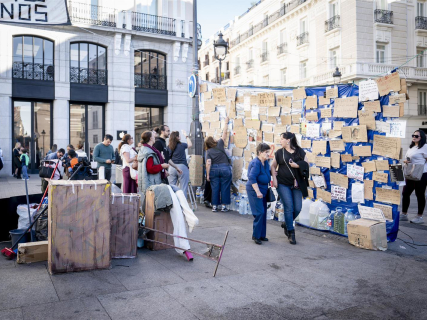
Unions and groups from seven countries meet in Paris to coordinate new protests in Europe

Trade unions and social movements from seven countries meet in Paris to coordinate a great wave of new protests in Europe.

fotonoticia 20261102192021 1920

fotonoticia 20261102192021 1920

Add DEMÓCRATA to Google

Ask FREN

Published

Last updated

1 minute

Most read

Elecciones 29N · Encuestas

La media de las encuestas

Media a 2 de noviembre de 2026 · 16 institutos

  • PP30,5 %
  • PSOE27,4 %
  • Vox19,1 %
  • Frente Amplio6,4 %
  • ERC2,4 %
  • Podemos2,4 %
010203040ene 2024jul 2024ene 2025jul 2025ene 2026jul 2026

Media del último estudio de cada instituto en 30 días y su evolución semanal desde el 23J. Partidos con al menos un 2 %.

Todas las encuestas

Elecciones generales del 29 de noviembre · Demócrata

Housing unions, labor organizations and social movements from France, Spain, Italy, Portugal, Greece, Belgium and England will meet this Tuesday in Paris in an "urgent" meeting, with the aim of closing a joint mobilization in the "maximum number of countries possible," as detailed by the Confederation of Unions and Tenants in a statement.

The call comes in a scenario marked by the general strikes already announced in France, Spain and Italy, as well as by the recent protests held in Portugal.

The meeting is scheduled for 16:00 at the headquarters of Droit au Logement (DAL). It is being held just 48 hours before the general strike called in France for this Thursday and aims to exchange the experiences of the mobilizations carried out in recent months, which, according to the organizers, have brought together hundreds of thousands of people in the streets of different countries.

At the end of the meeting, the delegations will offer a joint press conference in which they will announce the agreements reached on the next mobilization actions.

More key points, information and questions with FREN

AI-GENERATED CONTENT

What are the next steps to formalize the European housing mobilization after the meeting in Paris?

The next announced step is to make the agreements public in a joint press conference and specify the upcoming mobilization actions. However, there is an important timing clarification: the information published by Demócrata on November 2 presents the Paris meeting as an appointment scheduled for Tuesday, not as a concluded event. Therefore, it is not yet possible to assign a definitive schedule, an approved manifesto, or a permanent coordination structure.

The steps that are announced

According to Demócrata's information, the planned sequence is as follows:

  • Hold the coordination meeting. Housing unions, labor organizations, and social movements from France, Spain, Italy, Portugal, Greece, Belgium, and England will meet at 4:00 p.m. at the Droit au Logement (DAL) headquarters in Paris.
  • Share experiences from recent protests. The delegations want to compare mobilizations from recent months to prepare a joint response. According to the organizers, these protests have gathered hundreds of thousands of people in different countries.
  • Agree on an international mobilization. The declared goal is to organize joint actions in as many countries as possible. The seven represented territories constitute the starting point, not an announced limit for memberships.
  • Communicate the agreements and upcoming actions. At the end, the delegations will hold a joint press conference. This announcement will be the milestone to know what commitments have actually been adopted and how they will translate into calls.
What remains to be specified to formalize it

The consulted call does not detail a common European date, protest modalities, a complete list of adhering organizations, nor a coordinating body. It also does not announce the legal constitution of a platform. In this context, formalizing the mobilization means, above all, turning the will to coordinate into public and operational commitments, without confusing this task with a procedure before European institutions.

To assess the scope of what is announced after Paris, it is advisable to check five issues. These are monitoring elements, not agreements that can already be considered approved:

  • Shared demands: which claims all delegations endorse and which remain for each country.
  • Schedule: whether there will be a simultaneous day, a sequence of national protests, or both formats.
  • Responsible parties: which organizations will assume coordination and communication between countries.
  • Memberships: how other unions and groups can join the call.
  • Continuity: what meetings or mechanisms will allow verifying compliance with commitments.
Do not confuse the social campaign with the institutional agenda

The Paris mobilization and European housing policy are different processes. The Commission presented the European Affordable Housing Plan in December 2025 and announced that the next goal would be its implementation, with a new European Housing Alliance as a collaboration space, according to its official communication. This provides an institutional context but does not prove that the Paris organizers have agreed to participate in that alliance or link their protests to its schedule.

In short, the verifiable sequence is meeting, agreement among delegations, and public announcement of actions. The decisive moment will be the subsequent press conference: it will allow distinguishing a declaration of intent from a European call with dates, participants, and responsibilities. Until then, any proposal for a permanent secretariat, manifesto, or multi-year schedule must be presented as an organizational possibility, not as a decision made.

What are the legal competencies of the Confederation of Tenants' Unions in the field of housing in Europe?

The Confederation of Tenants' Unions, which seems to be the organization you are referring to, does not have public powers to regulate housing in Europe. It is a grouping of tenant organizations mainly from Spain: its function is to defend collective interests, coordinate campaigns, and influence housing policies. It is important to distinguish this capacity for action from the legal powers that belong to administrations, legislators, and courts.

What organization it is and where it operates

The Confederation was established in 2025 as a coordination space for territorial unions. It brings together organizations from Catalonia, Madrid, Valencia, Zaragoza, Seville, Malaga, Ibiza, Asturias, and other cities and territories, as explained by Demócrata. It is not an institution of the European Union nor a supranational authority.

Also, the word "union" does not mean it automatically has the representation powers typical of labor unions. The consulted sources do not sufficiently detail its statutes and registration to specify its exact legal form; therefore, they also do not allow attributing special procedural powers by its denomination alone.

What it can legally do

Its actions are situated in social organization and the exercise of rights recognized by applicable legislation. Specifically, it can carry out the following functions, with the corresponding requirements in each case:

  • Organize and support: gather tenant people, inform about rental problems, and provide collective support or legal advice.
  • Negotiate: promote agreements with landlords and real estate companies. Such negotiation does not allow it to unilaterally impose contractual conditions nor bind people it does not represent.
  • Report possible violations: report facts to competent authorities. As a related example, the Ministry of Consumer Affairs explained that its investigations into real estate companies started from complaints by the Tenants' Union-CECU and consumer associations. Investigation and possible sanction correspond to the Administration, not the complainant (Consumer statement).
  • Attend procedures: submit documents or take legal actions when it has the required standing, that is, the legal authorization to intervene in that matter. There is no automatic representation of all tenants.
  • Promote reforms and mobilizations: develop proposals, launch campaigns, and participate in dialogue spaces. Participation does not mean deciding or approving rules.
What it cannot decide

The Confederation cannot enact laws, mandatorily set rents, impose fines, grant aid, or allocate public housing. It also cannot resolve disputes with binding effects, annul contracts on its own decision, or judicially suspend an eviction. It can claim such actions or request protection through the corresponding channels, but the decision belongs to the competent body.

Likewise, calling a "rent strike" does not turn the suspension of payment into a right equivalent to a labor strike. The organization itself describes it as organized civil disobedience; its call alone does not eliminate contractual obligations, according to the explanation published by Demócrata.

What its European dimension means

In Europe, it can cooperate with other organizations and intervene in public debate. Demócrata documents international meetings and coordination proposals of the European housing movement, but this constitutes social advocacy, not an attribution of European competencies (international coordination).

Regulatory competencies over housing mainly belong to States and their territorial authorities; the European Union influences through areas such as financing, energy, or public aid. In short, the Confederation can defend, negotiate, and promote changes, but cannot replace those institutions.

What results did the main parties obtain in the last parliamentary elections in France, Spain, and Italy?

The last national parliamentary elections held were those of France in June-July 2024, Spain in July 2023, and Italy in September 2022. The New Popular Front obtained the most seats in France; the PP won in Spain; and Fratelli d’Italia was the leading Italian force. To compare equivalent results, the following data refer to the French National Assembly, the Spanish Congress, and the Italian Chamber of Deputies, not to the European elections.

France: 2024 legislative elections

It is important to distinguish the two rounds: the percentages correspond to the first and the seats to the final result. According to the electoral classification collected by PolitPro, the main candidacies obtained:

  • New Popular Front (NFP): 28.0% of the votes and 178 seats.
  • Ensemble: 20.0% and 150 seats.
  • Rassemblement National (RN): 29.2% and 125 seats.
  • Les Républicains (LR): 6.6% and 39 seats.

Additionally, this classification attributes 27 seats to other right-wing candidacies and 12 to other left-wing candidacies. These names describe French electoral categories, not single parties.

The NFP came first in deputies but did not reach the 289 needed for an absolute majority. RN achieved a higher vote percentage in the first round without finishing first in representation. It is worth noting that published counts vary depending on how allies and independent candidates are grouped: a July 2024 report offered 182 for NFP, 168 for Ensemble, and 143 for RN. Both classifications should not be mixed.

Spain: July 23, 2023 elections

The four main parties or coalitions concentrated 322 of the 350 Congress deputies. Their results were as follows, with percentages rounded to one decimal place:

  • People's Party (PP): 33.1% of the votes and 137 seats.
  • PSOE: 31.7% and 121 seats.
  • Vox: 12.4% and 33 seats.
  • Sumar: 12.3% and 31 seats; Podemos ran within this candidacy.

Among the remaining formations, ERC and Junts stood out with seven deputies each; EH Bildu with six; and PNV with five. BNG and Canary Coalition obtained one each.

The PP won in votes and seats but did not achieve an absolute majority. Its 137 deputies and Vox's 33 totaled 170, six less than the 176 needed. Demócrata records the final distribution and differentiates these results from later poll estimates.

Italy: September 25, 2022 elections

In the Chamber of Deputies, the main lists obtained these results, according to the compilation by PolitPro on Italy:

  • Fratelli d’Italia: 26.0% of the votes and 119 seats.
  • Partito Democratico: 19.1% and 69 seats.
  • Movimento 5 Stelle: 15.4% and 52 seats.
  • Lega: 8.8% and 66 seats.
  • Forza Italia: 8.1% and 45 seats.
  • Azione–Italia Viva: 7.8% and 21 seats.
  • Alleanza Verdi e Sinistra: 3.6% and 12 seats.
  • +Europa: 2.8% and two seats.

Fratelli d’Italia was the most voted formation and with the most deputies. The comparison requires caution: France uses two rounds; Spain distributes seats by provincial constituencies; and Italy combines proportional representation and single-member districts. Therefore, a higher national percentage does not always guarantee more deputies than another candidacy.

Play

Test your knowledge with FREN!

How much do you know about this topic? Answer the following 3 questions.

How many countries will be represented at the meeting in Paris to coordinate a European mobilization for housing?

Question 1 of 3

Where will the meeting of unions and social movements to address the European mobilization for housing be held?

Question 2 of 3

What action will the delegations take at the end of the meeting in Paris?

Question 3 of 3