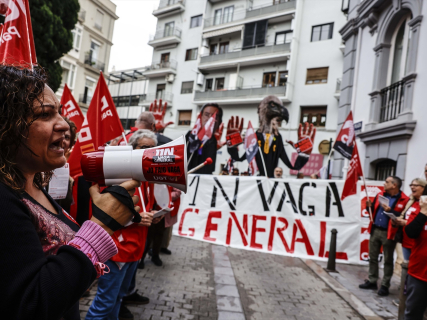
Who can go on a general strike and who cannot: the restrictions for police officers, lawyers and the self-employed

Military personnel and police are prohibited from supporting the strike, while healthcare workers, firefighters, and transport workers may be subject to minimum services. Salaried lawyers also have the right to strike, although the call does not suspend the scheduled trials

EuropaPress 7904353 manifestantes entrega manifiesto conjunto reivindicaciones laborales cara

EuropaPress 7904353 manifestantes entrega manifiesto conjunto reivindicaciones laborales cara

Add DEMÓCRATA to Google

Ask FREN

Published

Last updated

4 minutes

Most read

Elecciones 29N · Encuestas

La media de las encuestas

Media a 10 de noviembre de 2026 · 14 institutos

  • PP31,4 %
  • PSOE26,7 %
  • Vox19,1 %
  • Frente Amplio6,3 %
  • ERC2,5 %
01020304050ene 2024jul 2024ene 2025jul 2025ene 2026jul 2026

Media del último estudio de cada instituto en 30 días y su evolución semanal desde el 23J. Partidos con al menos un 2 %.

Todas las encuestas

Elecciones generales del 29 de noviembre · Demócrata

Not all workers will be able to support the general strike called for this Wednesday, 11 November. Although the Constitution recognizes the right to strike, Spanish legislation prohibits exercising it for military personnel and police officers and allows minimum services to be imposed in essential activities, such as healthcare, emergencies, or public transport.

Salaried lawyers may also participate in the call, although the strike does not exempt them from their obligations before the courts. Self-employed workers, for their part, may close their businesses to protest, but they must meet any professional commitments they have pending.

Military personnel and police officers are prohibited from going on strike

Members of the Armed Forces and of the Forces and Security Corps may not support a general strike. The prohibition includes military personnel, Civil Guards, national police officers, and agents of the regional and local police, regardless of the reason for the protest.

The article 6.8 of the Organic Law on Forces and Security Corps prevents them from exercising the right to strike and from taking part in coordinated actions that alter the normal functioning of services. Military personnel are expressly prohibited from exercising this right in the regulations that govern their rights and duties.

Doctors, firefighters, and civil servants can strike with minimum services

Healthcare employees, emergency services, and public transport workers may take part in a strike, although the competent authorities may set minimum services to guarantee essential services.

Workers designated to cover those services are obliged to comply with them, without that requirement extending to the rest of the workforce. A doctor or a public transport driver who does not have minimum services assigned may support the stoppage. Firefighters also retain that right, with the necessary limitations to handle indispensable interventions.

The article 15 of the Basic Statute of the Public Employee likewise recognizes the right to strike of civil servants, conditioned on maintaining essential services and with the exceptions provided for certain corps.

The strike of judges and prosecutors remains a matter of controversy

Associations of judges and prosecutors have called strikes on different occasions, despite the fact that there is no specific regulation on the exercise of this right. Unlike members of the armed forces and police, judges and prosecutors do not have an express prohibition on striking.

The General Council of the Judiciary (CGPJ) has defended that strikes by judges and magistrates lack normative coverage. The calling associations disagree and consider that the lack of legislative development is not enough to deprive them of a fundamental right.

Salaried lawyers can take part in the general strike

Lawyers hired by a firm may take part in a general strike that applies to them. The regulations that govern their special employment relationship recognize the collective rights of these professionals, including the right to strike.

Those who work on their own account may also interrupt their activity to support a protest, although they are not covered by the same employment guarantees as salaried workers.

The notice, however, does not alter lawyers’ obligations to the judicial authorities, especially when they have hearings or actions previously scheduled.

A lawyer cannot consider a trial suspended for participating in the strike

Trials scheduled during a strike day are not automatically suspended, even if the lawyer responsible for the defense has the right to take part in it. Hearings remain scheduled unless the judicial body orders their postponement.

The Civil Procedure Act regulates the grounds that allow a hearing to be suspended, but it does not include participation in a strike as a reason that would oblige it to be done. Criminal, labor, and administrative-contentious procedures are governed by their respective procedural rules.

The lawyer who wants to join the stoppage and has a trial scheduled must request its suspension and obtain a favorable ruling. Merely submitting the written brief does not authorize considering the proceeding postponed.

If the scheduling remains in force, failure to appear may harm the client’s interests and lead to professional liabilities, depending on the circumstances of the proceeding.

The Bar Association of Barcelona has recommended consulting in advance with the court office to check the possible impact of strikes on scheduled hearings.

Self-employed workers can close their businesses, but they must meet their commitments

Self-employed workers can close their establishments or interrupt their activity to take part in a protest. The Self-Employed Workers’ Statute recognizes the exercise of collective actions in defense of their professional interests, although these stoppages do not have the same effects as a labor strike.

The participation of an employee in a lawful strike temporarily suspends their employment contract. Self-employed workers do not have an employment relationship with an employer and, therefore, the closing of their business does not produce that suspension.

Contracts with clients, pending deliveries and other professional obligations remain in force, unless the parties agree to modify them or there is a legal reason that allows their breach.

A shopkeeper may decide not to open during the workday and an independent professional may suspend their services, but the protest does not automatically free them from the commitments they have undertaken.

The closing of a business does not require its employees to take part in the strike

Self-employed workers with contracted employees cannot impose on them their decision to take part in the stoppage. Employees retain the right to strike even if the owner wants to open the establishment and, if the owner decides to close, cannot consider as strikers the employees who were willing to work.

The employer also cannot automatically deduct their salary for keeping the business closed. Lockout is subject to specific causes and requirements, so the voluntary decision to support a protest does not allow its labor consequences to be applied without more.

More key points, information and questions with FREN

AI-GENERATED CONTENT

What parliamentary procedures would be necessary to expressly regulate the right to strike for judges and prosecutors in Spain?

The appropriate route would be to approve an organic law, following the legislative procedure of the Congress and Senate, with an absolute majority in the Congress in the final overall vote. Expressly regulating this matter does not, by itself, require amending the Constitution, but it does require reconciling the strike with judicial independence and the rights of those who seek justice.

1. Determine the scope and rank

It would be necessary to define whether the intention is to recognize the right, establish its conditions, or introduce restrictions. These are not constitutionally interchangeable options: passing parliamentary procedures does not guarantee that any content will be constitutional.

The regulation of the core of a fundamental right is connected to the organic law reservation of article 81 of the Constitution. For judges and magistrates, there is also the reservation regarding their legal status in article 122.1. The initiative could amend the Organic Law of the Judiciary and coordinate that amendment with the Organic Statute of the Public Prosecutor's Office. The term "organic statute" does not by itself determine the rank of its provisions.

Only if the Constitution itself were to be amended would it be necessary to follow the corresponding amendment procedure. If article 28.2 were affected, the aggravated procedure would apply: two-thirds of both Chambers, dissolution, ratification by the new Cortes, approval by two-thirds, and a mandatory referendum.

2. Initiate the processing
  • Government bill: after its approval by the Council of Ministers, it would be sent to the Congress with a statement of reasons and background. It does not require consideration.
  • Bill proposal: it could come from constitutionally empowered subjects. In the Congress, it can be presented by a group or a deputy with fourteen other signatures. It must pass the consideration stage: the Plenary's decision to begin processing it. If it comes from the Senate and was considered there, that vote is not repeated.

The Board would order its publication and referral to the competent committee. It would also qualify its organic nature, after hearing the Board of Spokespersons, in accordance with article 130 of the Congress Regulations.

3. Amendments, committee, and Plenary

The ordinary deadline for amendments is fifteen working days, subject to modification. If a bill receives total amendments, the Plenary first debates its return or an alternative text. Proposals already considered have particularities, including the general exclusion of return amendments.

Then, a working group studies the articles and amendments and prepares a report. The committee debates and approves its report; the Plenary resolves the maintained amendments and votes on the text.

Organic approval requires an absolute majority in the final overall vote. If not reached, the text returns to the committee for a new report within a month. If that majority is again lacking, it is rejected.

4. Senate and final approval

The Senate may approve the text, introduce amendments, or veto it. The ordinary constitutional deadline is two months, reduced to twenty calendar days for projects declared urgent. The veto requires an absolute majority.

If there is a veto, the Congress needs an absolute majority to override it when it concerns an organic law. If there are amendments, it decides on them and submits the resulting whole to an absolute majority; if this fails, the initial text of the Congress is ratified and the Senate modifications are rejected.

Finally, royal sanction proceeds within fifteen days, promulgation, and publication.

5. Material guarantees

The text should specify call, prior notice, remuneration effects, responsibilities, and continuity guarantees: on-call duties, detainees, and urgent actions. It should also distinguish the judicial independence of judges from the organization of the Public Prosecutor's Office, avoiding interference in judicial decisions and protecting effective judicial protection.

What are the powers and functions of the General Council of the Judiciary according to Spanish legislation?

The General Council of the Judiciary (CGPJ) is the governing body of the Judiciary in Spain. Its main function is to guarantee the independence of judges and magistrates through the exercise of powers over their professional careers and the governmental functioning of judicial bodies. Its legal framework is mainly found in article 122 of the Constitution and in the Organic Law 6/1985, of the Judiciary, especially in its book VIII.

1. Judicial government, not administration of justice

The CGPJ does not judge or review sentences: that power belongs exclusively to courts and tribunals. It also cannot order a judge how to resolve a procedure nor replace judicial appeals. Its task is to protect judicial independence and exercise the governmental powers recognized by law, without assuming all administrative responsibilities of the Administration of Justice.

2. Judicial career and appointments

An essential part of its functions affects the professional trajectory of judges and magistrates:

  • Selection and training: it participates in the selection of members of the judicial career and develops their initial and continuous training competencies, especially through the Judicial School.
  • Assignments and promotions: it resolves competitions, promotions, and appointments attributed by legislation, according to applicable requirements and procedures.
  • Administrative situations: it decides on permits, leaves, absences, retirements, and other professional situations under legally established terms.
  • High judicial positions: it intervenes in the appointment of Supreme Court magistrates and presidencies of courts and courts of appeal. It proposes the appointment of the president of the Supreme Court and of the Council itself.

Additionally, it proposes the appointment of two magistrates of the Constitutional Court and must be heard before the appointment of the Attorney General. This does not mean it governs the Public Prosecutor's Office.

3. Inspection and disciplinary responsibility

The Council exercises superior inspection of the courts to verify the functioning of judicial services and detect deficiencies. This inspection does not allow controlling the legal interpretation of judges nor correcting their rulings.

It also exercises disciplinary power over judges and magistrates: it investigates possible professional infractions and adopts corresponding decisions through the provided bodies and procedures. Disciplinary responsibility is distinct from criminal or civil liability and must respect defense guarantees.

4. Regulations, reports, and proposals

The CGPJ can approve regulations on its organization, personnel, and functioning, as well as develop certain matters of the judicial statute within legal authorization. It cannot amend laws nor freely regulate any aspect of justice.

It issues reports on draft bills and general provisions related, among other matters, to judicial organization, the statute of judges and magistrates, procedural rules, and certain criminal or penitentiary aspects. These reports do not equate to approving the norm nor replace the decision of the Government or the Cortes.

5. Management and relationship with other institutions

  • Own budget: it prepares and executes its budget and controls its compliance.
  • Legal information: it organizes the official publication of judicial rulings and develops documentation tasks.
  • Annual report: it informs the General Cortes about the state, functioning, and needs of justice, being able to propose improvements.
  • Cooperation and coordination: it participates, within its powers, in institutional relations and international judicial cooperation.

Finally, its powers must be distinguished from those of the Ministry of Justice and autonomous communities regarding personal and material resources. Also, when the Council is acting in a caretaker capacity, the law limits certain powers, especially appointments: its ordinary powers are not fully maintained in that situation.

What legal requirements must an employer meet to carry out a lockout in Spain?

In Spain, an employer can only carry out a defensive and temporary lockout, linked to a strike or other collective work disruption and justified by one of the legally provided causes. It is not enough that there is a strike, nor can the lockout be used as a general pressure measure on the workforce.

The essential requirements are found in articles 12 to 15 of Royal Decree-Law 17/1977, on labor relations. This figure should not be confused with the definitive closure of a company for economic reasons.

1. Existence of a collective conflict and a specific cause

Article 12 allows closing the workplace only "in case of strike or any other form of collective irregularity in the work regime," when at least one of these circumstances occurs:

  • Notorious danger of violence to people or serious damage to property. A generic concern is not enough: the danger required by the norm must exist.
  • Illegal occupation of the center or any of its dependencies, or a certain danger that it will occur. The law requires illegality of the occupation or certainty of the danger, not mere suspicion.
  • Serious impediment to the normal production process due to the volume of absences or irregularities in work. A reduction in activity alone does not equate to the serious impediment required.

Therefore, the decision must be supported by facts that fit one of those causes. The mere call for a strike or losses associated with the conflict do not, by themselves, authorize closure.

2. Defensive, not offensive purpose

The closure must respond to the above circumstances and serve to protect people, property, or the possibility of resuming activity. The preamble of the Royal Decree-Law itself states that only a "response" closure is valid.

It cannot be used preventively to prevent a future strike nor maintained as punishment or pressure once the cause that justified it has disappeared.

3. Communication to the labor authority

The employer does not need prior administrative authorization. However, article 13.1 requires notifying the labor authority within twelve hours from when the closure is carried out. It is a subsequent communication, not a permission request.

The cited articles do not establish a general mandatory prior notice to the workers' representation. As a practical precaution, it is advisable to document the facts, the time of closure, the affected centers, and the communication made; that documentation does not replace the existence of a legal cause.

4. Indispensable duration and reopening

According to article 13.2, the closure must be limited to the time indispensable to ensure the resumption of activity or eliminate the causes that motivated it. There is no fixed duration that automatically allows maintaining it.

Also, according to article 14, the employer must reopen when the labor authority requires it, within the indicated period, allowing the staff to return. Having legally initiated the closure does not permit prolonging it without justification.

5. Consequences of non-compliance

Article 12.2 refers, for the effects of lawful closure on affected personnel, to paragraphs 1, 2, and 3 of article 6. The legality of the closure and its effects can be examined by the labor jurisdiction.

If the closure is illegal, article 15 establishes the obligation to reopen and pay the wages accrued by those who stopped working as a consequence, without prejudice to corresponding sanctions. It also provides consequences for failing to comply with the reopening requirement.

Play

Test your knowledge with FREN!

How much do you know about this topic? Answer the following 3 questions.

Which workers are expressly prohibited from supporting a general strike in Spain?

Question 1 of 3

What happens if a lawyer has a trial scheduled on a strike day and decides to join the strike?

Question 2 of 3

What must healthcare, emergency, and public transport workers guarantee during a strike?

Question 3 of 3