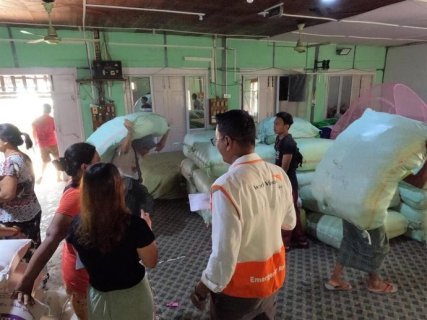
World Humanitarian Day: 907 workers were killed, injured, or kidnapped in 2025

The data from the Aid Worker Security Database counts 350 dead, 322 injured, and 235 kidnapped during the last complete year, while the United Nations demands greater protection for those who work in conflict zones.

2 minutes

WhatsApp Image 2026 08 19 at 16.54.51

WhatsApp Image 2026 08 19 at 16.54.51

Add DEMÓCRATA to Google

Ask FREN

Published

Last updated

2 minutes

Most read

The World Humanitarian Day arrives this August 19 with a figure that reflects the deterioration of security for those working in some of the largest crises on the planet: 907 humanitarian workers were killed, injured, or kidnapped during 2025, according to the latest consolidated data from the Aid Worker Security Database (AWSD).

The balance is divided into 350 workers dead, 322 injured, and 235 kidnapped. If the 280 detentions recorded by the database are added — a category that AWSD warns has more limited historical information — the total number of affected rises to 1,187.

The United Nations uses a different methodology and places the number of at least 326 humanitarian workers killed in 21 countries during 2025. The organization also warns that more than 1,010 humanitarian aid professionals have died in the last three years.

Why it is celebrated on August 19

World Humanitarian Day is commemorated every August 19 in memory of the attack against the United Nations headquarters at the Canal Hotel in Baghdad in 2003.

The attack killed 22 people, including the UN Special Representative for Iraq, Sérgio Vieira de Mello. The General Assembly subsequently established this day to recognize those who provide assistance to populations affected by conflicts and disasters.

The campaign is coordinated by the United Nations Office for the Coordination of Humanitarian Affairs (OCHA).

More than 250 million people need help

The violence against workers also occurs at a time of enormous pressure on the international assistance system.

More than 252 million people urgently needed humanitarian assistance and protection at the end of May 2026, 13 million more than when the Global Humanitarian Overview was presented for this year.

Humanitarian organizations had planned to assist 143.2 million people and prioritize nearly 89 million with the most severe needs.

However, the main problem is again funding. As of May 31, humanitarian plans needed 33.66 billion dollars, but had only received 8.21 billion: 24.4% of what was needed.

Humanitarian workers turned into targets

International humanitarian law establishes that civilians, including humanitarian and health personnel, must be respected and protected during armed conflicts.

It also forces the parties to allow and facilitate the arrival of humanitarian aid to the population that needs it.

However, the United Nations denounces that humanitarian workers continue to be murdered, injured, kidnapped, detained, and obstructed while carrying out their work. Most of the victims are also national workers providing assistance within their own countries.

The attacks have consequences that go beyond the victims themselves: they can interrupt the distribution of food, healthcare assistance, or protection services for entire populations.

That is why the message chosen by the United Nations for this World Humanitarian Day 2026 hardens the tone compared to previous years: "The time for concern is over. The time for consequences has come".

More key points, information and questions with FREN

AI-GENERATED CONTENT

What parliamentary procedures or resolutions has the UN General Assembly approved in recent years to strengthen the protection of humanitarian workers?

In recent years, the UN General Assembly has not created a new specific “regime” for humanitarian workers, but it has strengthened their protection through various thematic resolutions and, above all, contextual resolutions (Gaza, Yemen, Haiti, etc.) that emphasize the obligation to respect humanitarian personnel and ensure their safe access. This is complemented by the stricter framework set by the Security Council, especially resolution 2286 (2016) on the medical mission, which the UN itself and States — including Spain — continue to invoke as a central reference.

1. Thematic resolutions on the safety of humanitarian and UN personnel

The General Assembly resolutions on “safety and security of humanitarian personnel and protection of United Nations personnel” are periodic texts that:

  • Reaffirm that States have the legal obligation, under International Humanitarian Law (IHL), to protect humanitarian and UN personnel and to allow full, safe, and unimpeded humanitarian access.
  • Condemn attacks, kidnappings, arbitrary detentions, and the “illegal confiscation” of UN property, in line with what the Secretary-General and the Security Council have recalled in cases such as Yemen and other contexts, where the protection of UN and NGO staff and their facilities is emphasized.
  • Call on States to investigate and prosecute these attacks and to cooperate with the UN to end impunity.
  • Invite the Secretary-General to continue reporting on incidents and on measures to improve the security of personnel deployed in high-risk environments.

Although the consulted documentation does not cite specific numbers, these resolutions have been regularly adopted in recent sessions, progressively strengthening the language on criminal responsibility and humanitarian access.

2. Resolutions on Gaza and Palestine with direct impact on humanitarian work

Several recent General Assembly resolutions focused on the conflict in Palestine include key provisions for the protection of humanitarian workers:

  • Resolution on the catastrophe in Gaza (June 2025), promoted by Spain and Palestine and approved by the General Assembly, which demands an immediate ceasefire and emphasizes that the UN Relief and Works Agency for Palestine Refugees (UNRWA) is the “backbone” of the humanitarian response, rejecting any action that undermines its mandate and demanding that it be able to operate according to the principles of humanity, neutrality, impartiality, and independence (Moncloa note).
  • Resolution of September 18, 2024, in which the Assembly demands that Israel end the occupation within twelve months, following the advisory opinion of the International Court of Justice. Amnesty International highlights that this resolution is linked to the obligation to respect IHL and to stop systematic abuses that also affect humanitarian action (Demócrata).
  • Resolution extending UNRWA’s mandate for three years, approved in 2025, which “reflects international confidence” in the agency’s role and condemns the assault on its headquarters in East Jerusalem, describing it as a violation of International Law and the inviolability of UN facilities (Demócrata).
  • Another 2025 resolution in which the Assembly supports the ICJ advisory opinion on Israel’s obligation to cooperate with UNRWA and other UN agencies in the occupied territories, politically reinforcing demands for humanitarian access and protection of these agencies’ personnel (Demócrata).

Overall, these resolutions not only call for the protection of the civilian population but also for allowing the UN and NGOs to operate safely, providing additional political shielding for their humanitarian workers.

3. Other relevant General Assembly decisions

  • Resolution in defense of the International Criminal Court (ICC), in which the Assembly rejects any “threat, attack, or interference” against the ICC and its personnel, and affirms that they must be able to carry out their mandate without intimidation (Demócrata). Although it refers to judicial officials, it reinforces the general line of protecting those acting on behalf of International Law.
  • The 2025 budget resolutions for the 2026 fiscal year, approved by the General Assembly, adjust the UN’s regular budget but maintain mandates for missions such as MONUSCO or UNMISS — later reinforced by the Security Council — whose explicit priority is to protect the civilian population and ensure conditions for humanitarian aid, with UN personnel deployed on the front lines (Demócrata).

In summary, the General Assembly has acted on three complementary levels: periodic resolutions on the safety of humanitarian and UN personnel; situational texts (especially on Gaza and Palestine) demanding safe access and respect for humanitarian agencies; and resolutions supporting bodies and institutions — such as UNRWA or the ICC — whose secure functioning is key to protecting those working on the ground.

What are the main functions and competencies of the United Nations Office for the Coordination of Humanitarian Affairs (OCHA)?

The United Nations Office for the Coordination of Humanitarian Affairs (OCHA) is the UN body responsible for leading and coordinating the international response to severe humanitarian crises, such as armed conflicts, natural disasters, or complex emergencies. Its central mission is to ensure that aid reaches affected populations quickly, effectively, and based on needs, avoiding duplication and gaps in the response.

1. Coordination of the international humanitarian response

OCHA’s most characteristic function is coordination among the various humanitarian actors:

  • Convening and facilitating inter-agency coordination through mechanisms like the “cluster approach,” which groups UN agencies, international NGOs, the Red Cross, and other actors by sectors (health, water and sanitation, shelter, protection, etc.). OCHA does not directly implement most projects but ensures that actors organize and collaborate.
  • Supporting the UN Resident/Humanitarian Coordinator in each country by providing technical and operational support to lead the response, set priorities, and represent the humanitarian system vis-à-vis governments and donors.
  • Developing and facilitating humanitarian response plans that define objectives, activities, estimated costs, and responsibilities of each organization, based on a joint needs analysis.

2. Needs assessment and situation analysis

OCHA plays a key role in assessing and analyzing crises:

  • Promoting joint needs assessments, encouraging common methodologies so that different actors share data and have a homogeneous evidence base.
  • Producing reports and analyses on crisis evolution, severity of needs, and aid coverage. It publishes, among others, global and country humanitarian overviews, maps, context sheets, and early warnings.
  • Managing and disseminating humanitarian information through specialized platforms (e.g., portals with open data on crises), so governments, donors, NGOs, and interested populations can make better-informed decisions.

3. Resource mobilization and humanitarian financing

Another central competency of OCHA is mobilizing and managing funds for emergencies:

  • Leading funding appeals (Humanitarian Appeals), presenting to the international community the scale of needs, estimated response costs, and funding priorities.
  • Managing multilateral funds such as the Central Emergency Response Fund (CERF) and various Country-Based Pooled Funds, which provide rapid and relatively flexible resources to actors on the ground.
  • Tracking financing, identifying gaps between needs and available resources, and promoting a more equitable and efficient distribution of aid.

4. Advocacy and protection of humanitarian principles

OCHA also acts on the political and normative level:

  • Defending humanitarian access, negotiating with governments and armed groups so humanitarian actors can enter affected areas and operate safely.
  • Promoting respect for international humanitarian law and the humanitarian principles of humanity, neutrality, impartiality, and independence, denouncing obstacles to access, attacks against humanitarian personnel, or misuse of aid.
  • Advising the Secretary-General and UN bodies (such as the Security Council) on the humanitarian dimension of conflicts and crises, so political decisions take into account the needs of the civilian population.

5. Preparedness, risk reduction, and long-term approach

Although mostly associated with emergencies, OCHA also works on preparedness and risk reduction:

  • Strengthening response capacity of governments and local actors by promoting contingency plans, drills, and training.
  • Integrating disaster risk reduction and resilience into humanitarian planning, coordinating with development and climate change adaptation initiatives.
  • Promoting “nexus” approaches linking humanitarian action, development, and peace, so short-term response connects with durable solutions and crisis prevention.

In summary, OCHA is not the main implementer of projects on the ground but the “architect of global humanitarian coordination”: it organizes, articulates, and supports the multiple actors involved so that international aid is faster, more coherent, evidence-based, and centered on people affected by crises.

Could you detail how the cluster system coordinated by OCHA functions in a specific humanitarian emergency? What role does OCHA play in the relationship with national governments during a crisis and how does it manage access conflicts? How is OCHA structured internally (headquarters, regional and country offices) and how are its competencies distributed?

What requirements does international humanitarian law establish for the protection of humanitarian personnel in conflict zones?

International Humanitarian Law (IHL), also called the law of armed conflict, establishes a set of rules to protect humanitarian personnel operating in war zones. Its objective is to allow these individuals to assist the civilian population without being attacked, intimidated, or arbitrarily obstructed.

The main legal basis is found in the 1949 Geneva Conventions and their Additional Protocols, as well as in customary international humanitarian law, which binds both States and non-state armed groups. From these rules derive several key requirements.

1. Principle of distinction and prohibition of attacks

The central requirement is the principle of distinction: parties to the conflict must at all times distinguish between combatants and civilians, and may only direct attacks against military objectives. Humanitarian personnel, whether from the UN, NGOs, or the International Committee of the Red Cross (ICRC), are generally considered civilian population, provided they do not directly participate in hostilities.

From this derive two fundamental obligations:

  • Prohibition of attacking humanitarian personnel while they do not directly participate in combat.
  • Prohibition of indiscriminate attacks that do not distinguish between military targets and humanitarian personnel/facilities.

Personnel who directly participate in hostilities (e.g., collaborating in military operations) temporarily lose this protection against attacks but retain other basic guarantees against ill-treatment, torture, or summary executions.

2. Specific respect and protection

Beyond general protection as civilians, IHL requires that medical and humanitarian personnel be “respected and protected”. This implies, among other things:

  • Not only refraining from attacking them but also not deliberately obstructing their work, except for imperative military security reasons.
  • Not subjecting them to threats, coercion, kidnappings, or disappearances aimed at influencing their work.
  • Facilitating, as far as possible, their safe movement, for example through guarantees of passage or localized ceasefires for humanitarian operations.

In the case of medical personnel (doctors, nurses, ambulance and hospital staff), protection is even stronger: they cannot be punished for treating wounded and sick from the “enemy side,” and medical services must not be used for military purposes.

3. Identification and emblems

IHL provides for identification systems to reinforce protection:

  • Emblems such as the red cross, red crescent, or red crystal for medical services and certain humanitarian actors.
  • Visible markings on vehicles, facilities, and personnel (vests, helmets) indicating their humanitarian character.

Parties to the conflict have the duty to recognize and respect these emblems. At the same time, it is strictly prohibited to:

  • Make improper or deceptive use of humanitarian emblems (perfidy), for example to disguise military operations.
  • Give humanitarian personnel a military appearance that causes confusion about their civilian status.

4. Access and facilitation of aid

IHL also regulates humanitarian access. When the civilian population suffers severe shortages of food, medicine, or other essential goods, parties to the conflict must:

  • Allow and facilitate the rapid and unimpeded passage of impartial humanitarian relief, under certain control conditions.
  • Not use civilian hunger as a method of warfare, which implies not arbitrarily blocking aid.

Parties may impose reasonable controls (convoy registration, escort, cargo verification) but must not use them as a pretext to effectively prevent assistance or endanger humanitarian personnel.

5. Responsibility and international crimes

IHL requires that States and, in certain cases, individuals assume responsibility for violations against humanitarian personnel. Deliberately attacking protected humanitarian or medical workers may constitute:

  • A grave breach of the Geneva Conventions (a war crime under conventional law).
  • A war crime prosecutable by national courts or the International Criminal Court, where it has jurisdiction.

States have the obligation to investigate, prosecute, and sanction those responsible for attacks against humanitarian personnel and facilities, as well as to repair, as far as possible, the damage caused.

In summary, IHL requires that every party to a conflict clearly identify humanitarian personnel, treat them as protected civilians, respect their emblems, not arbitrarily obstruct their work, and hold perpetrators criminally accountable when they are attacked. Without these guarantees, assistance to conflict victims becomes impossible and the humanitarian effects of war dramatically worsen.

Play

Test your knowledge with FREN!

How much do you know about this topic? Answer the following 3 questions.

Why is World Humanitarian Day celebrated on August 19?

Question 1 of 3

How many humanitarian workers were killed, injured, or kidnapped during 2025 according to the Aid Worker Security Database?

Question 2 of 3

What percentage of the funding needed for humanitarian aid had been received by May 31, 2026?

Question 3 of 3

Hola, soy Fren. ¿Cómo te ayudo?