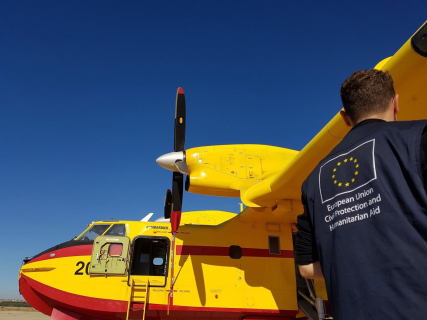
The European Union (EU) has reinforced this Monday, August 17, its response to the earthquake in Colombia with the sending of tents, blankets, water filters, and cooking materials. The supplies have been offered by Sweden, Germany, and Luxembourg to meet the most urgent needs of the affected population.
The European Commission will coordinate the delivery through the Emergency Response Coordination Centre. According to the statement released by Brussels, the operation is carried out after Colombia activated the EU Civil Protection Mechanism.
This material assistance adds to the 2.1 million euros of emergency humanitarian funding announced on August 12. The money will be used to provide healthcare, water, sanitation, shelter, food, protection, and direct economic aid.
What aid each European country sends to Colombia
The three countries that have specified their contributions so far offer material mainly intended to provide temporary shelter, access to safe water, and basic utensils for the affected families:
- Sweden has offered 150 tents and 360 blankets.
- Germany is sending 3,000 cooking sets and 2,500 water filters.
- Luxembourg has offered another 79 tents.
The Commission distinguishes between the material already sent by Germany and the supplies offered by Sweden and Luxembourg. The Emergency Response Coordination Centre will be responsible for adjusting the contributions to the requests of the Colombian authorities and organizing their transport and delivery.
The President of the European Commission, Ursula von der Leyen, has stated that "in times of tragedy, solidarity means action" and has emphasized that Europe will stand with Colombia during the emergency and the subsequent recovery.
Brussels sends a rapid response coordinator
The Commission has also deployed a rapid response coordinator to Colombia. Their role will be to facilitate on-the-ground coordination between national authorities, European countries, Civil Protection teams, and humanitarian organizations.
The Emergency Response Coordination Centre operates 24 hours a day and acts as a liaison point between member states, the other ten participating countries in the European mechanism, the authorities of the affected state, and emergency experts.
Your intervention does not replace the national services of Colombia. The mechanism allows a country affected by a disaster to request international help and for Brussels to centralize the available offers to avoid duplications and cover the needs that have not yet been addressed.
The activation can translate into the sending of specialized teams, experts, field hospitals, means of transport, shelters, generators, or basic supplies, depending on the nature of the emergency and the requests of the requesting country.
The aid adds to the package of 2.1 million euros
The material assistance announced this Monday complements the package of 2.1 million euros initially mobilized by the European Commission.
Of that amount, two million correspond to new emergency funding. The other 100,000 euros come from a project funded by the EU that the German Red Cross immediately redirected after the earthquake.
This first reassignment is intended to address the needs of 2,500 families in Chocó and Valle del Cauca, two of the territories affected by the earthquake. The humanitarian projects funded with the rest of the package will provide:
- Health services.
- Drinking water, sanitation, and hygiene.
- Food and temporary shelters.
- Protection for the most vulnerable people.
- Direct economic aid to cover basic needs.
The Commission has left open the possibility of increasing its contribution if assessments on the ground detect new needs during the emergency or recovery phase.
Copernicus helps assess the damage
The European response began during the first hours after the earthquake with the activation of Copernicus, the European Union's Earth observation program.
Its emergency mapping service uses satellite images to identify damaged buildings, affected infrastructures, and areas whose access may be more complicated. The maps are provided to intervention teams to support rescue operations and prepare the first damage assessments.
This tool allows for comparing images before and after a disaster. It does not replace inspections carried out on the ground, but it can accelerate the localization of priority areas, especially when ground communications are interrupted.
The largest earthquake recorded in Colombia this century
The earthquake occurred on August 10 at 7:34 hours, according to local time, and reached a magnitude of 7.4. According to the Colombian Geological Service, it had its epicenter in San José del Palmar, in the department of Chocó, and originated at a depth of 103 kilometers.