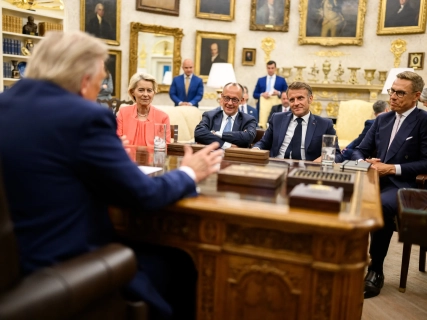
Europe celebrates, but does not deceive itself: Trump has lost Congress, not power

The well-known lame duck, the “lame duck” of North American politics, does not have to be a docile president in his last two years in office. On the contrary: with less room at home and less to lose, he may well be eager to leave his mark abroad

p20250818dt 2747 54730975647 o de3931.jpg

p20250818dt 2747 54730975647 o de3931.jpg

Add DEMÓCRATA to Google

Ask FREN

Published

7 minutes

Most read

Elecciones 29N · Encuestas

La media de las encuestas

Media a 7 de noviembre de 2026 · 11 institutos

  • PP31,0 %
  • PSOE26,2 %
  • Vox19,5 %
  • Frente Amplio6,6 %
  • ERC2,4 %
  • SALF2,2 %
  • Podemos2,1 %
01020304050ene 2024jul 2024ene 2025jul 2025ene 2026jul 2026

Media del último estudio de cada instituto en 30 días y su evolución semanal desde el 23J. Partidos con al menos un 2 %.

Todas las encuestas

Elecciones generales del 29 de noviembre · Demócrata

There are election nights that are followed with more interest outside than inside the country where they are held. The American midterm elections are one of them. In Europe we’ve stayed up late again, keeping an eye on the results of electoral districts that many citizens would probably not be able to place on a map. The Democratic victory has caused understandable satisfaction in European capitals. There is no reason not to. Trump has just received a severe rebuke, and his project has shown that it is not invulnerable. But it is worth not confusing joy with analysis. The Democrats have won Congress, but Trump retains the White House and much of the tools with which he has turned international relations upside down. Europe has reasons to toast, but not so many to pop the champagne.

Politically, the result matters. Americans have expressed their dissatisfaction with an Administration that has made permanent confrontation, economic nationalism, and distrust toward institutions a way of governing. The Democratic recovery of Congress slows the president’s legislative agenda, opens the door to parliamentary investigations, and restores to the chambers a function of oversight that, for two years, they have exercised with less enthusiasm than one would expect from a consolidated democracy.

European reading

For Europe, moreover, the result has a meaning that goes beyond North American politics. It is a setback for the MAGA movement and for a nationalist and reactionary current that has found in Trump something more than a political reference: an ideological ally and a boost for its own aspirations. Knowing that there is electoral opposition to that project is good news for those of us who defend liberal democracy, multilateralism, and an integrated Europe. Although it’s not advisable to exaggerate the contagion: the European far right has its own dynamics and does not need Trump to survive. And one thing is that Americans voted against Trump, and another very different thing is that they have decided to change their country’s external course. That is where caution begins.

Because Trump has lost Congress, but not the presidential power. The new Chambers will not be sworn in until January 2027 and, until then, the president will continue to rely on the current Republican majorities: two months of leeway that Brussels would do well not to underestimate. After that, the Constitution will continue to grant him broad powers in diplomacy, defense and foreign relations. He will be able to govern through executive orders, impose trade measures, decide military deployments and condition relations with his allies. Congress will be able to oversee, investigate, block appointments and make certain initiatives difficult, but it does not have a switch to turn off Trumpism.

It is also worth not underestimating the lever he does have: the budget. That is where aid to Ukraine is decided, sanctions on Russia and the limits on a possible withdrawal of troops from Europe. It is an interesting asymmetry: Congress will have more influence over European security than over tariffs, and both policies will remain in different hands.

A "duck" with less to lose

In fact, some analysts point to an unsettling paradox: a weakened Trump at home may turn out to be more unpredictable abroad. With the domestic agenda stuck, foreign policy is the stage where he can show that he still has decision-making capacity. Pressure on Europe, commercial threats, demands to NATO allies or decisions on Ukraine can become tools to feed his image of strength. The well-known lame duck, the "duck with a limp," of North American politics, does not have to be a docile president in his last two years in office. On the contrary: with less room at home and less to lose, he may have plenty of desire to leave his mark abroad. And he does not seem, precisely, willing to dedicate his last two years to gardening. It is certainly not the scenario that calms Brussels the most.
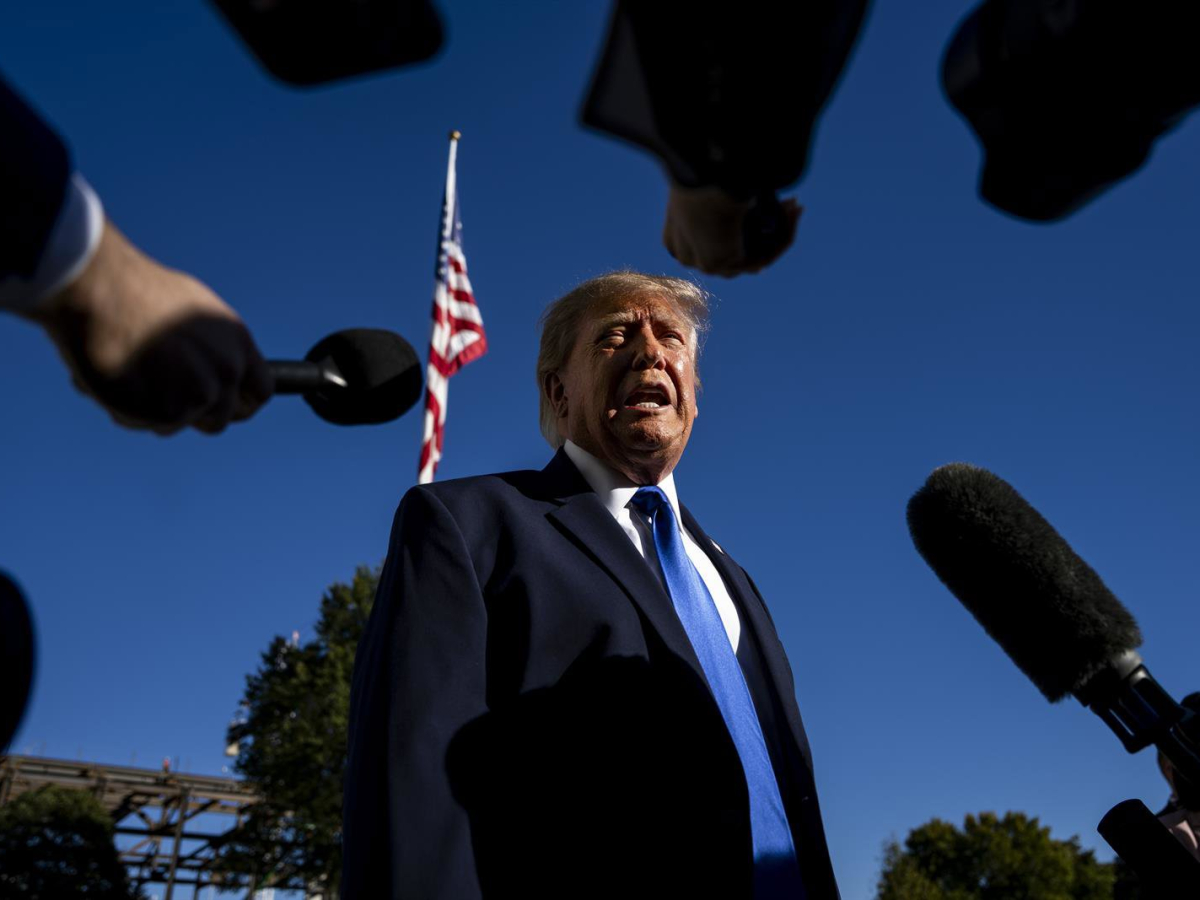
The president of the United States, Donald Trump Bonnie Cash-Pool via CNP / Zuma Press / Europe Pre
The president of the United States, Donald Trump Bonnie Cash-Pool via CNP / Zuma Press / Europe Pre -

The economy also does not invite optimism. It would be an error to believe that American protectionism was born with Trump and will go away with him. The defense of the domestic industry, technological competition with China, subsidies to domestic companies, and trade as an instrument of power are part of a deeper transformation. Biden kept much of that direction, although with other methods and a much more pleasant language. The speeches change, but not necessarily the interests. America First may be more strident with Trump, but the priority of protecting American industry and jobs has followers in both parties. In Washington they may disagree about how to deal the cards, but not about who should take home the prize.

It is worth remembering this because in Europe we have tended to personalize the problem too much. The same goes for security: the shift of priorities toward the Indo-Pacific, the rivalry with China, the exhaustion of part of American society with external commitments, and the demand that Europeans pay a larger share of their defense respond to structural factors, not to character. Democrats will disagree with Trump’s manners, not the bill.

The gap beyond Trump

One of the great European mistakes appears here: believing that Trump’s defeat means the return of the America we knew. Mark Leonard, of the European Council on Foreign Relations, has dubbed that attitude Westalgia, and Dave Keating has recently brought it back: the nostalgia of the Atlanticist establishment for the old transatlantic relationship. Brussels expects the return of America as usual as if it were waiting for the ex to come back arrepentido. And Keating adds an uncomfortable paradox: we follow with almost unhealthy attention who wins a seat in Texas, but we do not always know who decides in Brussels the policies that condition our future. Perhaps the problem is not only that the United States has changed, but that Europe behaves as if it did not have to do so.

It is not a new criticism. For some time now I have argued that the transatlantic relationship has stopped working on the basis of an alliance between equals. The Turnberry tariff agreement between Trump and Ursula von der Leyen was a good example: it was sold as a pragmatic solution to avoid a trade war, but it also made clear the asymmetry of a relationship in which Washington pressures and Brussels looks for how to accommodate itself. Europe presented as a victory what others would have called surrender with a good presentation. Avoiding a trade war was reasonable; turning the concession into a method is another matter.

The president of the European Commission, Ursula von der Leyen, and the president of the United States, Donald Trump, after announcing the tariff pact that validates a year later the plenary session of the European Parliament. Fred Guerdin/EU Commission /dpa
The president of the European Commission, Ursula von der Leyen, and the president of the United States, Donald Trump, after announcing the tariff pact that validates a year later the plenary session of the European Parliament. Fred Guerdin/EU Commission /dpa -

The experience afterward should have taught us that giving in does not always end with demands. Canada has recently shown that it is also possible to defend one’s own interests and accept that doing so has a cost. This is not about imitating anyone or responding with reprisals to every threat, but about understanding that prudence and docility are not synonyms. The first involves taking on a cost to protect a greater interest; the second, accepting an imposition out of fear of the price of resisting. Europe has been confusing these two things for far too long.

Far from Washington’s umbrella

Something similar happens in security. Ukraine has shown to what extent we depend on the United States for essential capabilities: intelligence, logistics, strategic transport, air defense and nuclear deterrence. The NATO alliance remains indispensable, but an alliance cannot rest indefinitely on the idea that one of its members decides when, how, under what conditions and at what price it provides its support. Strategic autonomy does not mean breaking with Washington or building an alternative alliance, but having enough capacity so that cooperation is a choice and not a necessity imposed by our weakness.

The same is true for digital and energy sovereignty. Europe proclaims it while its cloud services, its satellite communications, and much of its artificial intelligence depend on US companies, and while it replaces Russian gas with US liquefied natural gas: changing suppliers is not the same as gaining independence. There is no shortage of documents: the Strategic Compass, the Draghi report, solemn communications without end. What is missing is turning them into capabilities and decisions.

The president of the US, Donald Trump, during the NATO summit held in Ankara. Europe Press/Contacto/BENOIT DOPPAGNE
The president of the US, Donald Trump, during the NATO summit held in Ankara. Europe Press/Contacto/BENOIT DOPPAGNE -

The Democratic victory offers, yes, some opportunities. A Congress in Democratic hands can recover areas for dialogue, oversee the president, and serve as an interlocutor for European governments. But it is also not a good idea to idealize it: the party is divided over the international role of the United States, and nothing guarantees that a future Democratic Administration will restore the commitment of yesteryear. The America of 2028, whether Republican or Democratic, will not necessarily be the one from twenty years ago.

That is why the conclusion should be rather less complacent than some European toasts. Trump’s electoral defeat is good news for American democracy and for those of us who believe in a transatlantic relationship based on respect and cooperation. But it does not resolve European vulnerability, nor does it, by itself, change the strategic interests of the United States. Europe cannot continue to organize its future while waiting for a more agreeable, more predictable, or more familiar president to be installed in Washington.

We can celebrate that Americans have put electoral limits on Trump. What we cannot do is turn that celebration into a new excuse to postpone our own responsibilities. We need more industry, more investment, more homegrown technology, more defense capability, and a foreign policy that does not depend on the changes in mood from the White House. And, above all, political will to use the economic and commercial power we have when our fundamental interests are at stake.

The old America is not necessarily going to return because the Democrats have recovered Congress. And maybe it is time to accept that the problem is not only that the United States has stopped being the ally we were expecting, but that Europe still has not learned to be the partner it needs. And some of the elections that can condition our future the most are not held in Texas or in Pennsylvania, but here, starting with the French presidential elections of 2027. We have been too long waiting for ballots in which we do not vote, while neglecting the ones that are really ours. It is time to stop expecting it to be Americans who win ours.

More key points, information and questions with FREN

AI-GENERATED CONTENT

What are the next steps in the process of taking office for the new United States Congress after the midterm elections?

After midterm elections in the United States, the “new Congress” does not take office overnight. There are a series of formal and political steps that take place from the closing of the polls until the full operation of the new House of Representatives and Senate. Broadly speaking, the process is divided into three phases: closing of the outgoing legislature, internal organization of the parties, and opening session of the new Congress.

1. Closing of the outgoing legislature (“lame duck session”)

Once the elections have been held, the outgoing Congress usually continues working for a few weeks in what is known as the lame duck session:

  • The outgoing Congress remains in session until noon on January 3 (unless a law sets another date). It can approve laws, budgets, or appointments.
  • There is no swearing-in yet of the new members: those elected in the midterms do not vote or formally participate in this phase.
  • Meanwhile, the election results are certified at the state level: each state verifies, resolves possible recounts or disputes, and issues the official proclamation of the winners.

Only when the results are certified and the end of the term approaches does the formal phase of constituting the new Congress begin.

2. Internal organization of the parties

Before the inaugural session, the parties (mainly Democratic and Republican) organize their own structure:

  • Group meetings (caucus or conference): newly elected members and returning ones meet by party and chamber (for example, the House Democratic Caucus or the Senate Republican Conference).
  • Election of leaders: in these meetings, internal leaders are chosen:
    • In the House of Representatives: majority or minority leader, “whips” (responsible for vote discipline), group chairs, etc.
    • In the Senate: majority leader, minority leader, and their teams.
  • Proposal of candidates for Speaker (House): the party expected to hold the majority in the House of Representatives designates its candidate for Speaker of the House, who must then be elected in a plenary session.
  • Negotiation of committees: negotiations begin on the distribution of committee chairmanships, member slots, and legislative priorities for the new legislature.

At the same time, new congress members participate in orientation programs organized by the House or Senate, where they are explained internal functioning, ethics rules, voting procedures, use of resources, and basic logistics.

3. Opening session and swearing-in of the new House of Representatives

The new House of Representatives meets for the first time on the date set by the Constitution (usually January 3):

  • Provisional constitution of the House: the session is traditionally opened by the oldest member of the majority party who is not a freshman, acting as temporary chair.
  • Election of the Speaker: the House proceeds to vote for the Speaker. An absolute majority of votes cast is required. Until the Speaker is elected, the House cannot proceed with the rest of the steps, so if there are deadlocks, votes may be repeated.
  • Oath of office of the representatives: once the Speaker is elected, they administer the collective oath to all members of the House, who are then formally invested in their office.
  • Approval of the Rules: the new majority presents a resolution with the internal rules of operation for the legislature (these can be renewed or modified from the previous ones). Without adopted rules, activity is very limited.
  • Organization of committees: resolutions are approved that set the size of each committee and the distribution of seats among parties. Subsequently, committee chairs and specific members are designated.

4. Swearing-in and organization of the Senate

The Senate is also partially renewed after the midterms (approximately one-third of the seats):

  • In the inaugural session, newly elected senators take the oath before the Vice President of the United States, who is the President of the Senate.
  • The parties ratify or adjust their leadership (majority/minority leader, “whips”) and agree on the distribution of seats in committees.
  • The Senate, unlike the House, is a continuous body: two-thirds of its members remain in office, which softens the transition, but a reconfiguration of forces still occurs based on the election results.

5. Launching the new legislative agenda

Once both chambers have sworn in their members, elected leadership, adopted rules, and organized committees, the new Congress is fully constituted. From there, the next steps are political:

  • Presentation of the first bills and resolutions by the majority and the opposition.
  • Definition of the work calendar (plenary sessions, committee hearings, processing deadlines).
  • Coordination with the White House to promote or block the president’s agenda, especially in a context of a divided Congress after midterms.

In summary, the next steps after the midterm elections involve certifying results, internally organizing the parties, holding the inaugural session of each chamber (with election of leaders and oath), and constituting committees. Only then can the new Congress begin to fully exercise its legislative and oversight functions.

How does this swearing-in process differ from that of a Congress newly elected in a presidential election? What happens if the House of Representatives fails to elect a Speaker in the first vote? How does it affect the legislative agenda after the midterms if one party controls only one of the two chambers?

What are the powers and responsibilities of the President of the European Commission according to the EU Treaties?

The President of the European Commission is, according to the Treaties of the European Union, the figure who provides the general political orientation of the Commission and ensures its effective and collegiate functioning. Their powers are mainly set out in Article 17 of the Treaty on European Union (TEU) and, complementarily, in the Treaty on the Functioning of the EU (TFEU).

1. Defining the political orientations of the Commission

Article 17.6 TEU establishes that the president “shall define the political guidelines” according to which the Commission carries out its functions. This means that:

  • They set the political priorities of the Commission’s mandate (for example, climate agenda, digital, social, etc.).
  • They guide the institution’s annual work program, deciding which legislative and non-legislative proposals are presented and on what schedule.
  • They act as the main political reference of the Commission vis-à-vis other EU institutions and the Member States.

Although the Commission decides collegially, this orientation function makes the president the “political director” of the European executive.

2. Internal organization of the Commission and allocation of portfolios

The president has broad powers over the internal organization of the College of Commissioners:

  • Distribution of portfolios: proposes the internal structure of the Commission (vice presidencies, executive commissioners, grouping of competences) and assigns each portfolio to commissioners designated by the Member States, in coordination with the Council and the European Parliament.
  • Reallocation of competences: can modify during the mandate the distribution of responsibilities among commissioners (for example, transferring or reorganizing policy areas).
  • Appointment of the High Representative as vice-president: the High Representative of the Union for Foreign Affairs and Security Policy is, by Treaty, one of the vice-presidents of the Commission; the president integrates and coordinates their role within the College.

Together, these powers allow the president to configure the European “political cabinet” and adapt its structure to the strategic priorities of the mandate.

3. Direction and discipline of the College of Commissioners

The Treaty also grants the president powers of internal direction and discipline:

  • Presiding over meetings: directs and chairs the meetings of the College, setting the agenda and guiding deliberations.
  • Promoting collegiality: ensures that decisions are adopted according to the principle of collective responsibility of the Commission.
  • Requesting the resignation of commissioners: Article 17.6 TEU empowers the president to ask for the individual resignation of any member of the Commission. This is a key prerogative of internal political control.

These powers strengthen the president’s ability to guarantee the political coherence of the institution and the accountability of its members.

4. Institutional representation of the Commission

Externally and interinstitutionally, the president plays a central role:

  • Relationship with the European Parliament: is the Commission’s main interlocutor before the Parliament, presents the general political orientations at the start of the legislature, defends the annual work program, and regularly participates in key plenary debates, including the State of the Union debates.
  • Relationship with the European Council and the Council: although Article 15 TEU assigns the presidency of the European Council to another figure, the president of the Commission participates in its meetings and defends the institutional position of the Commission in the preparation and execution of decisions of the European Council and the Council.
  • External representation of the EU in Commission competences: in areas where the Commission has competence (for example, common commercial policy), the president acts as a representative of the Union vis-à-vis third countries and international organizations, in close coordination with the High Representative.
5. Role in the appointment and democratic legitimacy of the Commission

Although this is a shared competence with other institutions, the Treaties emphasize the president’s position in the political configuration of the Commission:

  • They are proposed by the European Council “taking into account the results of the European Parliament elections” and must be elected by the Parliament by majority (art. 17.7 TEU), which grants them enhanced political legitimacy.
  • Once elected, they participate in forming the team of commissioners and in drafting the political guidelines submitted for the Parliament’s approval vote, which decides on the Commission as a whole.

In summary, the Treaties make the President of the European Commission the political and organizational center of gravity of the institution: setting its strategic direction, distributing and coordinating portfolios, maintaining internal discipline of the College, and acting as the main political face and voice of the Commission before other EU institutions and externally.

What legal requirements must the U.S. Congress meet to approve measures that limit the president's foreign policy?

For the United States Congress to approve measures that limit the president’s foreign policy, it must comply with the general constitutional requirements for producing federal laws and, where applicable, the specific rules affecting Executive powers (commander-in-chief, treaty negotiation, etc.). There is no “special procedure” solely to limit foreign policy, but there are material and formal limits that condition what Congress can do and how.

1. Constitutional basis: separation of powers

The U.S. Constitution divides foreign policy between Congress and the president:

  • Article I (Congress): power to declare war, regulate foreign commerce, raise and fund armed forces, approve budgets, define crimes against international law, and ratify treaties (Senate).
  • Article II (President): head of the Executive and commander-in-chief of the Armed Forces; directs diplomacy, negotiates treaties and international agreements, and appoints ambassadors (with the Senate’s “advice and consent”).

Any measure by Congress that limits foreign policy must be based on one of these constitutional powers (spending, commerce, use of force, agency organization, etc.) and cannot effectively nullify the president’s exclusive powers (for example, deciding whom to receive or what to politically declare).

2. Formal requirements to pass a law

To pass a law that limits the president’s foreign actions, Congress must follow the ordinary legislative procedure:

  • Initiative: a member of the House of Representatives or the Senate introduces a bill that includes the restrictions (for example, prohibiting funding certain military operations or conditioning foreign aid).
  • Committee processing: the bill goes to the relevant committees (Foreign Relations, Armed Services, Appropriations…). Hearings are held, amendments negotiated, and a vote taken on whether the text advances.
  • Approval in each Chamber: the bill must be approved by simple majority in the House and Senate, in identical terms. If each chamber approves a different version, a conference committee is convened to agree on a common text which is then voted on again.
  • Submission to the president: the law approved by both chambers is sent to the president for signature.

3. Presidential veto and supermajorities

Since these measures often limit the Executive’s margin of action, it is common for the president to exercise the veto. In that case:

  • The president returns the unsigned law to Congress with a veto message.
  • For the law to take effect despite the veto, each chamber must approve it again with a two-thirds majority.

Therefore, a key political-legal requirement to effectively limit presidential foreign policy is to gather that supermajority when the Executive opposes it. Without that, the president can block the law (except in cases such as letting the deadline pass without veto or signature, in which case the law takes effect, or the “pocket veto” at the end of a session).

4. Specific tools used by Congress

Besides the general procedure, there are areas where the Constitution gives Congress a specific role that translates into concrete formal requirements:

  • International treaties: the president negotiates, but the Senate must give its consent by a two-thirds majority. Without that majority, the treaty cannot be ratified.
  • Power of the purse: to condition or limit foreign actions, Congress can include clauses in appropriations laws that prohibit spending funds on certain operations, countries, or programs. These clauses must be approved with the same procedure and, again, overcome a possible veto.
  • War Powers: through laws like the War Powers Resolution, Congress has established notification requirements and time limits on the use of force without prior Congressional authorization. Legally, these norms are ordinary laws, subject to the same majority and veto scheme.
  • Organization and mandates of agencies: Congress can create, abolish, or redefine competencies of departments (State, Defense, etc.), imposing reporting obligations to Congress or preconditions (for example, reports or certifications) for certain foreign policy decisions.

5. Material limits

Finally, all the above must respect other constitutional requirements:

  • Not infringe exclusive presidential powers in purely diplomatic or symbolic areas.
  • Not contradict fundamental rights or procedural guarantees (for example, sanctions that violate due process).
  • Comply with the principle of constitutional supremacy: any law that exceeds Congress’s powers or unconstitutionally invades the core of executive functions can be annulled by the courts.

In summary, Congress can greatly limit presidential foreign policy, but only through laws passed according to the ordinary constitutional procedure, subject to veto and judicial review, and based on its express powers over spending, war, commerce, and treaties.

Play

Test your knowledge with FREN!

How much do you know about this topic? Answer the following 3 questions.

What immediate effect does the Democratic victory in the United States Congress have for Donald Trump?

Question 1 of 3

Which policy does the article consider transcends Trump's figure and has support in both American parties?

Question 2 of 3

According to the article, what mistake does Europe make regarding US policy after Trump's defeat?

Question 3 of 3