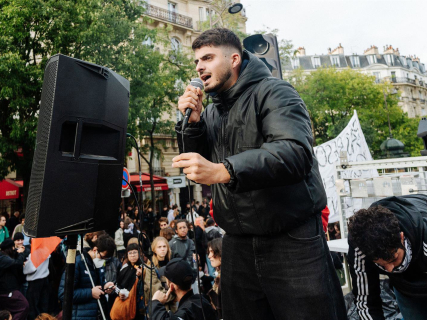

France faces a new day of mobilizations this Saturday, a week after the serious disturbances of October 17. Emmanuel Macron's meeting with youth representatives has not resolved the crisis: according to the Centre d'information et de documentation jeunesse (CIDJ), the organizations left Friday's meeting dissatisfied and maintain their call to mobilize until the meeting on Monday with the Prime Minister, Sébastien Lecornu.
The president has opened a response avenue regarding Parcoursup, the platform for access to higher education at the center of the demands. The representatives received at the Élysée claim that Macron announced a reform of that system. The specific scope of that promise and its translation into decisions remain crucial to assess whether there is a negotiated exit.
Why young people are protesting in France
The educational demands include the lack of teachers and support staff, the conditions of the buildings, and the organization of school life. The discussion about Parcoursup adds a concern for the future: how to access the desired training and what opportunities to find afterward.
The mobilizations have coincided with a broader discontent over the cost of living. On October 17, students, unions, and other social groups converged. Le Monde's report distinguished between the demonstrators and the autonomous groups that were involved in confrontations and damage. This separation is essential: the demands of a protest do not make all its participants responsible for the disturbances.
Limoges shows that the crisis also affects the functioning of cities
The fire at the Limoges town hall is one of the episodes that explain the severity of this week. The French government confirmed that Lecornu visited the city on Friday the 23rd to announce actions regarding security, repair of the building, and continuity of public services.
The reconstruction opens a different front from the police one. Neighbors need the administration to function, businesses must recover their activity, and authorities have to determine responsibilities. Restoring order and responding to the root of the discontent are related tasks, but neither replaces the other.
More security and a dispute over the right to protest
The device announced for this Saturday foresees 20% more personnel than that deployed on October 17, according to information from Le Monde about the Executive's preparations. The response includes restrictions on demonstrations and greater protection of points considered sensitive.
These decisions have opened another controversy. Mediapart documented how a student protest on Thursday in Paris went through a prohibition, a judicial authorization, and a new restriction that prevented its route. The tension no longer only affects the content of the demands: it also reaches the conditions under which they can be expressed.
The Government must avoid a repetition of the damages without treating a peaceful concentration and a violent action as equivalents. For the organizers, the ability to maintain organized protests will also be a test of strength and legitimacy.
What will happen now: the dates that will mark the exit from the crisis
The Ministry of Education has announced the rapid deployment of more than 3,000 substitute teachers in centers with the greatest needs, authorizations for new hires, and resources to cover short-term absences. It also proposes changes in student representation and budgets for projects driven by their participation bodies.
These are announcements that must be distinguished from their execution. The question for families and students is when those resources will arrive at the centers and what problems they will solve. The consultation opened on the Agora platform, closed on October 23, is scheduled for a national feedback at the end of the month.
Three scenarios for France after the black week
The first possibility is a partial de-escalation: that the meeting on Monday produces concrete measures, a timeline, and sufficient commitments for some organizations to reduce mobilization. It would not require resolving all demands immediately, but it would need to offer verifiable results.
The second is a prolongation of the conflict if students consider the proposals insufficient. In that case, the Government would have to sustain both the educational negotiation and the management of new protests.
The third, more serious, would be that new violent episodes would shift the debate back towards security and narrow the margin for dialogue. They are scenarios for analysis, not announced outcomes. The immediate test will be double: what happens in the streets and what the Executive puts on the table on Monday