

It is not a goodbye, it is a see you later. Sometimes breakups are like that, in installments. First comes the "we need to talk"; when you think you have managed to control the shockwave, a "it's better if we take a break" appears; and it all ends with a "it's not you, it's me". This is, more or less, what has been happening in the corridors of NATO in recent months.
European allies are aware that their relationship with the United States is going through one of those strategic crises that can lead to a "temporary cessation of cohabitation". And, therefore, they are already preparing for all possible scenarios. What was considered a remote hypothesis just a few years ago has now become a real operational plan within the Atlantic Alliance.
Sources within the organization acknowledge that Washington has already made clear its intention for certain capabilities that the United States has assumed until now to pass progressively into European hands. In other words, for Europe to take charge once and for all of a much larger part of its own security.
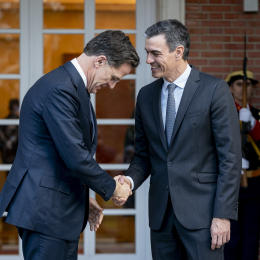
In Brussels, work is already underway with the premise that the world's leading military power will gradually reduce some of the resources it currently contributes to the allied defense structure. This is not an abrupt withdrawal or a formal break, but a profound redefinition of the division of responsibilities within the organization. "Contributions could begin to decrease in areas such as soldiers and physical weaponry. That is, in the most visible and tangible part of military force," explains a diplomatic source consulted by Demócrata.
According to various international media and as confirmed by EU sources, the United States would have already distributed preliminary documents among the allies regarding European contribution expectations in what some circles are already calling 'NATO 3.0'. Within this new division of responsibilities, a partial reduction of certain air and submarine capabilities currently deployed in European territory would fit. Far from being a future scenario, allied negotiating groups want to arrive with an advanced roadmap at the next summit of the organization's leaders, scheduled for July in Ankara.
Thus, unlike on previous occasions, when European capitals held their breath at the threats of the US president —as when he openly acknowledged in April that "NATO never convinced him"—, now work is already underway on a much more concrete hypothesis: a White House significantly less involved in the defense of the continent. The process of strategic burden sharing is already underway, acknowledge several diplomatic sources consulted in Brussels.
Spain seeks to gain weight in the new distribution
It is in this context that Spain wants to demonstrate to its allies not only its military capability but also its political commitment to the organization's objectives.
In the environment of the Minister of Defense, Margarita Robles, it has been studied how the country can contribute to the new distribution of capabilities and responsibilities. According to sources familiar with the conversations, Madrid would have already submitted preliminary drafts with possible national contributions to cover part of the gaps that Washington may leave. Spain would not be alone. A large group of Alliance members is already working on similar initiatives with the aim of identifying those capabilities where Europe can assume greater operational responsibility.
The intention is that national commitments to compensate for the US withdrawal can be defined before the July meeting, after an intense round of technical and political meetings among allies.

The objective is not only to respond to an American demand. There is also a growing conviction within NATO that Europe must strengthen its operational autonomy to guarantee its long-term security, especially in an increasingly volatile international context.
The real problem is not the troops
However, the debate does not revolve exclusively around the number of soldiers or weapons systems deployed on the ground. Strategic ruptures are usually accompanied by much deeper changes. "The Americans will likely start by reducing their presence in physical weaponry and military personnel. We will see partial withdrawals of certain force capabilities," explain diplomatic voices.
The real problem appears when the conversation shifts to the realm of military intelligence. Currently, American dominance in areas such as satellite surveillance, electronic warfare, strategic intelligence gathering, and certain command and control systems is practically absolute. “The really important gap would be in the satellite and electronic warfare domain. There is no immediate alternative capable of replacing the United States,” explain the same sources.
This is a widely shared concern within the organization. While the production of armored vehicles, ammunition, or air defense systems can be increased through industrial investments, building an advanced intelligence architecture requires decades of technological development, complex infrastructure, and enormous financial capacity.

Featured story
The defense industry fails to take off, but Brussels believes it has found the solution
7 minutes
Therefore, numerous allied officials believe that the risk for Europe lies not so much in a reduction of American forces as in a potential decrease in their strategic intelligence support.
From the American administration, the debate is framed in different terms. For the American Secretary of State, Marco Rubio, the usefulness of the Alliance for Washington must also be evaluated from a logic of reciprocity.
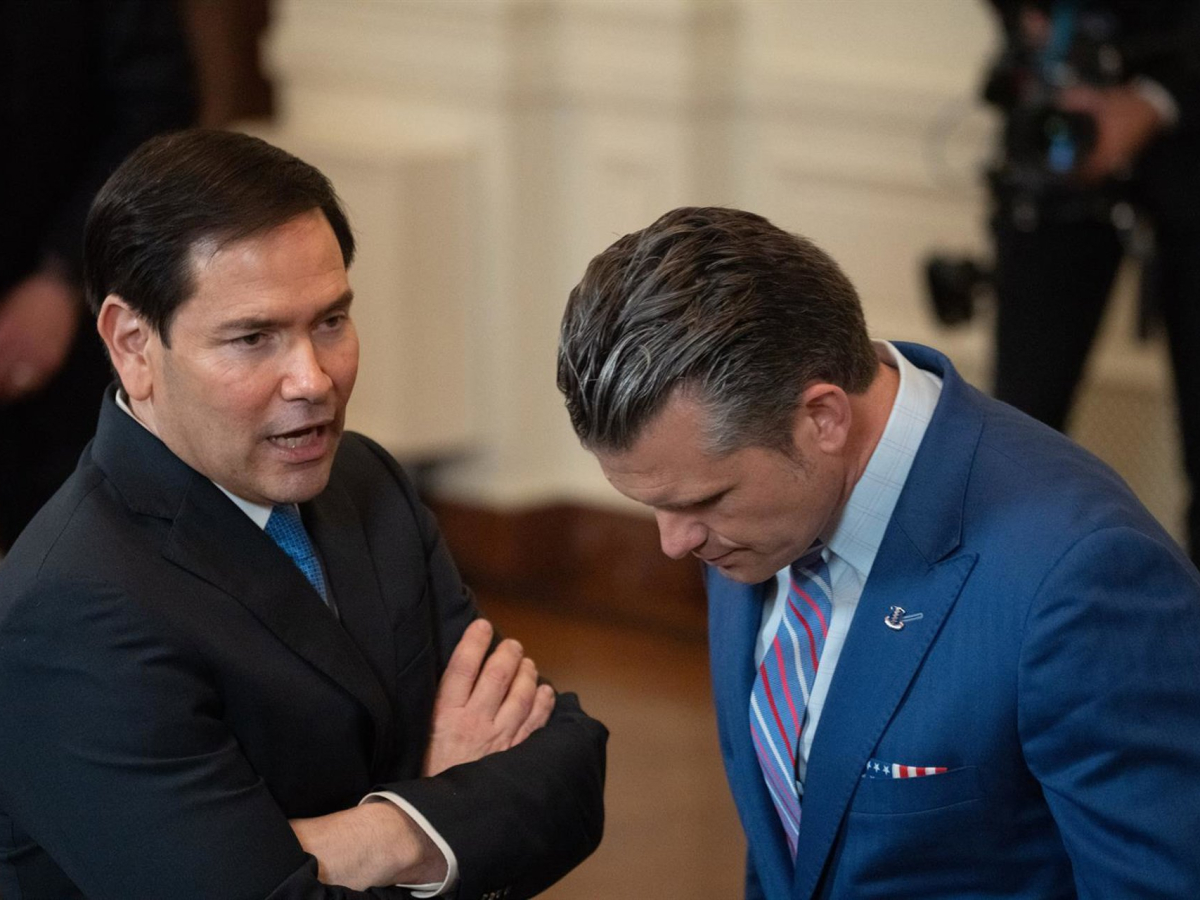
During an appearance before a Senate committee earlier this month, Rubio argued that one of the main benefits the United States derives from NATO is access to military facilities spread across the continent. However, he questioned whether it still made sense to maintain certain dynamics within the organization when “some allies deny the use of bases in contingency situations.” These statements have been interpreted by various European diplomats as a new sign that Washington intends to profoundly review the terms of its commitment to continental security.
The European Industrial Challenge
NATO will therefore have to face a period of adjustment that will require years of adaptation. The process involves progressively strengthening capabilities related to intelligence, surveillance, reconnaissance, air defense, strategic transport, and operational command, areas in which the Pentagon continues to maintain a technological and operational advantage that is difficult to match.
Otherwise, allied sources warn, a NATO with less US participation could face significant strategic vulnerabilities. However, within the organization itself, there is also a current that considers this process logical.
In May, the Supreme Allied Commander Europe, Alexus Grynkewich, framed the partial US withdrawal as a natural evolution derived from the strengthening of European capabilities. “This allows it to limit itself to providing those critical capabilities that allies cannot yet provide,” he stated at the time. From this perspective, the progressive reduction of the US role would not necessarily be bad news for Europe, but the definitive push for the Twenty-Seven to assume greater responsibilities in defense matters.
Rutte accelerates industry mobilization
However, the US issue is not the only challenge facing the organization. Europeans are aware that, to date, the continent's defense industry is still not fully self-sufficient to respond to all the strategic needs posed by the new geopolitical context.
Therefore, NATO Secretary General Mark Rutte has made coordinating the allies' demand a top priority to offer greater predictability to European manufacturers. The logic is simple: companies will only significantly increase their production capacities if they have a stable and predictable order book for the coming years.

To this end, the organization has convened the industrial sector before the July summit to convey an unequivocal message: Europe needs to produce more and do it faster. The forum will serve to align the military needs of member states with the production capabilities of the continental industry, thus reducing some of the bottlenecks that continue to affect the sector.
What is intended, in practice, is that European companies can take off definitively thanks to greater coordination between the spending commitments made by governments and the industrial investments necessary to execute them.
Faced with criticism about a possible protectionist turn in defense matters, sources consulted in Brussels reject this interpretation. The priority, they maintain, is to bet on “made in Europe” whenever possible. However, when Community industrial capacity proves insufficient or there is no competitive technological alternative, allies will continue to turn to suppliers from third countries. In that scenario, the United States will continue to be a fundamental partner, although other players such as South Korea are also gaining importance, whose defense industry has consolidated in recent years as one of the most dynamic in the international market.
The conclusion that is beginning to gain ground in Brussels is clear: the debate is no longer about whether Europe should assume more responsibility for its own defense, but about the speed at which it will be able to do so. Because the NATO of the future will continue to count on the United States, but more and more European leaders are assuming that the era in which Washington automatically covered any strategic deficiency on the continent is coming to an end.