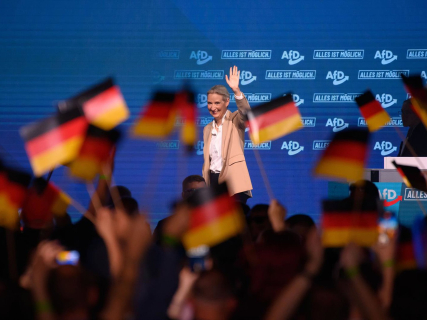

The great political novelty of the night is not only in the result of AfD, but in what begins to move around it. The main candidate of the BSW in Saxony-Anhalt, Claudia Wittig, has opened the door for Ulrich Siegmund's party to have some kind of participation in power after its electoral victory.
"If 44% of voters have chosen AfD, then, in my opinion, it would be completely undemocratic not to involve it in some way in the Government," Wittig stated in a television intervention reported by several German media. The leader of the BSW also expressed openness to studying support or agreements on specific initiatives on a case-by-case basis.
A relevant change in the midst of the battle for the Government
The statement has immediate relevance because AfD wins the elections in Saxony-Anhalt with around 44%-44.5% in the first projections, but falls short of an absolute majority. In that scenario, any party that enters the Landtag and agrees to facilitate parliamentary decisions can completely alter the reading of the night.
The BSW appears precisely in the decisive zone. Some projections place it at 5% and others slightly below. That threshold not only decides whether it enters Parliament, but also how much real margin AfD will have to aspire to govern or to condition the legislature.
So far, the sanitary cordon against AfD was one of the central elements of the German political landscape. Wittig's statement does not equate to announcing a coalition, but it does break the absolute closure that other parties have been defending and grants political legitimacy to the idea that a winning force with that level of support cannot be completely sidelined.
What exactly has the BSW said
Wittig's phrase must be read precisely. The BSW candidate has not confirmed a government pact nor announced that she will vote in favor of Ulrich Siegmund as minister president.
What she does assert is that excluding AfD outright despite its level of support would be "completely undemocratic." That position aligns with previous statements from the environment of Sahra Wagenknecht, who had already been criticizing the so-called Brandmauer, the political barrier erected against AfD.
The importance of this nuance is great. A formal coalition is not the same as a willingness to negotiate concrete initiatives, abstain in decisive votes, or accept that AfD has some type of institutional role. But all those options shift the political debate much more than what was happening before the polls closed.
AfD wins, but the key is already who isolates it and who does not
The result of AfD was anticipated by the polls. What was not entirely discounted was that, as soon as the first data was known, a party with options to enter Parliament would launch such an explicit message about the exclusion of the winning formation.
This makes the BSW a much more relevant actor than its percentages indicate. If it enters the Landtag, it can influence not only the parliamentary arithmetic but also the political climate of the negotiation.
For the CDU and for the rest of the parties opposed to any collaboration with AfD, the statement adds pressure. It would no longer be just about containing the leading force, but doing so in a context where part of the discourse on governability begins to change.
Die Linke responds and reinforces the rejection of AfD
In the face of that opening from the BSW, Die Linke has come out to mark the opposite line. Its leader Heidi Reichinnek has defended that "there should never be cooperation with a far-right party," according to a reaction disseminated during the election night.
The response clearly sets the political clash that the day leaves. While the BSW questions maintaining AfD, backed by nearly 44% of voters, out of power, Die Linke insists that no avenue of cooperation with the far right should be opened.