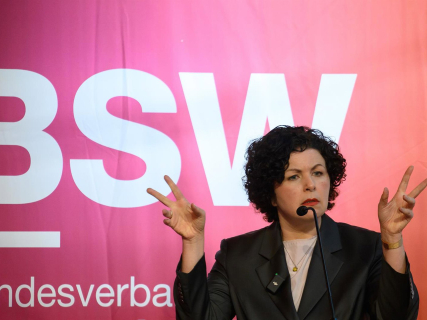

The Sahra Wagenknecht Alliance (BSW, for its initials in German) proposed this Sunday the creation of a "non-partisan" Executive as a "third way" after the victory of the far-right party Alternative for Germany (AfD) in the regional elections held in the state of Saxony-Anhalt.
The co-chair of BSW, Amira Mohamed Ali, emphasized that during the campaign they committed to not supporting either AfD or the outgoing government of the Christian Democratic Union (CDU) and, instead, suggests a "non-partisan prime minister."
"We will do exactly what we announced before the elections. We will not vote for Mr. (Sven) Schulze (CDU) or Mr. (Ulrich) Siegmund (AfD)," she stated, according to German media reports. "We have to get out of these trenches. It is a trench war and that is why we have decided that it is time for a new model: a prime minister recognized as impartial who governs with rotating majorities, with the participation of the entire parliament," Mohamed Ali added.
According to her defense, this model would allow for the implementation of measures focused on concrete problems, "which in the long run can also help overcome divisions."
According to exit polls released by the ARD and ZDF networks, AfD would have obtained between 39 and 41 seats, with support from 44.5 or 44% of voters. The CDU would come in second place with 18.5% in both studies, which would mean about 16 deputies, after losing 18.6 points compared to the previous elections.
In third place would be tied the historic Social Democratic Party of Germany (SPD), The Left, and The Greens, with 9% support and between 8 and 9 seats each. BSW would be in sixth place with 5%, ahead of the Free Democratic Party (FDP), which would remain at 2%. The minimum threshold to access the regional Parliament is 5%.
Voter turnout has been another of the highlighted data of the electoral day: it would have reached 80% of the census at the close of the polling stations, well above the 60.3% recorded in the previous regional elections.