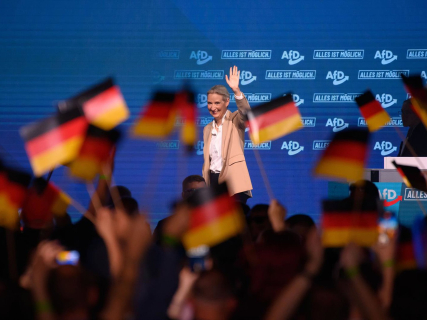
Election results in Germany: AfD without absolute as the count progresses while the CDU sinks

The official count of the elections in Saxony-Anhalt has already reached 32%, with 867 of the 2,660 districts counted. The second projection from ARD/Infratest dimap keeps AfD at 44.4% and CDU at 18.4%, while Ulrich Siegmund remains three seats below the absolute majority and BSW stays stuck at the decisive 5%.

4 minutes

fotonoticia 20260906184826 1920

fotonoticia 20260906184826 1920

Add DEMÓCRATA to Google

Ask FREN

Published

Last updated

4 minutes

Most read

The counting of the elections in Saxony-Anhalt is progressing without altering for now the earthquake that the first estimates showed. The official count has already reached 32%, with 867 of the 2,660 electoral districts counted by the electoral administration of the Land

The second Hochrechnung from ARD/Infratest dimap, which already incorporates real results in addition to the exit poll, places AfD at 44.4%. The CDU continues to collapse at 18.4%, practically half of the 37.1% with which it won the 2021 elections. 

AfD remains three seats away from an absolute majority

The projection keeps AfD at 39 deputies. To control the Landtag alone, it needs 42. Ulrich Siegmund's party is therefore still three seats below the absolute majority. The situation remains open because the final distribution also depends on how many parties surpass the 5% threshold. 

The second Hochrechnung thus leaves the result:

  • AfD: 44.4%
  • CDU: 18.4%
  • Die Linke: 9.3%
  • Greens: 8.7%
  • SPD: 8.4%
  • BSW: 5.0%
  • FDP: 2.2%

BSW is exactly on the border that allows entry into Parliament. It is one of the data points that can most alter the final distribution in the coming hours. 

The real count confirms for now the snapshot from 18:00

The transition from the first projection to the Hochrechnungen is relevant. At 18:00, the figures were mainly from interviews conducted with voters as they left the polling stations. The successive Hochrechnungen incorporate real results from the tables that have already finished counting.

And for now, there is hardly any movement. AfD started the night at 44.5% and now appears at 44.4%. The CDU goes from 18.5% to 18.4%. Die Linke is at 9.3%, the Greens at 8.7%, and the SPD at 8.4%. 

AfD mobilizes 157,000 former abstainers

The first data on vote transfer also helps explain AfD's jump.

According to Infratest dimap, the party would have captured around 157,000 voters who did not vote in the 2021 regional elections. It is, by far, its largest growth pool. 

AfD would have also gained about 83,000 votes directly from the CDU. To this, 19,000 former FDP voters, 11,000 from Die Linke, 7,000 from the SPD, and about 35,000 from other parties are added. These are still provisional estimates of electoral transfer. 

The data helps to understand two simultaneous phenomena of the night: the extraordinary mobilization of the electorate and the Christian Democratic collapse.

Participation skyrockets to 76.5%

The provisional participation stands at 76.5%, compared to 60.3% recorded in 2021. That is 16.2 points more.

ARD analyses indicate that AfD has been the main beneficiary from the turnout of former abstainers. Siegmund's party has not only grown by taking votes from other forces, but by incorporating a very high number of voters who did not participate five years ago. 

Siegmund rejects governing in a minority

The uncertainty over the absolute majority has already caused a first significant movement from AfD. Ulrich Siegmund has ruled out leading a minority government on ZDF if he ultimately does not reach 42 deputies. The candidate asserts that he does not consider that formula and points out that AfD would be open to a coalition with any party willing to change migration and energy policies, although he states that he currently sees no available partner. 

The position introduces pressure in the subsequent negotiation. AfD could win by more than 25 points and still end up without an immediate path to government.

BSW accepts concrete agreements with AfD, but will not vote for Siegmund

The position of BSW has clarified overnight. Its candidate, Claudia Wittig, has stated that she can imagine agreements with AfD for certain projects. But she has ruled out voting for both Ulrich Siegmund and the CDU candidate, Sven Schulze, as minister president. 

Wittig proposes instead an independent head of government from the parties who can seek different majorities for each initiative.

Die Linke maintains the opposing position. Its leadership has rejected the possibility of variable parliamentary majorities alongside AfD. 

CDU's defeat already opens an internal crisis

The magnitude of CDU's fall is causing consequences even before the counting is finished. The Junge Union of Saxony-Anhalt has demanded the resignation of the entire regional leadership of the party. It considers that the responsibility for the result lies with the entire leadership and calls for a complete renewal. 

The former regional education minister Eva Feußner has gone in the same direction and has directly called for Sven Schulze's resignation as regional president of the CDU. She also rejects any cooperation with Die Linke. 

Schulze, for his part, has congratulated AfD on the victory and has acknowledged that he expected a better result for his party.

FDP loses Parliament and its leader announces his departure

The FDP appears at only 2.2% and is clearly below the threshold of 5%.

Its regional leader, Lydia Hüskens, has already announced that she will leave the position and has taken political responsibility for the result. The FDP was part of the outgoing Government along with CDU and SPD. 

The Greens are experiencing the opposite situation. With around 8.7%, they are heading towards the best result in their history in Saxony-Anhalt, although their leaders have focused their first statements on the advance of AfD

More key points, information and questions with FREN

AI-GENERATED CONTENT

What are the legal steps and deadlines foreseen for government formation in Saxony-Anhalt after the regional elections?

With the information available in the consulted sources, it is not possible to precisely reconstruct the specific legal steps nor the exact deadlines set by the Constitution of the federal state of Saxony-Anhalt for government formation after regional elections. The reviewed databases and news refer to elections in Saxony-Anhalt and German politics in general, but do not reproduce the constitutional text of the Land nor its parliamentary rules, which are precisely the norms that determine the schedule and required majorities.

However, there is a reference to the procedure for electing the federal chancellor in the German Basic Law and analogous examples of investitures in various Spanish autonomous parliaments, which allows explaining the type of elements that normally regulate this process, although without mechanically extrapolating those details to Saxony-Anhalt.

Which norms should be consulted in Saxony-Anhalt

To rigorously know the steps and deadlines in Saxony-Anhalt, one should refer to three types of provisions:

  • The Constitution of the Land Saxony-Anhalt (Verfassung des Landes Sachsen-Anhalt), where the principle of electing the minister-president by the Landtag is usually established and, sometimes, maximum deadlines or consequences of a deadlock.
  • The electoral law of the Land and, if applicable, the norm on the Landtag, which establishes the convocation and constitutive session of the parliament after the elections (date of constitution, initial agenda, etc.).
  • The Internal Rules of the Landtag of Saxony-Anhalt (Geschäftsordnung), which specify the procedure for proposal, debate, and voting of the candidate or candidates for minister-president, as well as possible repeated votes.

None of these texts have appeared reproduced or summarized in the news obtained by the search, so I cannot indicate the number of relevant articles, the exact number of days of the deadlines, nor the design of the voting rounds in that specific Land.

Available reference: German federal framework

One of the relevant pieces located explains the general method of electing the federal chancellor, regulated in Article 63 of the Basic Law (Grundgesetz). According to that article, cited in a report about forming a grand coalition in Germany, the chancellor is elected without debate by the Bundestag, upon proposal of the federal president, and must obtain a majority of the chamber's votes (analysis at eldiario.es).

This federal reference is useful only as an indication that, in the German system, the head of the Executive (federal or regional) is always elected by parliamentary vote, but it says nothing about the deadlines, majorities, and specific rounds set by the Constitution of Saxony-Anhalt for its minister-president.

Elements usually regulated (by comparative analogy)

The consulted news detail the investiture procedures in several Spanish autonomous parliaments (Castile and León, Valencian Community, Basque Parliament, Catalonia), which illustrate the type of issues that are likely also regulated in Saxony-Anhalt, although with their own numerical contents. Among other examples:

  • In Castile and León, a maximum deadline from the constitutive session is established for the president of the Cortes to propose a candidate, as well as the requirement of an absolute majority in a first vote and, if it fails, a second vote where a simple majority suffices. If within two months from the first investiture session no candidate is elected, the chamber is dissolved and new elections are called (analysis at Demócrata).
  • In the Valencian Community, after the presentation of candidacies, the rules set a time interval to convene the investiture plenary; the first vote requires an absolute majority and a possible second, 48 hours later, is resolved by simple majority. The possibility of new rounds of consultations is also foreseen and, after a deadline, automatic calling of elections if no one is invested (Valencian calendar).
  • In the Basque Parliament, the rules also provide for a vote with an absolute majority and, if necessary, a second with a simple majority, even regulating what happens in case of a tie (Basque investiture guide).

These designs show a comparative pattern: constitution of the parliament within a set deadline after the elections; proposal of candidate by the chamber's presidency after consultations; debate and investiture vote with a first reinforced round (absolute majority) and subsequent more flexible votes; and, ultimately, automatic dissolution and new elections if the deadlock persists. It is reasonable to think that Saxony-Anhalt has a similar normative architecture, but without the text of its Constitution and rules, it cannot be affirmed what exactly its figures, deadlines, and legal consequences are.

Conclusion and recommendation

In the absence of access in this search to the text of the Constitution of Saxony-Anhalt and the Rules of the Landtag, it is not possible to offer a precise and verifiable description of the legal steps and deadlines foreseen for government formation in that Land after regional elections. For a rigorous analysis, the safest way is to consult directly:

  • The consolidated text of the Verfassung des Landes Sachsen-Anhalt on the official website of the Landtag or the regional government.
  • The Geschäftsordnung des Landtages von Sachsen-Anhalt, which details the parliamentary procedure for electing the minister-president.
  • Any specific Land law that develops the investiture procedure or the calling of new elections in case of deadlock.

Only those primary sources allow answering your question with legal precision.

What powers does the minister-president of Saxony-Anhalt have according to the German Constitution?

I cannot reliably and documentedly answer your specific question about the powers of the minister-president of Saxony-Anhalt according to the German Constitution, because I specialize in the political and institutional system of Spain (State, Autonomous Communities, local entities, Spanish norms and procedures) and my search tools and databases are designed for that scope. Although the topic you raise is clearly political and institutional, it refers to a different legal system — the German one and, within it, the Land of Saxony-Anhalt — for which I do not have systematic access equivalent to what I have about Spain.

This means, in practice, that I cannot guarantee you a precise description of the formal powers of the minister-president of Saxony-Anhalt as they result from the German Basic Law (Grundgesetz) and the constitution of the Land itself, nor go into detail about their executive, representative, participation in the Bundesrat, or any specific powers included in Saxony-Anhalt's internal regulations. Giving a “textbook” answer based only on general knowledge would involve a high risk of normative inaccuracies, and my design prioritizes avoiding conveying doubtful or unverifiable information in legal-institutional matters.

Moreover, although at a comparative level many figures resemble each other — for example, the minister-president of a German Land shares certain functional traits with a president of an autonomous community in Spain (head of the regional government, political direction of the executive, ordinary representation of the territory, etc.) — the concrete differences in the distribution of powers, election procedure, parliamentary dissolution faculties, normative capacity, relations with the federal level, and other elements depend on very specific constitutional and statutory texts. Without being able to safely consult those sources for the specific case of Saxony-Anhalt, any parallel I made would risk being overly simplistic or outright wrong.

Where I can really be useful is in anything involving:

  • Equivalent Spanish institutions and offices, such as the powers of the President of the Government of Spain, of autonomous presidents (for example, the president of the Junta of Andalusia, the Generalitat of Catalonia, or the Xunta of Galicia), or mayors and other executive offices within the Spanish legal framework.
  • Spanish regulations and official texts, whether the Spanish Constitution, Statutes of Autonomy, organic laws, ordinary laws, royal decree-laws, royal decrees, or other regulations establishing powers, procedures, and institutional organization in Spain.
  • Functioning of the Spanish parliamentary and autonomous system, including law processing, motions of censure, confidence questions, relations between Government and Cortes Generales, and interactions between the State and Autonomous Communities.
  • Political and parliamentary context in Spain: relevant actors (parties, parliamentary groups, institutional leaders), ongoing debates, votes, legislative initiatives, and, in general, the dynamics of the Spanish political system.

If you wish, I can:

  • Explain in detail the powers of a Spanish office you consider comparable to the minister-president of Saxony-Anhalt (for example, an autonomous president) and, from there, help you build a general comparative framework on how regional government heads are typically organized in decentralized systems.
  • Analyze how the Spanish Constitution and Statutes of Autonomy structure the distribution of powers between the State and Autonomous Communities, and what role their presidents play in that scheme, which may serve as a reference if you are studying models of composite states.
  • Help you better understand the general concept of regional head of government in political science terms (responsibility before parliament, executive leadership, regulatory powers, appointment and dismissal of ministers, etc.), provided it is accepted that the examples and concrete references I may develop will be essentially Spanish.

In summary, due to my specialization and the tools I have access to, I cannot give you a rigorous technical answer about the powers of the minister-president of Saxony-Anhalt according to the German Constitution and Land regulations, but I can offer you in-depth explanations about offices, powers, and government structures within the Spanish system, as well as general comparisons starting from there. If you reformulate your question oriented to Spain or a contrast between Spain and Germany at a more conceptual level, I will be happy to help you within that framework.

What is Ulrich Siegmund's political trajectory before leading AfD in Saxony-Anhalt?

The accessible sources we have been able to consult offer very little concrete and verifiable information about the political trajectory of Ulrich Siegmund before positioning himself at the forefront of AfD in Saxony-Anhalt. What consistently appears is that his known political career is closely linked to Alternative for Germany and the Land of Saxony-Anhalt itself, with no trace of a relevant stage in other traditional parties nor of prominent public offices prior to AfD.

Currently, political reports describe him as a young leader – around 36 years old – who heads AfD's candidacy for the presidency of the regional government of Saxony-Anhalt and serves as head of the parliamentary group of the party in the Land parliament. That position as group leader in the regional chamber is the clearest and most documented starting point of his trajectory: it indicates that, before taking the leap to lead the regional organization, Siegmund had already consolidated as a central figure of the party in the parliamentary sphere of the state.

The analytical pieces on the Saxony-Anhalt elections highlight above all his current role and political profile rather than a detailed biography. It is emphasized that he has built a significant part of his projection through very intensive social media campaigns, with videos and direct messages, and that he has managed to embody AfD's characteristic discourse in eastern Germany: emphasis on immigration, national identity, security, as well as strong opposition to the policies of the conservative federal government. This communication style and thematic agenda point to a leader politically formed within the internal culture of AfD, rather than in the traditional apparatus of other parties.

What can be inferred from his current situation is that Siegmund has followed a relatively typical path within emerging parties: first militancy and activism in the regional structure, then access to a seat in the Land parliament and, subsequently, rise to the leadership of the parliamentary group as a reference figure of the party in Saxony-Anhalt. That internal progression – activist, regional deputy, group leader – is consistent with the place he occupies today, but the consulted sources do not detail the dates nor intermediate steps (for example, previous organizational responsibilities in the party, local offices, or experience in affiliated associations).

There are also no verifiable references to a significant political stage in other formations, whether from the traditional right or other spaces. The analyses focus more on his role as a generational face of AfD in an eastern Land, where the party aims to govern a federal state for the first time, than on a long history in German public life. This suggests that his political visibility at the national level is relatively recent and directly linked to AfD's rise in the last decade.

Another relevant contextual fact affecting the reading of his trajectory is that the AfD section in Saxony-Anhalt is classified as far-right extremist by the regional constitutional protection services. That Siegmund has reached the leadership of the parliamentary group and regional leadership in a structure under that classification places his career within the most radicalized segment of the German political spectrum. However, media sources focus on the current implications of that classification (debate about possible partial banning of the party, cordon sanitaire by other forces, etc.) and do not reconstruct in detail how he climbed positions in that environment.

In summary, based on the available information, it can be said that Ulrich Siegmund's known political trajectory before leading AfD in Saxony-Anhalt is that of an emerging cadre formed entirely within AfD's structure in the Land: activism and internal activity, election as regional deputy, and consolidation as head of the parliamentary group, without a broad public biography prior in other parties nor major institutional offices outside AfD's scope. The fine detail of his first steps – date of affiliation, intermediate organizational responsibilities, possible local offices or activity in satellite organizations – is not documented in the accessible sources, so beyond that general scheme, it would not be rigorous to add concrete data.

Play

Test your knowledge with FREN!

How much do you know about this topic? Answer the following 3 questions.

What percentage of votes did AfD obtain according to the second projection by ARD/Infratest dimap?

Question 1 of 3

Which party was left out of the regional Parliament after obtaining less than 5% of the votes?

Question 2 of 3

By how many seats does AfD fall short of an absolute majority in the Saxony-Anhalt Parliament according to provisional data?

Question 3 of 3

Hola, soy Fren. ¿Cómo te ayudo?