

From Dublin, special correspondent.- It was the vanguard of the class. Whoever had best prepared for the exam. Everything was ready to achieve an honors matriculation. However, in the end she had to attend remedial classes. What has happened to us if, apparently, nothing has happened? From leading the regulation of artificial intelligence to being forced to redefine its strategy so as not to fall behind in its development. The European Union has seen how AI climbed to the very top of the priorities on its agenda, in an implicit recognition that the rules are no longer enough to compete in a technological race that moves at a difficult-to-follow pace.
For the first time, the heads of Government of the Twenty-Seven will address this issue this Friday in Dublin, the capital of one of the main European hubs of big tech. The president of the European Council, António Costa, has wanted to make artificial intelligence the central matter of the summit organized under Irish presidency, despite arriving at the meeting partially overshadowed by other matters of the highest importance, such as the war in Ukraine or the race to lead the European Central Bank (ECB).
The decision responds to a concern that has been gaining weight for some time in EU conversations. Artificial intelligence is already an “omnipresent” matter in the debates that take place daily in Brussels because of its impact on “our economies and societies.” Its development will condition both the continent’s industrial competitiveness and its ability to maintain a position of influence in the new technological scenario.
From regulating AI to building its own industry
The aim of the technical teams that have prepared the meeting is for Europe to “become a leading and sovereign actor” in strategic areas of the value chain of artificial intelligence. An ambition that forces Member States to face a dilemma that goes beyond regulation: how to ensure that these tools are at the service of European economies and not that economies end up depending on them.
As discussion forums on this issue multiply, European officials tend to remember that the continent starts from a "very solid" foundation. "We have world-class research, a very dynamic startup ecosystem and qualified talent," says a senior diplomatic source. However, behind that optimistic assessment there is also a less complacent admission: "We are still falling behind in some areas."

Featured story
The technological heart of Europe will measure the continent’s digital ambition
8 minutes
The gap between European capabilities and their translation into companies capable of competing on a global scale is precisely one of the matters that leaders want to examine in Dublin. To do so, the institutions consider it necessary to incorporate the industry perspective and to learn first-hand how the companies themselves perceive Europe’s position in relation to its international competitors.
Legislators acknowledge that they need to have companies on board to answer a fundamental question: "How do they feel Europe is positioned?" "We are not going to pretend that we are experts: the leaders will analyze this from a political standpoint," explains a diplomatic source. The intention is for the debate not to be limited to a statement of principles on technological sovereignty, but to make it possible to identify where the main shortcomings lie and what political decisions can help to correct them.
"We have the capacity to recover, rebuild and truly compete as well," they convey in Brussels. For that purpose, António Costa has invited Mistral AI’s chief executive officer, Arthur Mensch, to take the floor as an example of the "dynamic ecosystem of several companies in Europe." His presence is intended to bring to the debate the perspective of a European company that operates in one of the most strategic and contested sectors of the world economy.
Mistral, the example that Brussels wants to put on the table
The choice of Mensch is not accidental. The French company has become one of the reference points in the European artificial intelligence ecosystem and represents the type of entrepreneurial initiative that the EU institutions aspire to promote. The office of the president of the European Council considers it "interesting to listen to a CEO of a cutting-edge company to help frame this debate."
Mistral appears as a reference to illustrate the type of business ecosystem Europe needs to develop if it wants to reduce its technological dependence and gain autonomy in the race for artificial intelligence. The question is how to ensure that companies of this profile can grow, attract resources, and compete in a market dominated by major international players.

The key lies, to a large extent, in combining public and private financing. European governments will have to determine how to mobilize public resources that complement business investment and allow the development of homegrown technologies to be sustained. This is not only about backing specific companies, but about building the conditions for the entire fabric of European business to be able to take part in this transformation.
The approach that emerges from Dublin aims to serve as a push behind that strategy: Europe must keep investing, developing capabilities, and working with companies to prevent the distance from other competitors from turning into a structural disadvantage. The challenge is no longer just about writing the rules of artificial intelligence, but about having the industry needed to develop it and take advantage of it.
Featured story
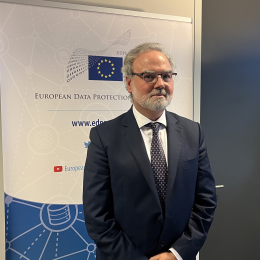
Leonardo Cervera (EDPS): "Data protection must allow the needs of companies to be met"
11 minutes
Going back to class to pass the makeup exam. That is, in a sense, the situation the European Union finds itself in now. But the business dimension is not the only one in which Europeans consider it necessary to strengthen their efforts. The debate will also have to address the safeguards that must accompany the expansion of these tools and the risks that their use poses.
Security, governance, and trust: the other European exam
Another of the central points of the talks will be the one related to the areas of "governance, security, and aspects of trust". Community institutions have been warning for some time about the effects these technologies can have on fundamental rights, the integrity of public debate, and even electoral processes, as well as the transformations they may cause in the labor market.
The concern is that the drive for competitiveness will not end up relegating the guarantees that have defined the European regulatory model. The Union has built much of its international position around protecting citizens and the ability to set limits on new technologies. Now it needs to show that both aspirations can coexist with the development of its own industry. This dimension of the debate will fall to Professor Geoffrey Hinton, Nobel Prize in Physics and one of the pioneering figures in the development of artificial intelligence. His participation will allow a scientific perspective to be incorporated into a discussion that until now has been heavily conditioned by regulatory decisions and the needs of industrial competitiveness.
The organizers of the meeting want to convey the idea that the time has come to give a European technological boost. The ambition is to prevent the diagnosis of the continent’s relative lag from turning into a self-fulfilling prophecy. "There is no reason to think that we have lost the race," they say from António Costa’s office.
Although he is not present at the summit because it coincides with the start of the election campaign, the President of the Spanish Government, Pedro Sánchez, has been defending in the European arena an artificial intelligence "focused on people." When asked by DEMÓCRATA, Moncloa sources recall that his approach involves protecting "fundamental rights, especially those of minors," while at the same time "preserving democratic integrity."
In light of the negotiations that are now opening up about the continent's technological future, Madrid is in favor of fully applying the European Union's Artificial Intelligence Regulation. The Executive considers that the regulatory framework approved by the Union already "provides sufficient instruments to supervise and control the most advanced models." Spain's position therefore involves preventing the review of European priorities in the area of competitiveness from translating into a weakening of regulatory guarantees. "We understand that competitiveness and regulation are complementary objectives," clarify sources from the Executive. A position that places the debate at one of the main dilemmas in European technology policy: how to facilitate the growth of companies and innovation without giving up the protection standards that have characterized the Community model.
The same sources argue that Europeans should not focus their efforts exclusively on developing advanced artificial intelligence models. The strategy should also extend to their deployment across the economy, from small and medium-sized enterprises to industry and public administrations. The challenge is not only to have homegrown technology, but also to ensure that its benefits reach the productive fabric and public services.
Along these lines, the Spanish Government backs a "greater public and private investment" and points as an example the role of the Sociedad Española para la Transformación Tecnológica (SETT) and the development of ALIA. The bet involves combining investment impetus with a greater incorporation of these tools into economic activity.
The Dublin summit aims to serve as a starting point for organizing all these priorities. Europe comes to the debate with advanced regulation, scientific capabilities, and companies that aspire to compete at the forefront, but also with the awareness that it needs to turn those strengths into industrial muscle. The test is no longer about demonstrating that it knows how to regulate artificial intelligence, but about proving that it can also develop it, fund it, and convert it into a competitive advantage.