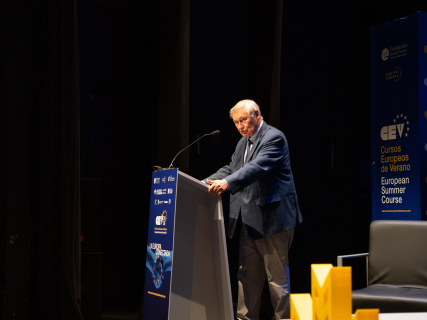

The Belgian diplomat Frans van Daele has placed technology at the center of the new geopolitical dispute and has warned that artificial intelligence, semiconductors, data centers, and energy have become strategic elements of the competition between states. During his speech at the forum "Connected Europe", organized this week by the association Team Europe in Pamplona, Van Daele also argued that Europe retains fundamental technological assets and rejected the idea that the Union is completely absent from the new race for power.
Van Daele began his speech by reviewing the transformation of the international landscape since the end of the Cold War. The diplomat recalled that, during his time as a young diplomat, the rivalry between the United States and the Soviet Union shaped a scenario in which the movements of each power were relatively predictable. "We were not friends, but the outcome of each friction was perfectly predictable", he explained when referring to that bipolar balance.
The collapse of the Soviet Union in 1991 has opened, according to his analysis, a great geopolitical vacuum. For years, he pointed out, it was believed that globalization would be able to fill that space and keep the world united around peace and prosperity. However, he warned that this process has also begun to be questioned from different parts of the world.
In his view, the vacuum left by the old bipolar order has ultimately given way to two main dynamics: the return of rivalry between great powers and greater freedom of action for small and medium-sized countries. "Small and medium-sized countries now have an opportunity," Van Daele suggested, arguing that these states are trying to strengthen their position in a much more fragmented international scenario.
Technology as a new factor of power
It is precisely in this new board where Van Daele has placed technology. "Technology is becoming a primary factor in the rivalry between states", he pointed out. The diplomat differentiated between two types of actors. On one hand, small and medium-sized countries, which are trying to take advantage of new strategic opportunities. On the other, large private companies, whose weight in sectors traditionally dominated by states has increased significantly.
Van Daele has cited Elon Musk and SpaceX as an example, whose activity has contributed to transforming the role of private companies in space exploration. The diplomat has also pointed out that other countries are trying to promote their own private companies to compete in this field. But the great technological battle, he has noted, is taking place among the great powers. Van Daele has identified two shared objectives by these states: to reduce their external dependence and to achieve a technological and economic position that allows them to be stronger than their rivals.
The first of these priorities is being reflected, he has explained, in efforts to ensure the supply of raw materials, components, and other products considered essential. The diplomat has mentioned agreements between the United States, Europe, and Asian countries aimed at strengthening supply chains and preventing certain resources from being used as instruments of coercion. Economic dependence has thus become a security issue.
The race for AI needs energy
The second major field of competition is artificial intelligence. Van Daele has highlighted the race between the United States and China to develop the most advanced models, but he has warned that technological capacity does not solely depend on algorithms. "To use artificial intelligence as an instrument of dominance, a lot of energy is still needed", he has pointed out.
Data centers have thus become a strategic infrastructure. The great powers are competing to have the largest and most advanced data centers, but their deployment requires enormous amounts of electricity. Van Daele has directly linked this issue to the growing energy debate in Europe. He has pointed out that several countries are reviewing their position on nuclear energy and has related this movement to the needs arising from the development of artificial intelligence.
This equation is joined by another great technological bottleneck: semiconductors. The diplomat has highlighted the importance of the machinery necessary to manufacture the most advanced chips and has emphasized that one of the companies capable of producing this type of equipment is European and Dutch. Van Daele's message has been clear: Europe is not completely absent from the technological race. "Europeans are not absent everywhere, as it sometimes seems we think", he defended.
The reference points to the strategic role of the European semiconductor industry and, especially, to the technological capacity of companies like ASML to manufacture the machines necessary to produce next-generation chips.
Europe does not need to become a superpower
The diplomat has also rejected the vision of a Europe doomed to be left out of the new international balance. Van Daele has defined himself as "Europeanist" and has defended the role that the Union has played over the last few decades. He has acknowledged that Europe does not intend to become a superpower in the traditional sense of the term nor pursues imperial ambitions, but has emphasized that this does not mean it lacks the capacity to exert influence.
In this sense, he has claimed some of the main successes of European integration, among them the enlargement towards Central and Eastern Europe. He recalled that when he began his career, the European Community had only six member states and pointed out that the European project was fundamentally born to guarantee peace among its members. The enlargement, he explained, has also responded to a logic of security. Europe has tried to prevent its eastern flank from becoming a zone of instability.
Van Daele has also acknowledged the weaknesses of the European economy. "Europe is underinvesting and overregulating", he summarized.
In terms of investment, he has placed part of the problem in the fragmentation of European capital markets. The diplomat has pointed out that every year hundreds of billions of euros leave Europe that end up financing investments in the United States, where there is a much more integrated capital market. "We have a fragmented capital market", he pointed out, while noting that some member states still want to maintain control over their own financial markets.
That said, Van Daele has admitted that Europe overregulates, but he has introduced a nuance that he considers fundamental to understanding the debate. "The European choice is never between zero rules and one rule. The choice is between 27 rules or one rule", he stated.
With this idea, he has defended the value of the single market against national regulatory fragmentation. For Van Daele, the European debate should not simply be framed as an opposition between regulation and deregulation, but rather between having a single common framework or maintaining 27 different regulatory systems. His intervention thus concluded with a defense of a Europe capable of competing in an increasingly technology-driven international landscape, but without renouncing the distinctive characteristics of the community project.