
How to harness the potential of Artificial Intelligence without losing control over it? It is the question that, with different nuances, is repeated daily in offices in Brussels, among officials, advisors, legislators, companies, and consultants. A question that, at times, is approached almost with the naivety of someone who trusts they can tame a technological revolution with the same instruction manual used to respond to the challenges of the past.
The problem is that Artificial Intelligence does not wait. While technological developments accelerate at an unprecedented speed, community negotiations maintain their own timelines, marked by institutional balance, the search for consensus among member states, and the complexity of building common rules for a market of almost 450 million citizens.
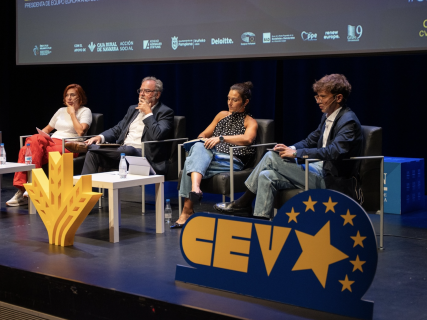
In that space between the speed of technology and the rhythm of European politics, nearly three hundred young professionals are gathering this week in Pamplona to try to provide their own answer. Under the motto "Connected Europe", the association Equipo Europa organizes a discussion forum that brings together institutional representatives, experts, companies, and members of civil society with the aim of putting into context, sizing, and shedding some light on some of the main dilemmas currently facing the European Union.
The immediate news often complicates the calm discussion of issues on which Brussels knows that time is not precisely its main ally. The community agenda progresses amid crises, legislative negotiations, political statements, and geopolitical urgencies. But there are debates that require looking up from the short term.
The regulatory future of the digital sector, European technological autonomy, the development of infrastructures, the ability to attract investment and talent, or the impact of Artificial Intelligence on rights and employment are issues that will determine a large part of Europe's position in the coming decades. Therefore, public and private representatives have taken advantage of these days in Pamplona to pause, analyze, and discuss before the frantic pace of the community capital imposes its own logic again.
Democrat, at the center of the European debate on AI
As a result of his experience and his daily work from Brussels, Demócrata has been part of the inaugural day of the forum, actively participating in the panel dedicated to the advances of Artificial Intelligence and its impact on the rights of European citizens. During his intervention, the correspondent of Demócrata in Brussels, Álvaro Villarroel, raised one of the central questions of the day: the need for Europe to find a balance between protection and competitiveness. "The debate is not just about how much we should regulate, but also how we manage to innovate, compete, and not fall behind."
Villarroel recalled that Artificial Intelligence is, probably, one of the technologies that is transforming society the fastest. Just a few years ago, it seemed like a tool reserved for experts, large companies, or technology laboratories. Today it is part of daily life and is changing the way we work, inform ourselves, research, learn, or even make decisions. Europe has wanted to give its own response to this transformation. It has been a pioneer in establishing a specific framework with the AI Act and has bet on a model based on innovation, but also on the protection of fundamental rights and on trust.
However, the European Union continues to face an uncomfortable reality: the United States and China are advancing with enormous investment capacities, large technology companies, and an increasingly intense race to lead this revolution.
The big question, therefore, is whether Europe can be something more than the great regulator of Artificial Intelligence. If it can also develop its own companies, attract talent, mobilize capital, and create the technologies that will define the future.
A race against the clock
Brussels is aware that it is immersed in a race against time. The stopwatch has been running for a while, and Europe is now trying to develop its own model that reduces some of the technological dependencies that hinder its capacity for growth and limit its decision-making margin.
The Secretary General of the European Data Protection Supervisor, Leonardo Cervera, defended during the debate a clearly European approach to this issue. "What is very important is that we have well-made Artificial Intelligence, because if we are going to do it poorly, it is better not to have it at all."
His approach moves away from any technophobic position. Artificial Intelligence, he argued, can transform entire sectors and bring enormous benefits in areas such as health, productivity, or connectivity. But precisely because of its transformative capacity, it needs principles, rules, and supervision. Cervera used a historical comparison to explain his vision. The first great technology that transformed humanity was fire, but not just any fire: controlled fire. "Always with caution, always with rules, and always supervised," he summarized. A logic that, in his opinion, should also be applied to Artificial Intelligence.
The European official thus defended the need for supervisors capable of putting a stop to those who use these tools for harmful purposes. Among his main concerns, he placed two areas: the development of autonomous weapons and the impact of automation on employment. "If Artificial Intelligence is not regulated and its speed is not moderated, it means automation. Automation means job destruction," he warned, calling for a much broader debate on the relationship between productivity, work, and social welfare.
The issue is not, therefore, solely about determining how many tasks machines will be able to perform, but about deciding which tasks we want them to do and which should remain reserved for human control.
Dependency is also technological
The Renew Europe MEP Oihane Agirregoitea shifted the debate from regulation to a question that Brussels considers increasingly strategic: the ability to produce and scale its own technology. Europe, she recalled, has shown that it can develop norms with global impact. But the crises of recent years have also left a clear lesson: regulating what others produce is not enough to guarantee European autonomy. The shortage of semiconductors, the energy crisis, and the growing geopolitical tensions have made it clear that vulnerability is closely linked to dependency.
For Agirregoitea, Europe must intervene, at least, in four major areas: investment, talent, infrastructure, and market. Financing appears as one of the main challenges. "We have not invested sufficiently in recent years," warned the MEP, who also advocated for facilitating access to capital and the growth of European startups and scale-ups to prevent companies with potential from having to leave the continent to find financing.
Talent is the second element. Europe needs to train, retain, and attract professionals in a context of global competition for highly qualified profiles. The third challenge is infrastructure. Technological infrastructure, computing capacity, cloud, data centers, and energy networks are part of the same equation. Artificial Intelligence needs industrial and technological capacity, but also a huge availability of energy. And there appears one of the great contradictions of the technological race: Europe wants to accelerate the adoption of AI to improve its competitiveness, but that acceleration will also increase energy needs.
During the question-and-answer session, Agirregoitea argued that the deployment of data centers and new AI models must progress in parallel with investments in renewable energies, energy efficiency, and electrical networks. One cannot, he summarized, aspire to massively incorporate AI into industry and everyday life without simultaneously addressing the resources that this model will need to function.
Regulate, simplify, and invest
The head of Innovation at MásOrange, Yaiza Rubio, brought the business perspective to the debate. Europe, she argued, must maintain continuity with its values and rules, but it also needs to ensure that companies can incorporate these tools safely and with a greater capacity to scale. Rubio warned that Artificial Intelligence is already advancing from the experimentation phase to the analysis of specific use cases and towards the automation of increasingly complex systems.
The AI agents, he pointed out, will allow the automation of numerous tasks and will force a reconsideration of the training and incorporation of new professionals into the labor market. The concern particularly affects young people. If certain entry-level functions disappear due to automation, the system will have to find new ways to train those who are graduating from university today and need to gain experience before taking on more complex responsibilities.
The conclusion shared by the participants was that Europe cannot limit itself to choosing between regulation or innovation. It needs both. But it also needs to review how it regulates. Regulatory simplification appears as one of the major priorities for the coming years, especially at a time when Brussels is trying to reduce administrative burdens and make the regulatory framework more accessible for companies and industrial sectors. The final formula proposed during the debate could be summarized in three concepts: smart simplification, targeted investment, and the ability to choose.