
Abascal appeals to the memory of 23J to call for a massive mobilization: "It is not done"

Vox presents its head of list for Congress at an event in Talavera de la Reina hours after the agreement with the PP for the Senate lists was made known.

WhatsApp Image 2026 10 26 at 19.40.12

WhatsApp Image 2026 10 26 at 19.40.12

Add DEMÓCRATA to Google

Ask FREN

Published

Last updated

2 minutes

Most read

Elecciones 29N · Encuestas

La media de las encuestas

Media a 26 de octubre de 2026 · 15 institutos

  • PP31,0 %
  • PSOE27,3 %
  • Vox18,9 %
  • Sumar6,4 %
  • Podemos2,9 %
  • ERC2,3 %
010203040ene 2024jul 2024ene 2025jul 2025ene 2026jul 2026

Media del último estudio de cada instituto en 30 días y su evolución semanal desde el 23J. Partidos con al menos un 2 %.

Todas las encuestas

Elecciones generales del 29 de noviembre · Demócrata

Talavera de la Reina (Toledo). Launch for the candidates of Vox to Congress. Santiago Abascal presented all his heads of list on Monday at an event in Talavera de la Reina (Toledo). In front of 1,200 people, the leader of the formation called to "protagonize a massive mobilization" and to "not get complacent." Abascal assured that "it is not done" and recalled how the change did not come in 2023 despite what the polls predicted.

The Senate sets the pace

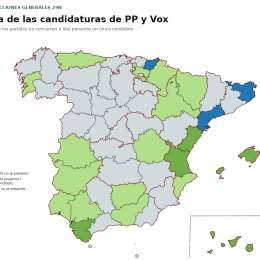
The event was held hours after the PP and Vox announced an agreement for the Senate lists. The agreement is structured in three blocks. In six provinces, Vox will not present its own candidates, but will be able to propose an independent to join the PP's candidacy.

In another 14 constituencies, Abascal's formation will limit its presence to a single candidate, compared to the three that the PP will present. Finally, the popular party will not run for the Senate in Guipúzcoa, Girona, and Tarragona. The objective is to counteract the effect of the coalition for the Senate of the PSOE and Frent e Amplio that are running together in most constituencies.
The polls speak

In the last general elections, the far-right party achieved 33 seats and the average of polls published in the last week places them at 67 representatives around 19%, which would be a historic result for the formation.

Although the leadership is cautious and expresses its distrust towards the polls, the trend is positive for Abascal's party. However, with the 23J in memory and a campaign that is expected to be very long ahead, they prefer to be cautious with the forecasts and "not to anticipate" hypothetical government majorities.

At the same time, at the internal level, the electoral floor they are working with is 16%. Within the formation, they are aware that a result below that figure would hinder the sum with the PP.

Clear symbolism

The choice of Talavera de la Reina to present the candidates of Vox for the 29N has not been casual. The provincial president of the party in Toledo, Daniel Arias, has referred in recent days to the battle of Talavera of 1809, during the War of Independence, as an example of defense of Spain. With this reference, Vox has also wanted to appeal to the moral and spirit of its voters, comparing the struggle of then with the one that, according to the formation, "must be fought now to regain the course of the country."

Manuel Mariscal, number one for Toledo, has assured that the one from his party has been the most numerous event that the municipality has hosted. From Vox, they also point out that 1,500 people have been left outside unable to enter the rally because the auditorium's capacity was filled early on. Before starting the rally, Abascal approached to greet all of them and addressed them with some words: "Let’s not take these elections for granted, let’s not think that Sánchez is already defeated. It depends on all of you, it depends on us."

WhatsApp Image 2026 10 26 at 19.38.01Abascal greets the crowd that could not access the venue | Vox

your face sounds familiar:

"We are conservatives even for this. Here we do not do experiments". This was the response of a member of the Vox leadership when asked by DEMÓCRATA about the preparation of the lists a few weeks ago. Now, with the heads of the lists already announced, the statement makes sense.

55.8% of the number ones for the 29N already held prominent positions in 2023, among leaders who repeat, change provinces, and candidates who rise from the second or third position.
More key points, information and questions with FREN

AI-GENERATED CONTENT

What is the next step in processing the agreement between PP and Vox for the Senate lists?

The next step is to formalize the candidacies before the Provincial Electoral Boards before 24:00 today, October 26. After that will come their publication, correction of possible defects, and official proclamation. It is not about processing the pact in the Senate, but about transferring the political agreement to the candidacies for the November 29 elections. (Demócrata, electoral calendar)

The political agreement is already closed

The most recent information from Demócrata indicates that Alberto Núñez Feijóo and Santiago Abascal gave the definitive approval to the understanding this Monday. Therefore, previous news that still placed it under negotiation have been surpassed by the announcement of the pact. The consulted sources do not show any additional internal ratification pending as a condition to apply it. (Demócrata, agreement closed)

The important distinction is that a national coalition with a joint brand has not been announced. The formula is a territorial coordination of candidacies: the deadline to communicate coalitions ended on October 16, but the presentation of candidates remains open until tonight. Therefore, the pending step is not to register a new PP-Vox coalition now, but to present the candidacies that materialize the agreement. (Demócrata, electoral formula)

What must be reflected in the candidacies
  • In six provinces: Vox will not present its own candidacy and the PP will incorporate an independent proposed by Vox, in second or third position. These are Las Palmas, Santa Cruz de Tenerife, Cádiz, Valencia, Castellón, and Illes Balears. (Demócrata, territorial distribution)
  • In three provinces: the PP will not present a candidacy for the Senate: Gipuzkoa, Girona, and Tarragona. (Demócrata, territorial distribution)
  • In fourteen others: Vox will present a single candidate. These are Sevilla, Huelva, Asturias, Badajoz, Álava, Navarra, Cáceres, Huesca, Zaragoza, Alicante, Granada, Cuenca, Pontevedra, and Jaén. (Demócrata, territorial distribution)
The calendar after presenting the lists

The next formal process has four milestones. It is advisable to distinguish the first publication of candidacies from their subsequent proclamation: initially appearing in the BOE does not mean that the electoral review has concluded. (Demócrata, electoral calendar)

  • October 26: the deadline to present candidacies ends at midnight.
  • October 28: the publication of the presented candidacies in the BOE is scheduled.
  • Review and correction: the boards will communicate detected or reported irregularities; the parties will have 48 hours from notification to correct defects.
  • November 2 and 3: the boards will have until the 2nd to proclaim the candidacies; the proclaimed ones will be published in the BOE the following day.

These dates and the correction period are included in the calendar published by Demócrata.

In short, the pact is announced, but its execution must be verified in the presented and proclaimed candidacies. The consulted sources do not yet confirm that all affected lists have completed both procedures. The decisive document to know the names and effective configuration will first be the publication on October 28 and then that of the proclaimed candidacies on November 3. (Demócrata, upcoming milestones)

What are the competencies of the president of Vox according to the party statutes?

According to the statutes published by VOX, the president exercises the legal and political representation of the party, presides over its main bodies, and directs and coordinates its activity at a superior level. He has broad organizational and executive powers, as well as an exceptional authority to intervene in crisis situations. These attributions coexist with the competencies of the collegiate bodies, especially the National Executive Committee (CEN).

Representation and presidency of bodies

The president represents VOX before public authorities, entities, institutions, courts, and natural or legal persons. This is the basis of his formal action on behalf of the party before third parties.

He is also responsible for presiding over the National Executive Committee and any other party bodies of which he is a member. It is important to distinguish between presiding over a body and individually exercising all its powers: when the statutes reserve a decision to the CEN, it corresponds to that collegiate body to adopt it.

Direction and superior coordination

The statutes assign the president the direction and superior coordination of VOX's action. To develop this responsibility, they list the following powers:

  • Execute the agreements adopted by the National Executive Committee, the Political Action Committee, the Management Committee, and other bodies of which he is a member. This function consists of carrying out decisions adopted by those bodies.
  • Issue internal orders and instructions related to the functioning of the party. This is an express organizational direction power, distinct from mere external representation.
  • Represent VOX internationally, without prejudice to delegating this function. Therefore, the statutes contemplate that international representation may be exercised by another person through delegation.
  • Direct the relationship with the Disenso Foundation, as a foundation linked to the party. The attribution refers to VOX's relationship with that entity and should not be confused with a general competence over all the foundation's decisions.
  • Appoint the general electoral representative, who depends on the National Electoral Office and represents the party in procedures related to the presentation of candidacies.
  • Exercise any other necessary powers for the proper fulfillment of his responsibilities. This general clause complements the previous attributions but does not eliminate the competencies assigned to other bodies by the statutes.
Exceptional powers in crises or conflicts

In case of crisis or conflict, the president may temporarily assume the competencies of any collegiate body of the party, except those of the National Executive Committee. This exception is relevant: the CEN is excluded from this possibility of presidential substitution.

The intervention is not indefinite either. It remains until the problem is resolved or the CEN meets. In that meeting, the measure must be justified and, if applicable, ratified. Therefore, it is an extraordinary, temporary power subject to the intervention of the national executive body.

What should not be confused with these competencies

In electoral matters, the expressly identified power is the appointment of the general electoral representative. It should not be equated with an automatic personal authority to approve all electoral lists: formal approval corresponds to the statutorily competent body.

Overall, the statutory design combines a presidency with broad powers of representation, direction, organization, and execution with decisions that remain collegiate. The reference for these attributions is the text of the statutes, also available from the VOX statutory page.

What results did the PP obtain in the last general elections and how many deputies does it currently have?

The People's Party obtained 137 seats in the last general elections held in Spain, on July 23, 2023. It received 8,091,840 votes, 33.05% of the valid vote, and was the most voted candidacy. The reference figure for its representation in the XV Legislature is also 137 deputies, although, as of October 26, 2026, it is advisable to distinguish that result from the situation of the Congress after the electoral call.

What result it achieved at the polls

The PP's data in the July 2023 general elections were as follows:

  • Votes: 8,091,840.
  • Percentage: 33.05% of the valid vote.
  • Deputies elected: 137.
  • Position: first force by votes and seats.

The PSOE obtained 121 deputies, so the difference between both formations was 16 seats. The result of 137 PP representatives also appears as a reference for the 2023 elections in comparisons published by Demócrata on October 12. That reference describes the electoral result, not an estimate of what might happen in the next elections.

What their 137 seats meant

The absolute majority in Congress is set at 176 deputies. Therefore, the PP lacked 39 seats to reach it alone. Being the candidacy with the most votes and representatives does not equate to having an absolute majority: these are two different ways to describe the result of an election.

The 137 seats allowed the PP to have the largest representation but not to reach that threshold alone. The relevant comparison to understand its result is, therefore, twofold: it was ahead of the PSOE by 16 deputies and below the 176 needed for an absolute majority.

How many deputies it currently has

If by "currently" you mean the size of the PP's representation from those elections, the usual answer is 137 deputies. That is the figure used during the XV Legislature to describe its presence in Congress, as reported by this information from Demócrata.

However, there is an important temporal nuance: the next general elections are scheduled for November 29, 2026. In this electoral period, the continuity of certain parliamentary functions corresponds to the Permanent Deputation. Therefore, the number of seats obtained by the PP in 2023 should not be confused with the number of members participating in that body, whose composition and functions are explained by Demócrata in this information.

Real results should also not be confused with polls. A survey may assign the PP more or fewer than 137 seats, but that projection does not change the result of the previous elections nor constitute a new distribution of deputies.

In summary: the PP won the general elections on July 23, 2023, with 8,091,840 votes, 33.05%, and 137 seats. 137 is the reference for its representation in the outgoing legislature; the new distribution will be determined in the November 29 elections.

Play

Test your knowledge with FREN!

How much do you know about this topic? Answer the following 3 questions.

Where did Santiago Abascal present the Vox lead candidates for the upcoming elections?

Question 1 of 3

What percentage of Vox lead candidates for 29N already held prominent positions in 2023?

Question 2 of 3

What is the electoral floor Vox is working with internally for the upcoming elections?

Question 3 of 3