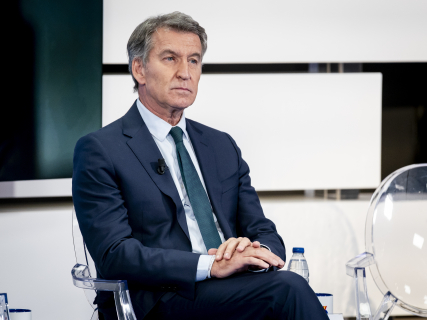
Feijóo holds Sánchez responsible for the rail crisis: "The bridge left, but Sánchez stayed"

The leader of the PP accuses the president of the Government of having chosen the heads of Transportes and Adif and assures that the minister’s resignation does not resolve management problems. At an event of La Razón, he promises to review public accounts and the railway system if he reaches La Moncloa

EuropaPress 7891600 presidente partido popular alberto nunez feijoo entrevista dirigida

EuropaPress 7891600 presidente partido popular alberto nunez feijoo entrevista dirigida

Add DEMÓCRATA to Google

Ask FREN

Published

Last updated

3 minutes

Most read

Elecciones 29N · Encuestas

La media de las encuestas

Media a 4 de noviembre de 2026 · 15 institutos

  • PP31,0 %
  • PSOE26,3 %
  • Vox19,5 %
  • Frente Amplio6,5 %
  • ERC2,5 %
  • Podemos2,2 %
  • SALF2,2 %
01020304050ene 2024jul 2024ene 2025jul 2025ene 2026jul 2026

Media del último estudio de cada instituto en 30 días y su evolución semanal desde el 23J. Partidos con al menos un 2 %.

Todas las encuestas

Elecciones generales del 29 de noviembre · Demócrata

The president of the PP and candidate for the general elections of November 29, Alberto Núñez Feijóo, has blamed this Wednesday Pedro Sánchez for the rail crisis and has warned that Óscar Puente’s resignation is not enough to clear political responsibilities for the accidents in Adamuz and Urda. During his speech at an event organized by La Razón in Madrid, the popular party leader accused the head of the Executive of having chosen the ministers who have run Transport during his eight years in government.

"Who appointed Óscar Puente and José Luis Ábalos is the same. That one didn’t leave," Feijóo said, summarizing his criticism with a phrase: "Mr. Puente left, but Sánchez stayed".

The PP leader has defended that rail problems are not solved only by changing the minister. "The problem is not with the ministers. The problem is with the management model that has led to the appointment of the ministers," he said, before calling for a change of Government.

His statements come one day after Puente’s resignation and on a day when the new head of Transport, Carlos Cuerpo, has addressed the handover at the presidency of Adif.

Feijóo accuses the Government of a management that "has a cost"

The popular candidate has devoted much of his speech to the two rail accidents that occurred this year, in which 115 people have died. In his view, the tragedies have revealed the consequences of the management of public infrastructure.

"The tragedies, first in Adamuz, now recently in Urda, have stripped bare the reality, as painful as it is unsettling, of what Spanish politics has been like over the last eight years," he said.

"Poor management has a cost", he insisted, before linking the lack of General State Budgets to the difficulties in planning investments and supervising public spending.

Feijóo also criticized the appointments made during the terms of Ábalos and Puente. He has accused the Executive of moving professionals out of the rail companies and has questioned the presence of people linked to previous officials of the ministry in the governing bodies of Renfe and Adif.

"It hasn’t cost us nothing to go from a corrupt minister to a tweeting minister," he said, referring to Ábalos and Puente.

The president of the PP has attributed to Sánchez the political responsibility for these decisions. "The person responsible for what happens in Spain and in important matters is a Government president who has been in power for eight years," he said.

He promises to review the public accounts and the railway situation

Feijóo has linked his criticism of the Government with the "national reconstruction" project that he wants to defend during the election campaign. He has announced that, if he arrives in La Moncloa, one of his first priorities will be to learn in detail the situation of the public accounts and the rail system.

He has also said that he will allow work to be carried out by experts, technicians and officials, and that he will demand responsibilities for the problems detected in public management.

"I will ensure personally that all those responsible for our country's systemic failure assume responsibilities," he promised.

The popular leader has insisted on the need to recover budget planning. "Spain needs Budgets, and it will have them," he said, after reproaching the Executive for having governed without approving new public accounts during the legislature.

In his view, the absence of Budgets makes it difficult to set priorities and control the destination of public resources. Feijóo has defended management based on respect for taxpayers' money, the balance between income and expenses, and the improvement of public services.

A "contract" with citizens and three electoral debates

The PP leader has also claimed the document of commitments that he presented weeks earlier as a candidate for the Presidency of the Government. He explained that it is not the electoral program, the drafting of which his party is finalizing, but an "agreement" with citizens.

His purpose, he said, is that "the word of the president of the Government has value" and that trust in institutions is restored.

Feijóo took advantage of the event to confirm his participation in the four-person electoral debate organized by Atresmedia. He also reiterated his commitment to take part in another debate on a private television station and in a third on public television.

"I like to keep commitments," he said.

In the final stretch of his remarks, he argued that Spain needs an Administration that works, protects citizens, and uses public resources with criteria of effectiveness.

"We are a wounded nation, but we are not a defeated nation," he said.

Feijóo has concluded his speech by assuring that his goal is to govern in order to solve the country’s problems and that he does not consider personal adversaries in his political rivals. "My enemies are the problems that harm Spain and its democracy", he said before opening the floor for questions.

More key points, information and questions with FREN

AI-GENERATED CONTENT

What is the current parliamentary status of the investigation into the Adamuz and Urda railway accidents?

As of November 4, 2026, the parliamentary investigation into Adamuz is not in an active hearing phase: its work was interrupted by the dissolution of the Cortes. Regarding Urda, which occurred after that dissolution, there is an initiative for the minister to provide explanations before the Permanent Deputation, but no specific investigative commission has been constituted nor parliamentary conclusions approved.

Adamuz: work carried out, but without approved conclusions

The main investigative instrument was the Senate's Investigation Commission on the state of the railway network in Spain. Its scope was broader than Adamuz and also included the Gelida accident; therefore, it should not be confused with a joint commission on Adamuz and Urda.

Hearings began on April 27, 2026. Senate documentation records the interventions of the president of the Railway Accident Investigation Commission, Ignacio Barrón, and the president of Adif, Luis Pedro Marco de la Peña, regarding both accidents and the state of the network. This is reflected in the official Senate information.

Representatives of operators and victims also appeared. Among the documented actions are the intervention of Mario Samper, president of the Adamuz victims association, on May 25, and that of the general director of OUIGO Spain, Amandine Thomas-Commin, on September 24. The latter is recorded in the Chamber's communication.

The decisive circumstance to understand the current status is Royal Decree 806/2026, of October 5, published on October 6, which dissolved the Congress and Senate and called elections. The dissolution ended the pending parliamentary work of that legislature: it is not simply a calendar pause. The consulted sources do not record a final report of conclusions approved before that closure. The dissolution decree can be consulted.

Urda: request for explanations, no commission constituted

The Urda accident occurred on October 28, when the Cortes were already dissolved. Therefore, it was not part of the previous hearings of the Senate commission on Adamuz and Gelida. It also cannot be automatically incorporated into work that had ended with the legislature.

The located parliamentary information indicates a registered appearance of the Minister of Transport and Sustainable Mobility before the Permanent Deputation of the Congress to explain the Government's management regarding Urda. However, it does not confirm that this appearance took place nor that a specific commission on the accident has been constituted. Registering a request for explanations does not equate to opening and developing an investigative commission.

What remains pending

In the next legislature, any new parliamentary investigation will require the corresponding agreements of the Chambers: the previous commission will not automatically resume. The documentation and hearings conducted are precedents but do not equate to approved political conclusions.

It is advisable to separate this parliamentary closure from the technical and judicial investigations, which do not end due to dissolution. According to Demócrata's information, Adamuz and Urda are investigated in independent judicial proceedings, in Montoro and Orgaz, respectively. In summary: Adamuz has an interrupted parliamentary investigation without located final conclusions; Urda has a control route before the Permanent Deputation, without an accredited own commission.

What are the legal powers of the Prime Minister of Spain regarding the appointment of ministers?

In the Spanish constitutional system, the Prime Minister plays a central role in the appointment and dismissal of ministers, but these powers are always exercised through formal acts of the King and within the limits set by the Constitution.

The main legal basis is found in the Spanish Constitution:

  • Article 98 CE: regulates the structure of the Government (prime minister, vice prime ministers, ministers, and other members established by law).
  • Article 100 CE: establishes that the other members of the Government are appointed and dismissed by the King, on the proposal of its president.
  • Article 62 CE: includes among the King's functions the appointment and dismissal of Government members, but always in accordance with the Constitution and laws, which implies the existence of proposal and countersignature.
1. Power of proposal over ministers

The key competence of the prime minister is the power of proposal. In practice, this means that:

  • The King does not choose ministers on his own initiative; he merely appoints and dismisses those proposed by the prime minister.
  • The prime minister decides who will be the persons forming the Government as ministers, as well as who should be dismissed.
  • This proposal is formalized in the corresponding royal decrees of appointment and dismissal, signed by the King and countersigned by the prime minister himself (politically and legally responsible for the act).

Therefore, legally, the prime minister does not "appoint" directly, but completely conditions the appointment and dismissal, as his proposal is essential and politically binding.

2. Configuration of the ministerial structure

Another essential competence of the prime minister is to determine the structure of the Government and, with it, the "map" of ministries on which appointments are projected. Specifically:

  • He can propose the existence of one or several vice prime ministers.
  • He can decide how many ministries there will be and with what names (for example, grouping or separating portfolios such as Economy and Finance, Education and Universities, etc.).
  • This configuration is usually set in a Royal Decree on the Government's structure, issued at the prime minister's initiative and approved by the King with his countersignature.

The consequence is that the prime minister not only chooses people but also designs the political organization that will then be filled with ministers. By changing the structure (creating, suppressing, or merging ministries), he conditions subsequent acts of appointment and dismissal.

3. Freedom of choice and limits

Within the Constitution, the prime minister's power of proposal is very broad:

  • The Constitution does not require ministers to be deputies or senators: they can be persons without a seat.
  • It does not set a minimum or maximum number of ministers.
  • It does not establish material suitability criteria beyond general ones (capacity to act, not being disqualified, etc.).

However, there are legal and political limits:

  • The constitutional framework must be respected (for example, prohibition of discrimination, incompatibilities, statute of senior officials, etc.).
  • The Government, including the selection of ministers, is subject to the political control of the Congress: if the composition causes a loss of parliamentary support, it can lead to censure or political crisis.
  • Appointment and dismissal acts are acts of the King countersigned; the prime minister's countersignature implies that he assumes political responsibility and, ultimately, legal responsibility as well.
4. Typical procedure for appointment and dismissal

In practice, the exercise of these powers follows a fairly stable scheme:

  • After the election and investiture of the prime minister by the Congress, the King formally appoints him by royal decree.
  • Then, the prime minister communicates to the King the list of ministers and, if applicable, vice prime ministers he proposes.
  • The royal decrees of appointment are issued, one for each minister or jointly, which are published in the Official State Gazette (BOE).
  • In case of subsequent reshuffles, the prime minister proposes dismissals and new appointments, which are formalized in new royal decrees.

In summary, the legal powers of the prime minister regarding the appointment of ministers can be synthesized as follows: he has the initiative and exclusive power of proposal over who enters and leaves the Government, decides the structure and number of ministries, and assumes political responsibility for those appointments and dismissals, which the King formalizes by royal decrees with his countersignature.

What has been Óscar Puente's political and professional trajectory before becoming Minister of Transport?

Before joining the Ministry of Transport and Sustainable Mobility in November 2023, Óscar Puente had practiced law for twenty years and developed his political career mainly in Valladolid. He was a councilor, PSOE leader, and mayor of the city for eight years. His national projection began as spokesperson of the Federal Socialist Executive and was reinforced with his election as deputy in 2023.

Education and professional activity

Born in Valladolid on November 15, 1968, Puente graduated in Law from the University of Valladolid and completed a master's degree in Political Management at the Jaime Vera Foundation. He practiced law between 1995 and June 2015, combining it during part of that period with his political responsibilities. He left professional practice upon assuming the Mayoralty, according to his official biography.

He also had a theatrical facet prior to his full dedication to institutions: he was an actor between 1988 and 1999 and performed in Madrid, Almagro, and Paris. This activity partially coincided with his early years as a lawyer, as noted in this profile by Demócrata.

Early responsibilities in the PSOE

He joined the PSOE in 1990 and began holding organizational responsibilities in 2004, when he was appointed deputy secretary general of the Provincial Executive of Valladolid. In 2007 he obtained his first councilor seat and, in 2008, assumed the presidency of the Socialist Municipal Group. In 2009 he became secretary general of the Municipal Executive, a position he held until 2021. These milestones are recorded in his ministerial biography.

Eight years as Mayor of Valladolid

After eight years as an opposition councilor, he reached the Mayoralty in June 2015. Although the PP had been the most voted force, Puente gathered the necessary support to form an alternative municipal majority. In 2019, the PSOE won the local elections and he continued as mayor for a second term, according to the reconstruction of his trajectory published by Demócrata.

During this stage, he also held municipal responsibilities: he presided over the Spanish Network of Healthy Cities of the Spanish Federation of Municipalities and Provinces between 2015 and 2019; he was a member of its Governing Board between 2019 and 2023; and represented the federation in the Urban Initiatives Network between 2020 and 2023. His biography also records the first vice presidency of the Ibero-American Organization of Intermunicipal Cooperation, according to La Moncloa.

National projection and arrival at Congress

Between June 2017 and October 2021 he was spokesperson of the Federal Executive of the PSOE, after supporting Pedro Sánchez in the 2017 primaries. He combined that role with the Mayoralty, adding party public communication on national matters to municipal management, according to Demócrata.

In the May 2023 municipal elections, the PSOE was again the most voted force in Valladolid, but the agreement between PP and Vox allowed Jesús Julio Carnero to access the Mayoralty. Puente then led the socialist candidacy for Valladolid in the July general elections and obtained a seat in Congress. In September, he spoke for the PSOE in the investiture of Alberto Núñez Feijóo, an intervention that increased his national notoriety, as explained by Demócrata.

His incorporation into the Government in November 2023 thus culminated a path combining legal experience, party leadership, and municipal management, with a still brief parliamentary stage.

Play

Test your knowledge with FREN!

How much do you know about this topic? Answer the following 3 questions.

Who has held Pedro Sánchez responsible for the railway crisis following Óscar Puente's resignation?

Question 1 of 3

How many people have died in the railway accidents mentioned by Feijóo?

Question 2 of 3

What has Feijóo promised to do if he reaches La Moncloa?

Question 3 of 3