

The leader of the PP starts today, along with Xavier García Albiol a tour of visits to the areas affected by street violence. The incidents in Barcelona, A Coruña, Pamplona and Bilbao, with attacks on police and damage to businesses, open a debate about the response of the Interior and the competencies of the regional police.
Alberto Núñez Feijóo has decided to make citizen security one of the main axes of his campaign for the general elections on November 29. The president of the Popular Party will begin in Barcelona, accompanied by Xavier García Albiol, a series of visits to places affected by episodes of street violence, with the intention of understanding the damages suffered by merchants and neighbors and conveying his proposals to reinforce public order.
The initiative, according to popular sources consulted by DEMÓCRATA, also responds to a political conviction: the PP believes that the government of Pedro Sánchez is not making the necessary decisions to guarantee safety on the streets.
The choice of Barcelona is not casual. The city has just recorded disturbances that have resulted in 128 detainees, 72 of them minors, fifteen police officers injured, 23 businesses vandalized, and 33 interventions by firefighters due to fires.
The call, mainly disseminated through TikTok, reproduced formulas of youth mobilization observed previously in France and ended with barricades, looting, and attacks against the Mossos d'Esquadra.
For the PP, the events in Barcelona cannot be analyzed in isolation. In recent days, violent episodes have been recorded in Coruña, Pamplona, and Bilbao, some linked to protests against Vox events or against the presence of Vito Quiles. Although their triggers are different and there is no accredited common organization, the incidents present a shared element: assaults or attacks against agents, disturbances of public order, and damage to public and private property.
In this campaign, the Galician leader wants to bring that diagnosis to the electoral field. His strategy consists of visiting the scenes of the disturbances, listening to those affected, and questioning the institutional response. The popular leadership maintains that it is not enough to condemn violence once it has occurred and demands a preventive and coordinated action from public authorities.
Featured story
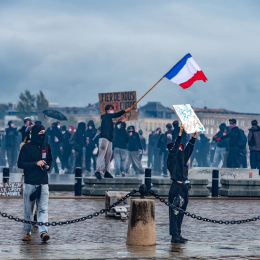
France raises the number of detainees in Paris to 142 after the protests on Saturday
1 minute
Featured story
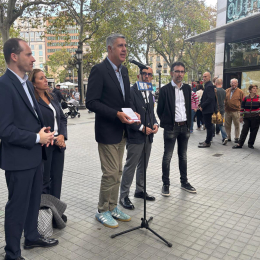
Albiol, "convinced" that the PP-Vox pact will come together to run jointly for the Senate
1 minute
The PP points to the Government: it is not enough to condemn the disturbances
The criticism that the PP directs at the Executive goes beyond the damage caused by violent protesters. The popular party considers that the central Government should exercise its security competencies with greater determination and guarantee an institutional response capable of preventing disturbances, protecting agents, and avoiding that protests lead to attacks against people and properties.
In this line, Feijóo has spoken out after the incidents in Bilbao. The popular president condemned what he described as a new attempt at intimidation by the violent left and linked his electoral proposal to the need for a Government that guarantees order and security. His message aims to place the actions of Sánchez's Executive under scrutiny on an issue that directly affects the daily lives of citizens.
The PP's approach therefore incorporates a specific political demand: that the authorities do not limit themselves to reacting when incidents have already occurred, but that they anticipate risk calls, reinforce devices when necessary, and ensure coordination between administrations.
However, the operational responsibility does not always correspond to the Ministry of the Interior. In Catalonia, the ordinary maintenance of citizen security mainly falls on the Mossos d'Esquadra, dependent on the Generalitat. In the Basque Country, that function corresponds to the Ertzaintza, under the authority of the Basque Government. In Navarra, both the Foral Police and the National Police intervene, while in Galicia the National Police depends on the Ministry of the Interior.
Hence, the political question that Feijóo wants to raise is broader: whether the set of administrations is providing a sufficient response to a succession of violent episodes and what changes should be introduced to prevent them.
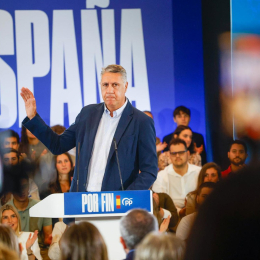
Barcelona, first stop: 128 detained and a mobilization inspired by France
The incidents recorded on Saturday, October 24, in the center of Barcelona constitute the largest episode by number of detainees.
Hundreds of young people gathered in Plaça de Catalunya after a call spread through social networks. Many were dressed in black and some had their faces covered. What began as an uncommunicated concentration ended with the throwing of objects, fires of urban furniture, and vandalism against commercial establishments.
The known balance is especially significant: 128 arrested, 72 minors, 23 affected businesses, and 33 interventions for fires. The Mossos also filed reports for the seizure of knives, aerosols, balaclavas, pyrotechnic material, and stones.
The mobilization presents similarities with the phenomenon known as Blocus, spread through social networks and related to youth convocations recorded in France. However, that similarity does not prove that the Spanish incidents are directed from abroad nor that there is a common organized structure.
The mayor of Barcelona, Jaume Collboni, described the mobilization as suspicious and emphasized that it did not respond to a conventional protest. He also initially estimated the damages caused to the burned urban furniture at around 36,000 euros.
A Coruña: twelve injured police officers during protests against Abascal
In A Coruña, the origin of the incidents was different. On October 21, about 5,000 people, according to police figures collected by EFE, participated in a concentration against an event by Santiago Abascal in María Pita square.
The National Police deployed a device to separate the demonstrators from the attendees of the Vox event. At the end of the call, a group of people, some hooded, began to throw stones, chairs, and firecrackers at the police cordon.
The confrontations resulted in two arrests, twelve injured officers, several injured demonstrators, and two journalists hit by objects. The officers carried out charges and used riot control material.
The police action also provoked criticism from some organizing groups, which denounced a disproportionate use of force. That controversy does not alter the fact that attacks against officers occurred.
Unlike Barcelona, in A Coruña the National Police depended directly on the Ministry of the Interior, so the decisions regarding the device and its planning are situated within the state security structure.
Pamplona: three arrested and four injured police officers
Navarra has also recorded episodes of violence associated with political and media convocations.
On October 15, the presence of Vito Quiles in the vicinity of Yamaguchi park in Pamplona triggered protests that ended with the throwing of stones and bottles, overturned containers, and police charges.
The subsequent balance raised to three the people detained, one of them a minor, and four the agents of the National Police injured lightly. The operation involved members of the National Police and the Foral Police.
The Government delegate in Navarra, Alicia Echeverría, condemned the incidents and defended that ideological discrepancies should be expressed through democratic procedures and without resorting to violence.
The episode illustrates one of the issues that the PP wants to convey to the campaign: how to ensure that public events can be held safely and prevent a part of the participants in the protests from imposing their positions by force.
Bilbao: attacks on the Ertzaintza even after the event was canceled
Bilbao experienced this Monday one of the most recent episodes. A mobilization against the presence of Vito Quiles in the vicinity of the University of Deusto ended with barricades, burning vehicles, damage to businesses, and throwing stones at agents of the Ertzaintza.
The most relevant fact is that the event of Quiles had been canceled before the most serious disturbances occurred. The Department of Security of the Basque Government interpreted this circumstance as an indication that those who carried out the attacks sought to provoke public order disturbances regardless of the celebration of the meeting.
The final balance released this Tuesday by the Ertzaintza places at 17 the detained, ten of them minors, and one person under investigation. None of the arrested had been previously detained by the Basque Police. The investigation remains open to identify other possible participants.
According to official information, among the arrested are Spanish citizens and people of other origins.
In this case, the responsibility for the operation corresponded to the Ertzaintza, dependent on the Basque Executive, whose lehendakari, Imanol Pradales, condemned the disturbances.
Who are behind the disturbances: young people, radicals, and different profiles
One of the questions that the authorities raise is who is behind these episodes and to what extent there is the capacity for organization to transfer violent calls from one city to another.
The available data does not allow for a discussion of a unique profile. In Barcelona, 72 of the 128 detainees were minors and only two had a history of public disorder, according to the report from the Mossos. In Bilbao, the 17 arrested were between under 18 and 25 years old, and none had been previously detained by the Ertzaintza.
In A Coruña and Pamplona, for their part, the incidents occurred during protests called against specific acts or public presences, in which diverse groups participated as well as groups of hooded individuals who confronted the Police.
The presence of anti-system groups in certain episodes and the references to participants from different backgrounds do not authorize attributing a common identity to all those involved. Investigations must establish who organized each call, who participated in the attacks, and whether there were coordination mechanisms among those responsible for the violent acts.
Radical groups and organized calls behind the disturbances
Police investigations and statements from authorities point to the participation of radical groups and the preparation of violent actions in some of the disturbances recorded in Bilbao, Pamplona, and Barcelona.
In the Basque Country, the Minister of Security, Bingen Zupiria, has indicated that the young people involved may have followed directives from radical organizations, while the lehendakari, Imanol Pradales, has denounced the actions of hundreds of organized radicals. The altercations continued even after the event of Vito Quiles was canceled.
In Pamplona, according to what the EFE Agency published, GKS Iruñerria was identified among the organizers of the protests on October 15, while Diario de Navarra described the coordinated actions of groups dressed in black who threw objects at the Police.
In Barcelona, messages prior to the disturbances were also located with instructions to attend with balaclavas, gloves, and flares, as well as conversations about thefts. The Mossos are investigating who managed the anonymous accounts of Blocus, without any specific organization's responsibility being accredited so far.
The planning of police devices has also sparked criticism. According to El Español, the Mossos were aware of the call in Barcelona a week in advance, although they did not foresee the magnitude of the incidents. In Bilbao, the police union ErNE has questioned the early withdrawal of forces when there was still a risk of disturbances. The possible involvement of organized groups in the mobilization of young people, many of whom have no prior records, continues to be the subject of investigation.
The debate on the Interior: prevention, coordination, and support for the agents
The strategy of the PP places the Ministry of the Interior before a fundamental political question: what instruments should be used to prevent known gatherings from turning into episodes of violence.
In operational terms, the prevention of disturbances depends on several factors: the available police information, risk assessment, the size of the device, the separation of opposing gatherings, the protection of establishments, and the capacity for intervention at the first incidents.
It also requires cooperation between police forces and administrations, especially when calls are spread through social networks and can be reproduced in different cities.
The PP believes that the institutional response must be firmer and more coordinated, but the accusation that the Government is not issuing the pertinent orders requires distinguishing between a disagreement over security policy and the existence of specific operational instructions that have been omitted.
The devices deployed in Barcelona, A Coruña, Pamplona, and Bilbao demonstrate that the police did intervene, made arrests, and, in some cases, suffered numerous injuries. The debate, therefore, is not about determining whether there was police action, but whether the planning, resources, and decisions of the competent authorities were sufficient to prevent or contain the incidents.
The judicial response is also part of that discussion. Police arrests do not equate to convictions, and the alleged crimes of public disorder, damage, or assault against agents must be proven in the corresponding procedures. In cases involving minors, specialized jurisdiction also intervenes.
A 48-hour deadline
Feijóo wants to broaden the concept of security beyond disturbances. His approach also incorporates the protection of private property and the fight against the illegal occupation of housing.
The popular president has announced his intention to promote new legislation that facilitates the eviction of illegally occupied properties within a period of 48 hours, along with reforms of the Land Law and the Horizontal Property Law.
The party aims to link these proposals with a broader agenda of legal security, coexistence, and protection of property owners. However, these are distinct legal issues: the illegal occupation of a property, home invasion, and conflicts arising from rental non-payment do not have the same legal treatment nor can they be resolved through a single procedure.
The PP presents these reforms as part of its commitments for the first months of a potential Government. Their effective scope would depend on the drafting of the regulations, judicial guarantees, and the resources available to implement them.
A campaign that will bring security to the neighborhoods
The tour that Feijóo will start in Barcelona responds to the PP's desire to move the debate on security outside of conventional party events.
The popular leadership wants the candidate to listen directly to the merchants who have suffered damages, to the neighbors who demand greater protection, and to the professionals responsible for maintaining public order.
The main political accusation that Feijóo will direct at the Government is that Spain needs a more decisive response to violent behaviors and an institutional coordination that allows for their prevention. The Executive, for its part, has condemned the incidents and defends the actions of the police forces, so the discussion will likely shift to the sufficiency of the devices, the competencies of each administration, and the measures proposed by each party.
Barcelona will be the first stop of a strategy that the PP intends to maintain until the elections on November 29. The succession of disturbances has provided Feijóo with a new issue for political confrontation with Sánchez, but also an institutional debate: how to guarantee the right to protest without violence impeding the exercise of other freedoms or compromising the safety of citizens and the agents themselves.