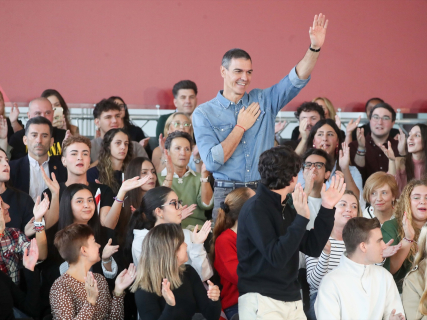

Pedro Sánchez has arrived this Sunday in Ponferrada with the campaign already fully launched. Barely 24 hours after his first rally in Dos Hermanas, the secretary general of the PSOE has filled the Turbinas Room of La Térmica Cultural to try to turn the start of the pre-campaign into a call to mobilization ahead of the general elections on November 29. He was accompanied by the leader of the socialists of Castilla y León, Carlos Martínez, the regional deputy secretary Nuria Rubio, and the secretary general of the PSOE of León, Javier Alfonso Cendón, in an event with the slogan "The strength of the people" and with an audience also outside the venue, according to local reports.
The most forceful moment of Sánchez's speech came when he resumed the controversy over the vote by mail, one of the first battlefields of the pre-campaign. The president has accused the right of resorting to "lies, insults, and cuts" and has focused his response on Alberto Núñez Feijóo, who presided over Correos between 2000 and 2003 and who this week claimed to trust "fully" in mail carriers and public employees, but not in the current executives of the company.
"In Feijóo, even Feijóo does not trust"
Sánchez has precisely used the past of the popular leader at the head of the postal company to respond to him. After sarcastically recalling that Feijóo held the Presidency of Correos when Francisco Álvarez-Cascos was minister, he concluded: "And we have heard Mr. Feijóo say: 'I do not trust the executives of Correos.' So, it is clear to us, Alberto: even Feijóo does not trust Feijóo. It will be true that he is not president because he does not want to be". The phrase provoked one of the biggest reactions from the audience and served the socialist candidate to link with the argument that the PSOE intends to establish from the start of the campaign: that PP and Vox are trying to sow distrust about the electoral process.
The origin of the controversy lies in the statements made in recent days by popular leaders. Isabel Díaz Ayuso went so far as to ask that "no one should even think about voting by mail" if they can do it in person, while Feijóo announced that the PP will propose to the Central Electoral Board "additional measures" to increase the guarantees of postal voting. The popular leader has insisted that his concerns are directed at the management of Correos and not at its workers. The PP itself has maintained different messages: Borja Sémper has defined the system as "guaranteeing," while other leaders have recommended going in person to the polls in case of doubts.
Voting by mail, in any case, is subject to various identification controls, inclusion in the census, custody, and delivery at polling stations. So far, no irregularities related to the 29-N process have been accredited that support the possibility of electoral fraud.
Sánchez places Feijóo and Abascal in the same block
The criticism of Feijóo has not been an isolated episode. Sánchez has tried throughout his intervention to present the PP and Vox as a single block and to contrast it with a progressive majority that, in his opinion, must mobilize again. "Opposite we have those of no, those of blockage, Feijóo and Abascal, Abascal and Feijóo, it doesn't matter, both are the same," he stated before calling for a socialist majority at the polls.
The president has even acknowledged, in an ironic tone, that he probably does not come across as likable to his opponents. "I know that they don't like me. What can I do? I can't be liked by everyone," he said, before demanding both parties "something to propose" beyond their rejection of the Government. The strategy connects with the message launched a day earlier in Dos Hermanas, where Sánchez called for "full ballot boxes" and accused the PP and Vox of trying to demobilize citizens.
Pensions and equality to defend the Government's balance
Sánchez has also used Ponferrada to defend the social balance of his governments. Before an audience with a significant presence of retirees, he contrasted his pension policy with that of the PP and highlighted that they have been revalued according to the CPI. He also stated that the so-called pension fund will reach 20 billion euros in 2026, a figure he has used to claim the sustainability of the system.
The second chosen ground has been equality. Sánchez has defended the funding of the State Pact against Gender Violence, the legislation on parity, and the salary measures approved during his term. "50% of the population are women. So 50% of economic, social, and political power for women," he proclaimed. With this, he has tried to convey to Ponferrada the main axes with which the PSOE wants to articulate its campaign: housing, pensions, social rights, and equality, against an opposition that he accuses of fundamentally proposing a repeal agenda.
Carlos Martínez claims Nevenka and the "workers' struggle"
Before Sánchez, the floor was taken by Carlos Martínez, Secretary General of the PSOE of Castilla y León, who has built an intervention much more linked to the territory. The socialist leader has claimed the working-class identity of Ponferrada and El Bierzo and has defended the role of unions as organizations capable of "channeling" that struggle. The choice of La Térmica Cultural, built on the industrial and mining past of the region, has also served as a symbolic setting for that message.
Martínez has also reserved part of his speech for Nevenka Fernández, former councilor of Ponferrada who reported then-mayor Ismael Álvarez for sexual harassment and whose case ended with a conviction. The socialist leader has defined her as a "pioneer" of the feminist struggle and has recovered her figure precisely in the city where one of the cases that marked the debate on sexual harassment in Spain occurred. "Ponferrada never fails, El Bierzo never fails, and León never fails," Martínez proclaimed before the attendees.
The regional leader has also celebrated that part of the audience could not access the venue due to lack of space and has promised to seek a larger capacity in future visits. It was a way to reinforce the mobilization message that ran through all the interventions and that the PSOE needs to convey now to the polls, especially in a Castilla y León where Martínez improved the socialist result in the regional elections of March, although the PP of Alfonso Fernández Mañueco was again the first force.
From "Mission Impossible" to the comeback of 29-N
The morning had begun even earlier with a cinematic metaphor. Javier Alfonso Cendón, leader of the Leonese PSOE, compared Sánchez to Tom Cruise in "Mission Impossible" and predicted a new electoral comeback. "The legend continues," he stated. Nuria Rubio, for her part, called to recover "class consciousness" and assured that "there is a match," with the aim of concentrating the progressive vote around the PSOE.
The tone summarizes well the moment in which the party finds itself. The event in Ponferrada has been Sánchez's second rally after announcing the advance of the general elections, and it comes with most polls placing the PP and Vox bloc ahead. The PSOE intends to respond with a campaign especially focused on its candidate and on mobilizing an electorate that it still considers recoverable.
Ponferrada has served to begin to outline that strategy. Carlos Martínez has contributed the territorial, worker, and feminist component; Sánchez has taken the discourse to the national confrontation with Feijóo and Abascal. And, above all issues, the mail-in vote has provided the phrase of the day. Sánchez has turned the doubts expressed by Feijóo about the direction of Correos into a personal attack against the popular candidate: "Even Feijóo does not trust Feijóo." With seven weeks to go until the 29-N, the tone of the pre-campaign already resembles that of a campaign in full swing.