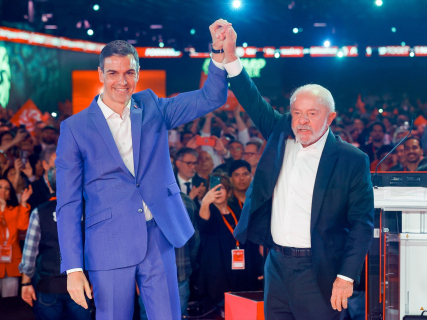

The victory of Luiz Inácio Lula da Silva in the presidential elections of Brazil has given the PSOE a new political argument just over a month before the general elections on November 29. Pedro Sánchez has celebrated the comeback of the Brazilian leader against Flávio Bolsonaro and has drawn a parallel with the Spanish electoral situation, while the socialists have begun to use the result to call for the mobilization of their supporters. One of the keys to the Brazilian campaign has precisely been in social networks, where the deputy André Janones has promoted a community of millions of people around Lula's candidacy.
The Brazilian president has obtained 51.79% of the votes against 48.21% of Flávio Bolsonaro, after having finished behind his rival in the first round on October 4. In just three weeks, Lula has managed to add more than ten million votes to his candidacy and reverse a disadvantage that had complicated his reelection.
"What has happened in Brazil will happen in Spain. The comeback of global progressivism has just begun," Sánchez has written on his X account. The PSOE has also celebrated the result with a message linking the Brazilian victory to the Spanish electoral date, while leaders like María Jesús Montero have interpreted the triumph as a response to the advance of the far right.
The PSOE turns Lula's victory into a call to its volunteers
The socialist leadership has gone a step further than institutional congratulations and has conveyed a message of mobilization to its membership inspired by the Brazilian result. In a campaign communication, the party has celebrated that Lula has won the elections and has presented his victory as an example of what can be achieved through the organized participation of supporters.
"A victory like this is not achieved alone", the message states, highlighting the work of those who organize, mobilize, and try to convince the undecided. The communication directly links the Brazilian result with the Spanish elections and encourages the recipients to join as volunteers for the November 29 campaign.
The email, accompanied by an image of Pedro Sánchez and Lula and a button to sign up for the campaign, contrasts the political projects of both countries and presents the two leaders as representatives of the same progressive orientation. It also insists on the capacity of personal mobilization to expand electoral support, an idea that has played a prominent role in the Brazilian strategy.
The coincidence between both messages is significant. While the PSOE tries to activate its supporters for the Spanish elections, Lula's campaign has managed to transform a digital community into an organized network for dissemination and electoral participation, although the characteristics of both political systems and their respective campaigns are different.
André Janones, the deputy behind Lula's Army
One of the most prominent images of the Brazilian electoral celebration has been Lula's recognition of André Janones, federal deputy from Minas Gerais and one of the main responsible for digital mobilization during the second round.
Janones has promoted the so-called Lula's Army, a WhatsApp channel that, according to the figures released about the campaign, has grown from about 50,000 followers in the first round to reach ten million during the second. The initiative has served to coordinate the activity of supporters and extend electoral messages to different platforms.
Lula himself has publicly acknowledged Janones' work during the celebration of his victory, where he referred to him as "our general" and highlighted his contribution to mobilizing supporters of the candidacy.
The deputy, son of a domestic worker and a father with a disability, trained as a lawyer after working to finance his studies, among other occupations such as a bus fare collector. His political career has been accompanied by intense activity on social media, where he has developed a direct and confrontational communication style.
His strategy has consisted of using WhatsApp not only as an information channel but as a coordination tool. Participants received content to share, publication proposals, and actions aimed at increasing the dissemination of Lula's messages on other platforms.
From WhatsApp to Instagram and X, the strategy to expand the campaign
The mobilization driven by Janones has gained special relevance after the first round, when the electoral result forced Lula to review his communication strategy and seek new formulas to reach voters.
The so-called Army of Lula has functioned as a content distribution network that sought to move political conversations to other digital spaces and to the personal contacts of its members. Among the promoted actions were sharing videos on Instagram, boosting hashtags on X, spreading messages among family and friends, and incorporating new participants into the channel.
The strategy has tried to contest the digital conversation against bolsonarism, which had developed a significant presence on social networks and messaging applications over the years. In the face of communication based exclusively on the official profiles of the party, Lula's team has resorted to a distributed structure in which the followers themselves contributed to multiplying the reach of the content.
Janones has also promoted a less institutional communication around Lula, encouraging him to participate in more informal formats and to use digital tools. Among the anecdotes of the campaign is the delivery of a mobile phone to the Brazilian president, after the deputy insisted on the importance of reinforcing his digital presence.
Another of the initiatives associated with Janones has been the recovery of the yellow jersey of the Brazilian national team as a shared symbol, after years of identification with the bolsonarist movement. Lula's campaign has tried to contest that political association and reclaim national symbols beyond electoral preferences.
The controversy with Meta over the treatment of Lula and Bolsonaro during the campaign
Lula's digital strategy has developed amid a controversy over the functioning of the platforms of Meta, owner of Facebook, Instagram, and WhatsApp. The campaign of the Brazilian president has accused the multinational technology company of favoring Flávio Bolsonaro through its recommendation systems and of harming the dissemination of content from the progressive candidate, accusations that the company has rejected.
The controversy took on a new dimension after the Brazilian newspaper Folha de S.Paulo published on October 16 a investigation based on internal communications from Meta workers. According to those documents, employees of the company acknowledged that Lula's accounts had suffered restrictions on Instagram, while the platform's recommendation systems had given visibility to Flávio Bolsonaro's profile.
One of the highlighted episodes occurred on October 9, when Lula's campaign was unable to promote certain Instagram posts for almost 24 hours. According to the published information, the incident could have reduced the potential reach of their ads by around 1.3 million people.
The internal communications also noted that Flávio Bolsonaro's profile appeared recommended in Instagram searches and that his WhatsApp channel could appear among the results when users searched for the so-called Lula's Army. These recommendations were particularly controversial due to Brazilian electoral restrictions on the algorithmic promotion of candidates' profiles and channels.
Meta acknowledged the existence of technical problems but denied that they were due to a political decision. The multinational assured that the incidents had affected different accounts and advertisers and rejected any accusations of deliberate interference in the Brazilian elections.
Meta's artificial intelligence also reached the Electoral Justice
The accusations against the company were not limited to the distribution of posts. Lula's campaign also questioned the functioning of Meta AI, the artificial intelligence tool integrated into WhatsApp, after several users reported differences in the responses generated about the two presidential candidates.
According to the complaints circulated during the second round, the tool rejected certain requests for creating images related to Lula, while it accepted similar requests when his name was replaced with Flávio Bolsonaro's.
The controversy reached the Superior Electoral Court of Brazil, which demanded explanations from the company about its mechanisms for distributing political content. A judicial resolution also ordered to avoid unjustified restrictions on the publications of both candidates and established that Meta AI should not favor any of the candidacies in its responses related to the elections.
On October 20, Meta presented to the Electoral Justice a document detailing 17 measures aimed at ensuring equivalent treatment of the two campaigns. Among them were human review of certain advertising accounts and mechanisms to quickly examine the automatic restrictions applied to the candidates.
The confrontation has highlighted the importance of moderation decisions and recommendation systems of large technology platforms during electoral campaigns. However, the reported incidents do not in themselves demonstrate that Meta institutionally supported Bolsonaro, an interpretation that the company has rejected.
Lula's Army was also under investigation
The dispute for control of the digital conversation also directly affected André Janones. On October 11, the Superior Electoral Court ordered the temporary suspension of his WhatsApp channel, at the request of Flávio Bolsonaro's candidacy, which questioned some of the activities carried out by the community.
Janones denounced the decision as an act of censorship and continued to defend the role of the channel as a tool for political mobilization. Lula's Army subsequently resumed its activity and continued to grow in the days leading up to the runoff.
On October 22, the president of the Superior Electoral Court, Kassio Nunes Marques, intervened again and granted Meta a period of 24 hours to present information about the operation of the channel. The Justice wanted to determine if there were irregular coordinated behaviors, systematic replication of content, or actions contrary to the platform's rules.
In its preliminary response on October 23, Meta stated that it had not found evidence of coordinated inauthentic behavior or violations of its rules by Lula's Army in the examined content. Nevertheless, the company requested more time to complete the analysis of other publications provided by Bolsonaro's candidacy.
The confrontation reflected to what extent technological platforms had become a battleground for electoral dispute in Brazil. While Lula's campaign denounced restrictions and an alleged unequal treatment, Bolsonaro's candidacy questioned the digital coordination driven by Janones.
A digital strategy that has also generated controversy
Janones' prominence has not been without controversy. His communication style, characterized by confrontational messages and intense activity on social media, has generated reservations even among sectors of the Brazilian left, concerned about the risks of reproducing some of the political communication practices used by their adversaries.
During the campaign, Flávio Bolsonaro's team reported to the Brazilian Electoral Justice the channel Ejército de Lula for the alleged dissemination of false information. Janones rejected the accusations and a technical report did not find, in the publications examined between October 2 and 11, the alleged claims. The deputy had also previously been involved in controversies for the dissemination of content questioned by independent fact-checkers.
The digital mobilization, in any case, does not explain alone the electoral comeback. Participation, the social policies of the Brazilian government, and Lula's ability to attract voters who had not supported him in the first round are also part of the analysis of the result.
The Brazilian experience has shown the potential of messaging applications to organize large political communities and coordinate the dissemination of electoral messages. However, it is difficult to measure how many concrete votes can be attributed to a digital strategy, especially when economic, social, and political factors intervene simultaneously.