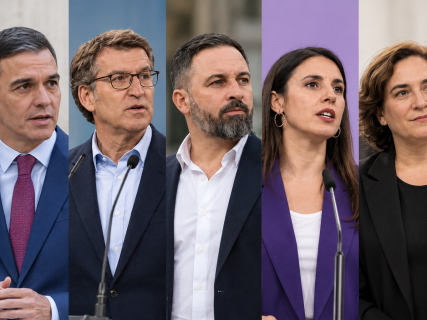

Political parties have found in microcredits a formula to finance their election campaigns without depending exclusively on bank loans. Less than three weeks before the general elections of November 29, Vox and PSOE offer their supporters interest rates higher than the official rates of the European Central Bank (ECB) in exchange for advancing them money to cover election expenses, while Podemos and Izquierda Unida have opted to request non-remunerated loans.
The highest offer corresponds to the party of Santiago Abascal, which pays a 4.25% annual interest rate, compared with the 3.75% offered by the socialists. Both percentages exceed the 2.5% at which the ECB’s deposit facility is currently set, the main benchmark for eurozone monetary policy since the last rate increase, applied in September.
The difference is 1.75 percentage points in the case of Vox and 1.25 points for the PSOE. Between the two formations there is, in addition, a distance of half a percentage point, although the interest that the lenders ultimately receive will depend on the time that elapses until the money is repaid.
The mechanism allows parties to obtain liquidity before the elections and to return the amounts received once they collect the corresponding public subsidies for their election results. Unlike donations, microcredits create an obligation to repay, with or without interest depending on the conditions of each formation.
Vox offers 4.25% and the PSOE 3.75%
Vox has launched a microcredit campaign with contributions ranging between 100 and 10,000 euros. The formation offers a fixed annual interest rate of 4.25% and ties repayment to the effective collection of election subsidies.
The PSOE, for its part, offers 3.75% per year and sets a maximum term of twelve months from the holding of the elections to repay the loans. The socialists already used this formula in previous calls, although then they offered lower remuneration: 2.5% in 2019 and 3% in 2023.
The increase is especially significant when compared with the ECB rates. Currently, the deposit facility stands at 2.5%, while the rate for the main refinancing operations is at 2.65%. If this second benchmark is used, the interest offered by Vox and PSOE is also higher, although the spread is reduced to 1.60 and 1.10 percentage points, respectively.
The comparison serves to gauge the remuneration offered by both parties, but it does not mean that citizens can obtain a deposit directly at 2.5% at the ECB. This facility is reserved for credit institutions and electoral microloans carry a different risk from that of traditional banking products.
How much parties pay for their microloans
The following table shows the terms announced for the 29N elections and their difference with respect to the ECB deposit rate.
| Party | Annual interest | Difference with the ECB |
|---|---|---|
| Vox | 4.25% | +1.75 points |
| PSOE | 3.75% | +1.25 points |
| Podemos | 0% | -2.50 points |
| Izquierda Unida | 0% | -2.50 points |
| ECB (deposit facility) | 2.50% | Reference |
Annual rates announced for the 29N campaign. Comparison with the ECB deposit facility in force on November 9, 2026.
How much a citizen can earn by lending 1,000 euros
The difference between the announced interests can be seen when calculating the remuneration of a 1,000-euro loan over a full year. In that scenario, Vox would pay 42.50 euros gross and PSOE, 37.50 euros.
However, electoral microloans are usually repaid when the parties receive public subsidies, so the loan may remain outstanding for less than twelve months. If it were repaid after six months and a proportional calculation of simple interest were applied, the remuneration would be 21.25 euros gross in Vox and 18.75 euros in the PSOE.
These amounts must be offset by the corresponding tax withholding. In general, the interest is subject to an IRPF withholding of 19%, so the net amounts received would be lower.
In addition, repayment is not guaranteed by a deposit guarantee fund. The citizen lends money directly to a political organization and assumes the risk that it may not be able to meet its obligations within the timeframes set.
Podemos and IU ask for money without paying interest
Podemos and Izquierda Unida have also turned to microcredits to finance the 29N campaign, although with a fundamental difference from Vox and PSOE: they offer no financial compensation to those who lend them money.
Podemos has used this tool since its first election campaigns and defends it as an alternative to bank financing. For these elections, it has set a fundraising target of 600,000 euros and, according to data published on November 2, it had already raised 496,617 euros.
The party links repayment of the loans to the receipt of electoral subsidies. If these prove insufficient, it considers a period of twelve months from the elections to repay the outstanding portion.
Izquierda Unida also requests interest-free contributions and plans to repay them after receiving the corresponding public funding. As the party explains, electoral subsidies are usually paid between six and twelve months after election day.
Más Madrid has likewise set up a microcredit campaign for the 2026-2027 election cycle, with contributions ranging from 100 to 10,000 euros and repayment in accordance with the contractual conditions.
A system overseen by the Court of Auditors
Although microcredits have become a common tool for election financing, they do not appear expressly regulated under that name in the Organic Law of the General Electoral Regime or in the Organic Law on the Financing of Political Parties.
This does not mean they fall outside oversight. The Court of Auditors supervises these operations and requires the parties to identify the lenders and document the agreed terms, including the amounts, the repayment deadlines, and the interest.
The oversight body already warned of the need to regulate these loans in greater detail, precisely because of the particularities they present compared with other forms of election financing.
Microcredits allow parties to advance resources without waiting for the outcome at the ballot box, but they also generate financial obligations that will have to be met after the election. The amount of the subsidies will depend on the results obtained and on compliance with legal requirements.
In these elections, the main difference between the formations that use this formula lies in the cost of attracting money. Vox and PSOE remunerate loans above the official ECB rates, while Podemos and IU appeal to financing from their supporters without offering interest.