
Trump's defeat moves into the pre-campaign: Sánchez sees the end of the “ultra wave” and Feijóo predicts a “political turnaround”

25 days before the general elections in Spain, the decisive Democratic victory in the U.S. midterms prompts congratulations and different interpretations among Spanish parties, which transfer the result to the pre-campaign of 29N

fotonoticia 20261103105500 1920

fotonoticia 20261103105500 1920

Add DEMÓCRATA to Google

Ask FREN

Published

Last updated

5 minutes

Most read

Elecciones 29N · Encuestas

La media de las encuestas

Media a 4 de noviembre de 2026 · 15 institutos

  • PP31,0 %
  • PSOE26,3 %
  • Vox19,5 %
  • Frente Amplio6,5 %
  • ERC2,5 %
  • Podemos2,2 %
  • SALF2,2 %
01020304050ene 2024jul 2024ene 2025jul 2025ene 2026jul 2026

Media del último estudio de cada instituto en 30 días y su evolución semanal desde el 23J. Partidos con al menos un 2 %.

Todas las encuestas

Elecciones generales del 29 de noviembre · Demócrata

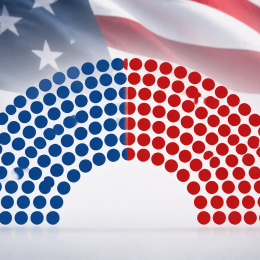
The results of the legislative elections of the United States landed this Wednesday in the election campaign of November 29. The Democratic Party has managed to wrest control of the Senate and the House of Representatives from the Republicans, in addition to winning several governor elections.

The defeat of Donald Trump’s Republicans has caused very different reactions among the main national parties, which have used the result to defend their own electoral arguments. Pedro Sánchez believes it anticipates a setback for the right in Spain, while Alberto Núñez Feijóo thinks that the accuracy of the U.S. polls should worry the president of the Government.

Vox has played down the result and has reminded people that defeats of U.S. presidents in midterm elections are usual. For their part, Frente Amplio, Podemos, and ERC have celebrated the Democratic victory, although with different interpretations.
Sánchez celebrates the retreat of the “ultra wave”

The president of the Government has congratulated the U.S. Democrats and has linked their victory to the rejection of Trump’s policies. In a message published on X, Sánchez has interpreted the results as an answer against hate, sexism, climate denialism, and the privileges of the elites.

The PSOE’s general secretary has taken the opportunity to send a message to his main political opponents in Spain: “The ultra wave that Feijóo and Abascal want to get on is no longer growing: it’s collapsing.”

The official account of the PSOE has also congratulated the Democratic Party for its "historic victory" on social media.

Feijóo asks Sánchez to "take note"

This morning, in an interview on Espejo Público on Antena 3, the Popular Party leader has acknowledged Trump’s defeat and has pointed out that Americans have withdrawn their trust from the Republican president.

However, Feijóo has preferred to highlight the behavior of the election polls and has carried that reflection over to the situation in Spanish politics. "If the American polls are right and also the Spanish ones are right, then on 29 November there will be a political reversal in Spain", he said.

The PP candidate for president of the Government has advised Sánchez to "take note" of what happened in the United States. Feijóo bases himself on polls that point to a change of government in Spain.

The PP spokesperson in Congress and top candidate for León, Ester Muñoz, has preferred to respond directly to the post in which the socialists were congratulating the Democrats and has warned the president of the government that "on 29N his wall will fall".

Abascal downplays the Republican defeat

Vox president Santiago Abascal has avoided interpreting the result as a shift in international political trends. In an interview with Onda Cero, he has recalled that U.S. presidents usually lose support in midterm elections.

Abascal has cited the precedents of Bill Clinton and George W. Bush to argue that the Republican setback should be understood within the usual dynamics of these contests.

He has also assured that he follows U.S. elections with "quite a lot less interest than national elections", because his national priority is the Spanish campaign.

Broad Front trusts in "turning the polls around"

Ada Colau has interpreted the Democrats’ victory as a rejection of Trump’s policies and the power of big technology companies. The leader has defended that "citizens can defeat the far right" and has called for that mobilization to also happen in Spain during her interview with Silvia Intxaurrondo on La Hora de la 1.

The former mayor of Barcelona has acknowledged receiving this defeat with "immense joy". About Trump, she has clarified that, in her view, he is "an authoritarian person" who is in the "antipodes" of what her coalition seeks to represent.

Just like Sánchez, he has referred to Lula’s comeback in Brazil and the victory of the student party in Serbia, and has thus pinned his hopes on "turning the polls around" in the elections of 29 November. His analysis has gone further. "How are these progressive victories happening? By talking about housing, about raising wages, about reducing precarity, about strengthening public services..", Colau insisted in a comparison applicable to his party’s electoral programme.

Podemos insists, "the vote isn’t enough, you have to force the changes"

Podemos has also assessed the Republican defeat positively, although it has introduced a nuance about the scope of electoral victories.

MEP Irene Montero has said that the United States has said "enough with Trump", but she has warned that winning an election is not enough if afterwards changes are not pushed forward to improve the population’s living conditions. "This has to serve to put an end to wars and genocide, to inequality, machismo, racism and the privileges of the 1%", Montero demanded.

For his part, the general secretary of the party, Ione Belarra, has interpreted the results as a demonstration that proposals focused on social issues can mobilize the electorate.

Rufián celebrates the defeat of “fascism”

The ERC spokesperson in Congress, Gabriel Rufián, has also reacted to the American results with a message of celebration.

The republican leader has highlighted that they have lost the “fascism” and the “bad people”, expressions with which he has summarized his political assessment of the defeat of the candidates backed by Trump.

Asked by journalists at a tribute event for the young anti-fascist Guillem Agulló, murdered in 1993, he directly pointed to other international politicians such as Donald Trump, Javier Milei, Jair Bolsonaro, Isabel Díaz Ayuso and Sílvia Orriols. “That badness, that being bad people, I think it’s good that they lose,” he summarized.

The same result, different conclusions for 29N

Less than a month before the Spanish general elections, the American results have become a new campaign argument. However, despite congratulations, statements, and comparisons with the Spanish political situation, the pre-campaign is still dominated by the consequences of the train accident in Urda, which has left 69 dead and has led to the resignation of the Minister of Transport, Óscar Puente.

The tragedy and the developments in the investigation concentrate much of the political confrontation, especially on social media, where parties and their leaders trade accusations about rail management, the Government’s responsibilities, and the resignations demanded after the accident. PP and Vox maintain pressure on the PSOE, while the socialists defend the actions of the Executive and claim Puente’s resignation as an exercise in political responsibility.

Thus, the pre-campaign — and presumably also the campaign — is fully played out on social networks, where the statements of the leaders, the videos of their interventions, and the cross-messages between parties fuel the political confrontation 25 days before the ballot boxes open.

More key points, information and questions with FREN

AI-GENERATED CONTENT

What phase of the electoral process are the Spanish general elections of November 29 currently in, and what are the next steps for their celebration?

As of November 4, 2026, the general elections of November 29 are in the pre-campaign and final voting preparation phase: the Cortes are dissolved and the calendar has reached the proclamation of candidacies. The official campaign has not yet started: it will begin on November 13. The next steps are to complete the organization of the polling stations, process the different voting modalities, and hold the campaign before going to the polls.

Phases that have been completed

The call was formalized by Royal Decree 806/2026, of October 5, published and in force since October 6. It dissolved the Congress and the Senate and set both the voting date of November 29 and the constitution of the new Chambers on December 23, as explained by Demócrata about the call.

The candidacies were submitted between October 21 and 26; their first publication took place on the 28th, followed by the review and correction of irregularities. The calendar set their proclamation on November 2 and their publication on the 3rd, without prejudice to possible appeals. Therefore, we are no longer in the ordinary period to register lists, but after their review, according to the Demócrata electoral calendar.

The specific period to consult and claim about the census, held from October 12 to 19, has also ended. Since November 2, census cards have been sent, indicating the location and table where one must vote, according to the official Interior guide.

The next steps until voting

  • Organization of polling stations. Appointments and notifications to presidents, members, and substitutes are being completed. Communications are scheduled between November 2 and 10. Information about appointments depends on each municipality: there is no single national consultation, as explained in this guide about polling stations.
  • November 13–27: electoral campaign. It will start at 00:00 on Friday the 13th and end at 24:00 on Friday the 27th. There will be fifteen days of official campaign, as confirmed by the Ministry of the Interior.
  • Until November 19: request postal voting. Sending documentation to applicants begins on November 9. The ordinary deadline to cast the vote ends on November 25. Those who request this modality and are registered in the census will no longer be able to vote in person, according to the official information on postal voting.
  • Voting from abroad. Registered residents in the corresponding census can send their vote by mail until November 24 or cast it in person from the 21st to the 26th, according to the guide for absent residents and the INE calendar.
  • November 28: reflection day. The campaign will have ended and electoral propaganda will not be allowed.
  • November 29: voting. Polling stations will be open from 9:00 to 20:00. Afterwards, the counting of the tables will begin, from which provisional results will emerge.

What happens afterwards

The consulted calendar places the start of the general scrutiny on December 2: the electoral boards will review the results before proclaiming the elected and resolving the corresponding claims. This procedure should not be confused with the provisional count on election night.

Finally, Congress and Senate will be constituted on December 23 at 10:00, as confirmed by the Congress of Deputies. The formation of the Government will be a subsequent and separate procedure from the holding of the elections.

What are the powers and functions of the President of the Government of Spain according to the Constitution, and what has been Pedro Sánchez's political trajectory?

The President of the Government directs the action of the Executive and coordinates its members, but his powers are subject to the Constitution, laws, and parliamentary control. Pedro Sánchez has held the Presidency since June 2018, after a trajectory that includes municipal, parliamentary responsibilities, and leadership of the PSOE.

Constitutional powers and functions

The Constitution distinguishes between the personal powers of the president and those of the Government as a collective body. This difference prevents attributing all decisions of the Council of Ministers individually to him.

  • Direction and coordination. Article 98.2 establishes that the president "directs the action of the Government and coordinates the functions of the other members thereof," without eliminating the direct competence and responsibility of each minister. Article 97 attributes to the Government the direction of domestic and foreign policy, the civil and military Administration, the defense of the State, the executive function, and regulatory power.
  • Formation of the Executive. According to Article 100, he proposes to the king the appointment and dismissal of the other members of the Government. The formal decision corresponds to the monarch.
  • Parliamentary confidence. According to Article 112, he can submit to Congress a vote of confidence on his program or a declaration of general policy, after deliberation of the Council of Ministers. It is passed by a simple majority: more favorable votes than contrary.
  • Dissolution and elections. Article 115 allows him to propose, under his responsibility and after deliberation of the Council of Ministers, the dissolution of the Congress, the Senate, or both chambers. The king decrees it. It cannot be proposed while a motion of censure is being processed and there are time limits.
  • Other powers. He proposes the consultative referendum, with prior authorization from Congress —Article 92—; endorses certain acts of the king, assuming responsibility —Article 64—; and can file appeals of unconstitutionality —Article 162—.

He is not directly elected by citizens: he receives the confidence of Congress and is appointed by the king —Article 99—. The Government is politically accountable to the Chamber and can be replaced through a motion of censure that includes an alternative candidate and obtains an absolute majority —Articles 113 and 114—.

Pedro Sánchez's political trajectory

  • Early responsibilities. Born in Madrid in 1972, he joined the PSOE in 1993. He was a councilor of the Madrid City Council between 2004 and 2009 and entered Congress in 2009; he returned in 2013 after an interruption (official biography).
  • Socialist leadership. He won the primaries on July 13, 2014, and led the candidacies of 2015 and 2016. He resigned as secretary general on October 1, 2016, during the party's internal crisis, and regained leadership in the primaries on May 21, 2017 (EFE profile).
  • Presidency in 2018. The motion of censure against Mariano Rajoy succeeded on June 1 with 180 favorable votes. It was the first access to the Presidency through this mechanism in Spain (Moncloa information).
  • Elections and coalitions. The PSOE obtained 123 seats in April 2019 and 120 in November, being first in both calls (results at Demócrata). Sánchez was invested on January 7, 2020, and formed a coalition with Unidas Podemos. After the July 2023 elections, he was again invested on November 16 and led a coalition with Sumar (investiture chronology).
  • Latest milestone. On October 5, 2026, he announced general elections for November 29 (institutional statement).

What were the results of the last legislative elections in Spain and how is the current Chamber of Deputies composed by political parties?

The last general elections held in Spain were on July 23, 2023. The Popular Party obtained the highest number of votes and seats, but no candidacy reached the absolute majority in Congress, set at 176 of its 350 deputies. To respond to the "current" composition, an important clarification: as of November 4, 2026, Spain is between legislatures, with the next elections called for November 29.

Results of the 2023 elections

The final distribution of seats in Congress was as follows. It is presented by electoral candidacies: this is especially important in Sumar, which brought together several parties, including Podemos, and whose 31 deputies should not be interpreted as representatives of a single party.

  • Popular Party (PP): 137 seats. It was the most voted candidacy, with 8,091,840 votes and 33.05%.
  • Spanish Socialist Workers' Party (PSOE): 121 seats. It obtained 7,760,970 votes and 31.70%, including associated socialist candidacies.
  • Vox: 33 seats. It received 3,033,744 votes, equivalent to 12.39%.
  • Sumar: 31 seats. Its joint candidacy received just over three million votes, approximately 12.3%.
  • Republican Left of Catalonia (ERC): 7 seats.
  • Junts per Catalunya: 7 seats.
  • EH Bildu: 6 seats.
  • Basque Nationalist Party (PNV): 5 seats.
  • Galician Nationalist Bloc (BNG): 1 seat.
  • Canarian Coalition (CC): 1 seat.
  • Navarrese People's Union (UPN): 1 seat.

The eleven candidacies summed up the 350 seats. The complete distribution can be consulted in this summary of results; the vote figures of the main candidacies also appear in this electoral balance.

What this result means

The PP outpaced the PSOE by 16 deputies, but was 39 short of the absolute majority. The sum of PP and Vox was 170 seats, six below that threshold; including the UPN deputy, it reached 171. On the other hand, PSOE and the Sumar candidacy initially gathered 152 representatives, also insufficient to reach 176 on their own.

Therefore, winning the elections in votes and seats did not equate to having a parliamentary majority of their own. These figures explain the importance of agreements between different candidacies but do not imply that their representatives always voted together. Demócrata records the definitive distribution of the four main candidacies in its comparison with 23J.

How the current Chamber should be described

In Spain, the official name of the lower house is the Congress of Deputies. It is advisable to distinguish three things: the seats obtained by each candidacy in the elections, the party membership of each deputy, and their integration into a parliamentary group. These three distributions may differ during a legislature.

An example was Podemos leaving the Plurinational Sumar Group: its representatives had been elected within that candidacy, so they should not be added to the 31 electoral seats as if they were additional seats. Demócrata explained this separation in its 2023 parliamentary analysis.

Also, after electoral dissolution, the previous distribution should not be presented as a currently constituted Plenary: the Permanent Deputation remains. Congress announced that the elections will be on November 29, 2026 and that the new Chambers will be constituted on December 23, according to its official communication. Until then, the exposed distribution is the electoral reference of the outgoing legislature, not the result of a new election.

Play

Test your knowledge with FREN!

How much do you know about this topic? Answer the following 3 questions.

What result did the Democrats achieve in the United States legislative elections according to the news?

Question 1 of 3

What argument has Pedro Sánchez used after the Democratic victory in the US?

Question 2 of 3

What has Santiago Abascal said about the Republican defeat in the United States?

Question 3 of 3