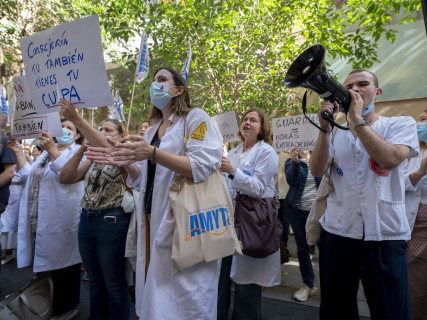

The Sindicato Médicos Unidos (SMU) has announced a strike of national and regional scope between November 16 and 27 with the objective of pressuring for the approval of a Statute of the Doctor that orders the specific conditions of the profession throughout the territory.
The organization has explained that the protest is structured around three main goals: to bring forward a Statute of the Doctor that establishes a common basis of professional conditions throughout the country; to demand from the Government "extraordinary and specific" funding that makes the improvements viable; and to call for the autonomous communities to take "immediate" actions that alleviate the labor situation of the physicians while the new rule is being processed and applied at the state level.
Regarding the Statute of the Doctor, the union emphasizes that it must be a national-level rule that regulates the particularities of professional practice. In this sense, it demands that the group have its own space for negotiation with the administration and rejects that its specificities be integrated into a general framework together with other labor categories.
For the Sindicato Médicos Unidos, the future Statute must include, among other aspects, the doctor's salary, the working day and rest periods, continuity of care, continuing training, professional career and retirement. "This regulation is necessary to establish a common basis of decent conditions for all doctors, regardless of the region in which they work," it has assured.
Likewise, the union maintains that the improvement of the profession's working conditions "cannot be addressed solely through declarations of intent". For this reason, it calls for the preparation of a "rigorous" economic report and "extraordinary and specific" funding that "makes it possible to face the necessary changes, and ensure that the measures translate into real improvements".
"This funding must make possible the strengthening of staffing levels, the transformation of the current on-call system, adequate remuneration of all medical working hours and the recovery of lost purchasing power," it has pointed out, also warning that "any reform that does not incorporate sufficient economic provision runs the risk of remaining a mere declaration of intent".
The call likewise seeks for the regional administrations to adopt measures "immediately" to improve the situation of doctors while the Estatuto del Médico is being processed. Among these actions, the union proposes the launching of specific negotiation tables for the profession and the extension of the 35-hour workweek in the territories where it has still not been implemented. Likewise, it demands adequate staffing levels to cover care needs "without systematically resorting to the overexertion of doctors".
Impact of the electoral cycle and call for dialogue
In the organization’s view, the calling of general elections and the existence of a caretaker Government "do not justify postponing the response to the medical conflict". Although it will be the next Executive that must confront the problem, the union considers that the Ministries of Health and Labor "remain valid institutional interlocutors within the powers they retain during this period".
At the same time, it recalls that the regional administrations remain "fully operational" to negotiate and implement measures in their respective areas. "Moreover, the electoral period offers all political formations the opportunity to make explicit public commitments on a future Estatuto del Médico that improves the working conditions of the entire profession", it emphasized.
The union has also stressed that "mobilization must serve to obtain concrete commitments and open an effective channel of negotiation". "None of the parties is interested in the conflict dragging on", it said.
Finally, it has made a call to the central and regional administrations "to assume their responsibility, open channels of negotiation and offer real responses to the demands of the group". In its view, "the medical profession and the Spanish healthcare system need structural and immediate solutions that halt the current deterioration that affects, above all, patients", it concluded.