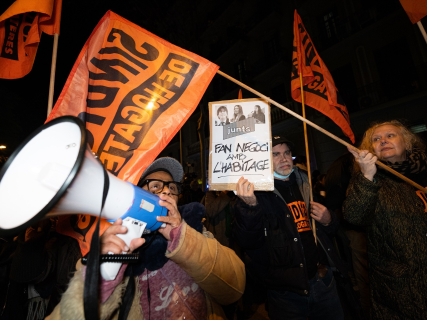
Barcelona faces a day of mobilizations for housing coinciding with Sánchez's visit.

The protests coincide with Sánchez's visit, who is scheduled to attend a public housing promotion this afternoon and later the Vanguardia Awards.

EuropaPress 7250973 representantes pah sindicat dhabitatge socialista catalunya coshac sindicat

EuropaPress 7250973 representantes pah sindicat dhabitatge socialista catalunya coshac sindicat

Add DEMÓCRATA to Google

Ask FREN

Published

Last updated

1 minute

Most read

Elecciones 29N · Encuestas

La media de las encuestas

Media a 26 de octubre de 2026 · 15 institutos

  • PP31,0 %
  • PSOE27,3 %
  • Vox18,9 %
  • Sumar6,4 %
  • Podemos2,9 %
  • ERC2,3 %
010203040ene 2024jul 2024ene 2025jul 2025ene 2026jul 2026

Media del último estudio de cada instituto en 30 días y su evolución semanal desde el 23J. Partidos con al menos un 2 %.

Todas las encuestas

Elecciones generales del 29 de noviembre · Demócrata

Barcelona, like many other cities in Spain, faces this Monday a day of mobilizations for housing, which has begun early in the morning and will have one of its main points of attention this afternoon, when the Sindicat de Llogateres has called for a concentration in front of the Palau de Congressos de Catalunya coinciding with the visit of Pedro Sánchez to the city.

The first actions are already underway. The union had called for mobilization since 7:30 AM at different points in Barcelona and, as Demócrata has been able to verify, one of the protests this morning has caused traffic disruptions. The call is part of a day designed to extend the mobilizations across different points in the city. Among the places indicated by the union for the early actions are the Hipercor de la Meridiana, the plaza de Sants, Sant Agustí street, and Tarragona street.

The protest in front of Sánchez, at 7:00 PM

The concentration will coincide with a day of institutional activity of the President of the Government in Barcelona. Sánchez is scheduled to visit at 4:00 PM a public housing promotion of affordable rent on Badajoz street along with the Minister of Housing, Isabel Rodríguez, and the President of the Generalitat, Salvador Illa.

The mobilization will have a new focus this afternoon in front of the Palau de Congressos de Catalunya, where Sánchez is scheduled to participate an hour later in the ceremony for the Premios Vanguardia 2026. The call was announced this Sunday by the spokesperson of the union, Enric Aragonès.

The union demands that the housing decree that the Government plans to bring this Tuesday to the Council of Ministers includes the automatic renewal of rental contracts, so that they have indefinite character. It also requests measures to prevent evictions of people in vulnerable situations.

The organization has framed the day as a response to the content that the decree will ultimately have. Enric Aragonès has warned that any regulation that does not incorporate the measures demanded by the tenants' movement will be considered insufficient by the union.

More key points, information and questions with FREN

AI-GENERATED CONTENT

What is the current status of the parliamentary processing of the housing decree that the Government plans to approve?

The “housing decree” referred to by the Government and the media these days has not yet started parliamentary processing. As of today, September 28, 2026, it is a royal decree-law in preparation that the Executive wants to bring to the Council of Ministers on the upcoming Tuesday, September 29, but it has not yet been approved or sent to Congress. Therefore, there is no ratification, no file registration, nor any phase in Congress or Senate.

1. What “housing decree” is it and at what stage is it?

The sources consulted consistently point to a new royal decree-law on housing that the Government wants to approve “in the coming weeks” and, specifically, at the Council of Ministers on Tuesday, September 29:

  • In January, the president announced a royal decree-law with measures on rental (regulation of seasonal and room rentals, tax incentives for landlords, etc.), whose approval “in the coming weeks” was reported by, among others, Demócrata (January article) and the Moncloa website (Campamento intervention).
  • In July, Demócrata detailed that the Government planned to approve “a new decree-law on housing” that would automatically extend rental contracts until 2028, regulate seasonal and room rentals, and raise the VAT on tourist apartments to 21% (article on the decree extending rentals).
  • This same outline is now confirmed: Demócrata summarizes that the Executive is working on “the new housing decree-law,” with two main blocks (rental stabilization and expansion of affordable housing stock) and that Tuesday, September 29 is the self-imposed deadline by the Government to bring it to the Council (analysis on the clash over rentals and evictions).
  • The President of the Government himself has publicly said that the Executive is working “against the clock to bring the royal decree-law on housing to the Council of Ministers on Tuesday” and has asked that Congress ratify it afterwards, as reported by the PSOE in its note “Pedro Sánchez to Maricarmen…” (PSOE note) and Demócrata (Demócrata report).

In summary: the “housing decree” is a new broad royal decree-law on rental and affordable housing, negotiated between PSOE and Sumar, whose approval in Council has not yet occurred.

2. Parliamentary processing: so far, nonexistent

Until the text is approved by the Council of Ministers and published in the Official State Gazette (BOE) as a royal decree-law, the parliamentary initiative does not arise. This implies:

  • There is not yet a Royal Decree-law number (it has not been published in the BOE).
  • There is no file number in Congress (neither 121/..., nor 130/..., etc.).
  • No date has been set yet for the ratification debate in the Plenary.
  • No decision has been made about its possible further processing as a bill.

What is recorded in the sources is that:

  • The Congress Board already had to schedule in March the ratification of a Royal Decree-law 8/2026, also on rental, within the package of measures against the Middle East crisis, and that this norm was repealed by the Plenary, as reported in the official note “Congress repeals the decree-law on rental measures…” (Congress note).
  • This precedent explains much of the current negotiations: various actors (Sumar, ERC, PNV, Podemos…) have declared that this new housing decree must reach the Plenary with a solid majority to avoid it falling again.

Consequently, as of today, the status of parliamentary processing is simple: it has not started. The decree is in the phase of political and technical negotiation prior to its possible approval by the Council of Ministers.

3. Other recent housing texts that may cause confusion

Besides this “new housing decree,” in recent months there have been other norms and reforms that sometimes get mixed in the debate:

  • Royal Decree-law 8/2026, of March 20, with urgent rental measures linked to the Middle East crisis: it was approved by the Council of Ministers and published; it was in force for several weeks, but the Congress Plenary repealed it on April 28, 2026 (Congress note already cited). It is not processed as a bill because the vote was for repeal, not ratification.
  • Royal Decree 326/2026, of April 22, which regulates the State Housing Plan 2026-2030, published in the BOE on April 23, 2026 (text in the BOE): it is an ordinary royal decree, not a royal decree-law, so it is not subject to parliamentary ratification, although it has been politically debated.

It is likely that in the press and political debate all of them are referred to interchangeably as “housing decree,” but only the new royal decree-law pending approval is the one the Government “plans to approve” right now and that has not yet entered the formal Congress-Senate circuit.

What specific content is being negotiated for the new housing decree (seasonal rentals, VAT on tourist apartments, contract extensions, etc.)? What was the exact vote in Congress that repealed Royal Decree-law 8/2026 on rentals and what arguments did each group present? How does the legal processing of a royal decree-law on housing differ from that of an ordinary law or a royal decree like the State Housing Plan 2026-2030?

What are the powers of the President of the Government regarding housing according to Spanish legislation?

The powers of the President of the Government regarding housing do not appear as a specific sectoral “block,” but derive from his general functions of directing the Government and domestic policy. Spanish legislation places the ordinary execution of housing in the autonomous communities and municipalities, while the State sets the bases and financing. Within this framework, the president exercises transversal political and regulatory leadership over this public policy.

1. Constitutional and competence distribution framework

The Spanish Constitution recognizes in its article 47 the right to enjoy decent and adequate housing and orders public authorities to promote the conditions to make it effective. The Law 12/2023, of May 24, on the right to housing, recalls in its preamble that housing is not a unique competence title, but an area where several state and regional titles concur, and emphasizes that:

  • Most of the execution competences in housing and urban planning correspond to the autonomous communities and local entities.
  • The State can set basic conditions of equality and common frameworks, for example on the right to housing or certain economic and civil aspects.

The Constitutional Court, when reviewing Law 12/2023, has ratified that the State has the capacity to define housing as a subjective right and to set common bases (under, among others, article 149.1.1.ª of the Constitution), but confirms that the communities maintain their exclusive competences in housing and urban planning. In this scheme, the President of the Government directs the State Executive's action on housing, but does not assume direct management of the residential stock or territorial aid, which depend on the regional and local levels.

2. Functions of the President of the Government relevant to housing

The central piece is Law 50/1997, of November 27, on the Government (> (text in the BOE). The consulted excerpt establishes that:

  • The Government “directs domestic and foreign policy” and exercises executive function and regulatory power.
  • “The President directs the Government's action and coordinates the functions of its other members.”
  • In any case, it corresponds to the president to:
    • “Establish the Government's political program and determine the guidelines of domestic and foreign policy and ensure their compliance.”
    • Create, modify, and suppress by royal decree the ministerial departments and State Secretariats, and approve the structure of the Presidency of the Government.
    • Convene and set the agenda of the Council of Ministers, the body that adopts agreements and royal decrees on housing matters (plans, fund distribution, regulations, etc.).
    • Endorse the acts of the King and submit laws for his sanction, and file appeals of unconstitutionality.

Although the law does not speak of “presidential powers in housing” sectorally, these functions directly project onto this policy: setting priorities, controlling the action of the Ministry of Housing, and leading the Council of Ministers when it approves regulations and budgetary decisions affecting the sector.

3. Practical application to housing policy

Based on these legal foundations, the president's powers in housing can be summarized on several levels:

  • Political direction: the president decides whether housing is a priority of the Government's program and sets the general lines (for example, strengthening the public stock, rental caps, or prioritizing rehabilitation). The Presidency's interventions recorded in official notes show how it frames housing as a “main axis” or “fifth pillar of the welfare state,” thus guiding the entire Executive.
  • Executive organization in housing: under Law 50/1997, the president proposes the creation, suppression, or reorganization of the Ministry of Housing and Urban Agenda and its State Secretariats, and appoints the head of the department. With this, he defines the political weight and structure of housing policy within the Government.
  • Regulatory impulse and approval of measures: the Council of Ministers, under his presidency, approves:
    • Bill projects (such as Law 12/2023 on housing itself) for submission to the Cortes.
    • Royal decrees and royal decree-laws with measures on rental, affordable housing, or public stock financing, which are then published in the BOE.
    • State housing plans (such as the 2026-2030 State Plan) and agreements on fund distribution to autonomous communities.
    All this is adopted collegially, but the political initiative and coordination fall on the Presidency.
  • Inter-administrative coordination: although communities are competent in housing, the president leads the State's position in presidents' conferences, in relations with regional governments and the European Union when there are funds or common housing frameworks, promoting agreements and responding politically to blockages or competence conflicts.
  • Defense of the State framework before the Constitutional Court: according to the Government Law, the president can file appeals of unconstitutionality against regional laws or other acts affecting the distribution of competences in housing or the basic legal regime set by the State, or defend the constitutionality of state laws such as Law 12/2023.

4. Material limits of these powers

All the above operates within two clear limits set by the Constitution and the Constitutional Court's jurisprudence:

  • The president cannot assume direct management of housing in an autonomous community nor substitute regional or local governments in their urban and daily housing competences.
  • His power focuses on strategic orientation, regulatory impulse, design of state plans, and resource allocation, as well as coordination and defense of the State's competence framework.

In sum, Spanish legislation configures the President of the Government as the ultimate responsible for the State housing strategy and political and regulatory leadership in this area, but framed in a decentralized system where execution and detailed regulation mainly correspond to autonomous communities and municipalities.

What legal requirements must autonomous communities meet to implement measures against evictions?

Autonomous communities have significant leeway to approve anti-eviction policies, but they must fit them within a very dense state framework (Constitution, basic civil and procedural legislation, and State housing law). The main requirements and limits are these:

1. Constitutional framework of competence distribution
  • Right of property and social function: article 33 of the CE recognizes the right of property and allows the law to delimit its content “according to its social function.” The Constitutional Court (TC) admits that housing has a strong social dimension but has annulled regional norms that empty the essential content of property (e.g., some expropriations of the use of vacant housing in Andalusia and the Basque Country: SSTC 93/2015 and 97/2018).
  • Right to housing: article 47 CE imposes on public authorities to promote access to decent housing, but as a guiding principle, not as a directly enforceable subjective right. Autonomous Communities (CCAA) can develop this mandate within their competences.
  • Exclusive state competences (article 149.1 CE), which CCAA cannot invade:
    • “Basic conditions of equality” in the exercise of rights (149.1.1ª).
    • Civil legislation, including the bases of contractual obligations (149.1.8ª): here lies the general urban lease regime (Law 29/1994) and mortgage credits.
    • Procedural legislation (149.1.6ª): regulation of eviction and enforcement procedures (Civil Procedure Law) is state-level.
    • General economic order and credit (149.1.11ª and 13ª), relevant when affecting banks and mortgage markets.
  • Regional competences: most Statutes attribute to CCAA competence in housing, urban planning, land use, and social services. On this basis, they can regulate public housing stock, aid, rehousing, applicant registries, accompanying measures, etc.
2. Basic state legislation conditioning regional measures

In light of recent jurisprudence (rulings on laws of Andalusia, Basque Country, Valencian Community, Aragon, and Catalonia), the TC has set these lines:

  • Eviction processes and requirements to sue: the LEC is basic. The TC has annulled several regional laws that:
    • Required offering social rent to the tenant as a prior condition to file an eviction or enforcement claim (e.g., Catalan laws: SSTC 37/2022, 57/2022, and 120/2024).
    • Introduced causes of inadmissibility, suspensions, or additional procedural conditions not foreseen by state law (Aragon, Valencian Community, STC 21/2019, STC 80/2018).
    CCAA can promote mediation or social rent, but without making them a key to court access.
  • Urban leases: Law 29/1994 sets the basic configuration of the contract (duration, extensions, termination causes, etc.). The TC has declared unconstitutional regional regimes of rent control or mandatory extensions that effectively altered the rental contract structure (SSTC 37/2022 and 57/2022 on the Catalan rent containment law).
  • Use expropriation measures: CCAA can use forced expropriation but respecting:
    • The state expropriation law (titles and guarantees).
    • The essential content of property rights and proportionality. The TC has annulled or limited automatic or overly broad expropriations linked to evictions or vacant housing (SSTC 93/2015, 32/2018, 97/2018, 25/2025).
  • Public aid and social benefits: state regulations on subsidies and public finance set bases that CCAA must respect. The TC has annulled regional provisions that redefined the nature of economic benefits or their non-seizability contravening state bases (STC 21/2019 and 5/2019 on Aragon).
  • State Law 12/2023, on the right to housing: establishes the basic framework on public housing stock, large holders, tension zones, and transparency. CCAA can develop and toughen measures within that framework but not contradict it. Several rulings (79/2024, 190/2025) have begun to delimit the boundary between state basics and regional scope.
3. Typical material requirements demanded by the Constitutional Court

From the repeated doctrine of the TC on regional anti-eviction norms, several practical criteria emerge:

  • Clear competence title: the measure must be based on housing, social services, or consumption, not on a “reinterpretation” of civil or procedural legislation.
  • Justification of general interest and social function: the norm must motivate the relation between the restriction (e.g., obligation to offer social rent, limitation on vacant housing of large holders) and the protection of vulnerable groups and the right to housing.
  • Proportionality: intense measures (use expropriation, expanded protection against eviction, sanctions) must be:
    • Adequate to avoid situations of destitution or homelessness.
    • Necessary (no less restrictive alternative equally effective exists).
    • Balanced regarding the sacrifice imposed on the owner.
  • No alteration of the judicial process: it is admitted that CCAA articulate coordination protocols, mediation services, obligation to notify social services, or priority access to public housing, but the decision to suspend or not an eviction is the judge's, according to the LEC and state norms (including exceptional measures adopted by royal decree-laws during crises like COVID-19).
  • Respect for legal certainty and basic equality: the regulation cannot create regimes so divergent that they break state common bases nor introduce retroactive sanctions or surprising effects for existing contracts.

In summary, autonomous communities can and should deploy a wide range of anti-eviction policies (public housing stock, rental aid, rehousing, mediation, coordination with courts, administrative obligations of large holders), but always within the limits set by the Constitution, state civil and procedural legislation, and Law 12/2023, without rewriting contracts or eviction procedures reserved to the State.

Can you detail what types of measures autonomous communities can approve to prevent evictions without invading state legislation? How has Law 12/2023 specifically affected the margin of action of autonomous communities in housing and evictions? Could you summarize the key Constitutional Court rulings on regional housing laws and which parts were declared unconstitutional?

Play

Test your knowledge with FREN!

How much do you know about this topic? Answer the following 3 questions.

Which organization has called for the housing protests in Barcelona?

Question 1 of 3

Where is the main gathering planned to coincide with Pedro Sánchez's visit?

Question 2 of 3

What does the union request regarding rental contracts?

Question 3 of 3