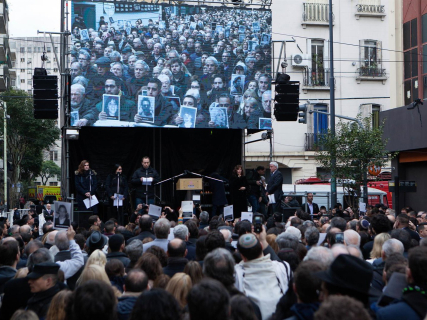

The Government of Argentina announced this Thursday that it will study the possibility of bringing the case regarding the attack against the Argentine Israeli Mutual Association (AMIA) before international justice, with the aim of achieving a conviction outside the country against Iran, identified as responsible for the terrorist attack carried out in 1994 in Buenos Aires, in which 85 people died.
The Argentine Minister of Justice, Juan Bautista Mahiques, explained on his social networks that he has met with the authorities of the AMIA to "analyze possible actions for lawsuits before international instances."
Mahiques emphasized that his Ministry maintains "a permanent commitment to the search for truth and justice for the 85 fatal victims, their families, and the hundreds of survivors."
The case regarding the attack continues its course through a trial in absentia. In September, Argentine federal judge Daniel Rafecas ordered the prosecution of eight high-ranking Iranian officials and members of the Lebanese Shiite party-militia Hezbollah, identified for their alleged participation in the planning and execution of the attack.
The judicial document details that the decision to carry out the attack was made in August 1993 by order of the highest authorities of the Iranian regime and that its execution was entrusted to Hezbollah, which coordinated the operation through a support network deployed in Latin America.
Rafecas defined the attack as a crime against humanity and framed it within the figure of genocide according to International Law.
In particular, the magistrate points to Ali Falahiyan, then Iranian Minister of Intelligence; Ali Velayati, who held the portfolio of Foreign Affairs; Mohsen Rezai, at that time commander of the Iranian Revolutionary Guard, and Ahmad Vahidi, commander of the Quds Force, an elite unit of the Revolutionary Guard.
As necessary participants are Hadi Soleimanpour, former Iranian ambassador to Argentina; Mohsen Rabani, cultural attaché of the Iranian Embassy, and Ahmad Asqari, intelligence agent of the Revolutionary Guard.
This prosecution represented a step forward in a case that, more than three decades after the attack, has still not reached the stage of oral trial.