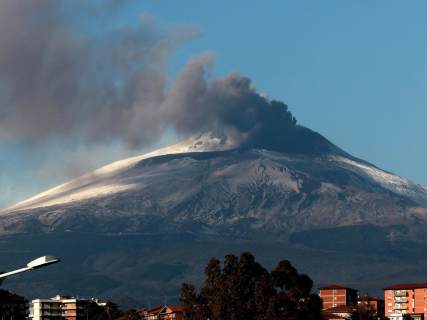
Eruption of Etna today: what is happening and why it affects flights from Catania

The Sicilian volcano maintains an activity that is generating ash emissions and air restrictions. The Etna observatory raised the code to red for aviation and Catania has had to suspend operations.

2 minutes

fotonoticia 20260706144845 1920

fotonoticia 20260706144845 1920

Add DEMÓCRATA to Google

Ask FREN

Published

Last updated

2 minutes

Most read

The Etna is affecting Catania flights again this Tuesday. The activity of the Sicilian volcano and the emission of ash have caused restrictions in the airspace and forced Fontanarossa airport to temporarily suspend its operations.

The situation has been ongoing since this Monday, when the emissions first forced the stoppage of arrivals and later expanded the restrictions to departures as well.

What is happening today with the Etna

The Etneo Observatory of the National Institute of Geophysics and Volcanology (INGV) raised the color code for aviation associated with Etna to red on September 14.

The VONA, notices specifically directed to pilots, controllers, and air operations managers, serve to communicate episodes of volcanic activity that may generate hazards related to ash clouds.

The current episode has forced the establishment of restrictions in sectors of the airspace used by Catania operations.

Why volcanic ash affects airplanes

The problem for aviation does not solely depend on whether there is a visible eruption from the ground.

Volcanic ash particles can move through the atmosphere and reach the flight paths of airplanes, which forces aviation authorities to adopt restrictions when there is a risk.

The direction and speed of the wind are decisive in determining where that cloud moves and which sectors of the airspace may be affected.

That is why the same eruption can generate very different consequences for the airport depending on atmospheric conditions.

The red code for aviation of the Etna

The INGV record shows that Etna reached the red code for aviation again on September 14.

This is not the first warning of this level recorded this month. The observatory has been alternating between orange and red codes throughout September as the activity of the volcano has changed.

This helps explain why incidents at Catania airport can appear, disappear, and reoccur within days.

Catania suffers cancellations again

The Sicilian airport had to suspend all its flights this Monday due to the ash emitted by Etna.

Initially, arrivals were halted, but later the suspension was also extended to departures.

The restrictions have continued this Tuesday, while the authorities continue evaluating the evolution of emissions and the presence of ash in the sectors used by aviation.

When will flights return to normal?

A definitive hour cannot be established in advance while the episode persists.

The recovery depends on the evolution of Etna's activity, ash emissions, the wind, and the decisions of the authorities responsible for airspace.

Even when a restriction is lifted, the airport may need time to absorb the accumulated cancellations and delays and to reposition aircraft and crews.

That is why those who have a flight to or from Catania should check their specific connection with the airline before traveling to the airport.

A September marked by the activity of the volcano

The warnings from INGV show a succession of episodes during September. Etna reached red code for aviation on different days of the month, interspersed with descents to orange level.

The current episode thus confirms that the air disturbances do not respond to a single isolated incident and requires maintaining vigilance over Catania while volcanic activity continues.

More key points, information and questions with FREN

AI-GENERATED CONTENT

What procedures or processes do the Italian authorities follow to manage the closure and reopening of airspace during volcanic episodes?

I do not have the specialized information or the necessary operational sources to precisely describe, step by step, the specific procedures that the Italian authorities follow to manage the closure and reopening of their airspace during volcanic episodes. I am specifically designed to work on the Spanish political-institutional system (Government of Spain, General Courts, regional parliaments, Spanish regulations, actors, and public debate in Spain) and my consultation tools are oriented to that scope. Therefore, I cannot provide you with a reliable and updated overview of Italy's internal procedures, which also depend on regulations and technical-operational protocols specific to that country.

To frame the topic, I can explain in general terms — not specific to Italy — how these types of decisions are usually structured in Europe within the framework of international civil aviation. This can help you understand the kind of procedures that probably also exist in Italy, although the names of bodies, exact competences, and specific formal steps may differ from the actual Italian ones.

In Europe, the management of airspace in the presence of volcanic ash is based on three pillars:

  • ICAO standards, which set global standards for air safety, including the operation of the so-called Volcanic Ash Advisory Centres (VAAC), which issue advisories on ash dispersion.
  • European Union and EASA regulations (European Union Aviation Safety Agency), which develop those standards for the European environment, setting risk assessment criteria and responsibilities among States, air navigation service providers, and airlines.
  • National protocols, which detail how in each country the civil aviation authority, air traffic control provider, meteorological and civil protection services, and the Government coordinate when closing, restricting, or reopening airspace.

In general terms, when a volcanic episode with possible impact on air traffic is detected, typical steps are taken:

  • Technical monitoring and alert: geological and meteorological services monitor the eruption and, together with the competent VAAC, prepare forecasts of ash dispersion (altitude, density, plume direction).
  • Risk assessment: the civil aviation authority and the air navigation service provider analyze that data to determine in which areas and flight levels the risk exceeds acceptable thresholds set by European regulations and recommendations from engine and aircraft manufacturers.
  • Decision on airspace: based on that assessment, it is decided whether to proceed with a total closure of certain areas, their restriction (for example, prohibiting certain flight levels), or allowing conditional operations (such as alternative routes or requiring specific plans from airlines).
  • Publication via NOTAM: any decision to close, restrict, or reopen is officially communicated through NOTAMs (Notices to Airmen), which are the standard instrument to inform airlines, pilots, and operators about the status of airspace and airports.
  • Interinstitutional coordination: there are usually crisis coordination centers where the aeronautical authority, air navigation provider, emergency services, civil protection, competent ministries, and sometimes representatives of airlines and airports meet to monitor the situation minute by minute.
  • Continuous review and reopening: as models and observations show a reduction in risk (dispersion or decrease in ash concentration, wind changes, end of the eruption), restrictions are reviewed and gradually lifted, publishing new NOTAMs and adapting routes and frequencies.

All this, I insist, is a general scheme applicable to many European States, but the specific details for Italy (which ministry signs which decision, which body formally manages the airspace, how the legal chain to order closures and reopenings is articulated, which decrees or internal regulations govern it, etc.) exceed the scope for which I am designed.

If you need exact information about the Italian case, I recommend consulting official sources from that country directly, such as the Italian national civil aviation authority, the air navigation service provider, Italian regulations on airspace management, and volcanic emergency plans. Those sources can provide you with a precise and legally reliable description of the specific procedures you seek.

On the other hand, if you want to analyze how analogous situations are managed in Spain (for example, the procedures for closure and reopening of Spanish airspace due to volcanic ash or similar phenomena), I could help you in much more detail, both in the regulatory and institutional and operational parts.

What are the competences and powers of the National Institute of Geophysics and Volcanology (INGV) in Italy?

I do not have, in this context, specific and verified information about the concrete competences and powers of the Istituto Nazionale di Geofisica e Vulcanologia (INGV) of Italy. My specialization and the tools I work with are focused on the Spanish political and institutional system (parliament, governments, regulations, actors, and processes in Spain), so I cannot offer you a detailed, official, and updated list of the legal or organizational functions of the INGV without resorting to external sources that I do not have enabled here.

To avoid providing inaccurate or outdated data about a specific foreign institution, it is important not to "fill in the gaps" with assumptions. In the case of technical bodies like the INGV, formal competences are usually defined in specific Italian regulations (laws on research organization, Italian government decrees, the institute's own statutes, etc.), and those regulations may have changed over time. Any adequate answer should be based directly on those sources or on the INGV's institutional website, and be able to precisely cite the legal framework, something I cannot do here.

That said, I can offer you a general framework, in generic terms and not strictly or exhaustively attributable to the INGV, about what this type of national geophysics and volcanology institutes usually do in European countries. This description should be understood as a general reference, not as an official enumeration of the INGV's competences:

  • Basic and applied scientific research in geophysics, seismology, volcanology, and associated disciplines (geodesy, space geodesy, Earth physics, etc.), aiming to improve knowledge of the planet's internal structure and functioning, especially seismic and volcanic zones.
  • Surveillance and monitoring of seismic and volcanic activity in the national territory, through networks of seismological stations, remote sensing systems, volcanic observatories, and other continuous observation infrastructures. This monitoring is usually carried out in coordination with civil protection services and other competent authorities.
  • Issuance of technical information and advisories on relevant geophysical phenomena (earthquakes, volcanic activity, ground deformation, tsunamis of seismic or volcanic origin, etc.), intended for civil protection authorities and, partly, the general public. In many countries, equivalent institutes act as technical references when seismic or volcanic crises occur.
  • Scientific and technical advice to public administrations (central government, regions, local entities) on matters related to seismic and volcanic risk, emergency planning, hazard mapping, or defining technical standards for earthquake-resistant construction and land use planning.
  • Management and dissemination of scientific data, including collection, validation, archiving, and making available seismic, geodetic, geological, and volcanic data series, both for the research community and, partly, for the general public. In Europe, it is common for these institutes to participate in shared scientific infrastructures and open data networks.
  • International collaboration in research projects, global observation networks, and information exchange mechanisms, especially in global seismology, volcanic surveillance, and natural risk management, in coordination with other institutes, universities, and multilateral organizations.
  • Training and outreach in geophysics and volcanology, including activities with universities (supervision of theses, participation in master's and specialized courses), as well as public education and awareness initiatives on seismic and volcanic risk (talks, educational materials, information on the institutional website, etc.).
  • Participation in emergency management as a technical reference body, issuing reports, possible evolution scenarios of a seismic or volcanic crisis, and recommendations based on the best available scientific evidence, which are then assessed by the competent civil protection and government authorities.

Again, it is essential to emphasize that the above list describes the type of functions that national geophysics and volcanology institutes usually have in Europe, but it cannot be taken, in this context, as an official and exhaustive list of the INGV's legal competences. For rigorous work, I would recommend going directly to:

  • The INGV's institutional website and its "mission," "compiti," "statuto," or equivalent section.
  • Italian regulations governing the organization of public research and, specifically, the creation and statute of the INGV.
  • Documentation from the Italian Protezione Civile about the operational relationship with the INGV regarding natural risks.

On the other hand, if you are interested in an analysis of competences and powers but referring to equivalent bodies in Spain (for example, the National Geographic Institute, the National Seismic Network, or research centers linked to the CSIC), I could help you more precisely, using Spanish parliamentary and regulatory information.

What legal requirements exist in Italian and European aviation legislation to establish air restrictions due to volcanic ash?

Air traffic restrictions due to volcanic ash in Europe, and particularly in Italy, are supported by a framework of international (ICAO), European (EU/EASA), and national regulations. Available documents allow identifying the essential elements: obligation to assess risk, central role of meteorological and volcanological services, competence of national authorities to close or limit airspace, and use of official aeronautical information (NOTAM, airspace sectors, etc.).

1. ICAO international framework: contingency plans for ash

At the international level, the International Civil Aviation Organization (ICAO) has approved for the European and North Atlantic regions a Volcanic Ash Contingency Plan – EUR and NAT Regions (EUR Doc 019/NAT Doc 006 Part II). This document, cited in an official agreement between the National Geographic Institute and AEMET published in the Spanish Official State Gazette (link), establishes that:

  • States must have specific surveillance, communication, and alert systems for volcanic activity and its impact on aviation.
  • A chain of responsibility is articulated involving volcanic ash advisory centers (VAAC), meteorological services, air navigation providers, and civil aviation authorities.
  • Based on information from these systems, competent authorities can issue advisories and adopt operational measures, ranging from diversions and route changes to closing airspace sectors when the risk to aircraft is high.

Although the plan does not itself "close" airspace, it serves as a mandatory technical-legal framework for each State (including Italy) to configure its own volcanic ash restriction procedures.

2. European level: role of the EU and EASA

At the European Union level, the closure or limitation of airspace for safety reasons is framed within the Single European Sky policy and the air safety system coordinated by the Commission and the European Union Aviation Safety Agency (EASA).

A European Commission document on its Air Safety List, relating to banned airlines, reminds that this list does not prevent Member States from adopting individual safety measures at the national level, provided they are also examined within the EU framework (Commission Q&A). This applies by analogy to restrictions linked to risks such as volcanic ash: the State may close or limit its airspace for safety reasons, without prejudice to European coordination.

EASA uses safety information bulletins for other risks (for example, conflict zones), in which:

  • It recommends operators not to fly in certain airspaces or flight levels.
  • It requires companies to have an updated risk assessment and a permanent monitoring system of the affected airspace situation.
  • It refers to the official aeronautical publications of national authorities (NOTAM, AIP), which are the ones that formally close or restrict airspace.

Although the examples cited in the press refer to armed conflicts, the legal scheme is the same for ash: EASA informs and recommends; the formal closure is decided by the national authority under its aviation legislation.

3. Italian practice: national authority, scientific information, and sectorial closures

Recent news about Etna show how these requirements materialize in Italy. In several eruptions in 2026, Catania-Fontanarossa airport:

  • Cancelled up to 130 flights and redirected others to Palermo, Comiso, or Trapani due to a "dense ash cloud complicating operations on the runway and in airspace" (Demócrata).
  • Kept "operations suspended" for several hours, affecting tens of thousands of passengers, "awaiting the evolution of the volcanic phenomenon and safety conditions."
  • Applied partial airspace closures allowing only a limited number of landings per hour, while maintaining takeoffs, depending on the intensity of volcanic activity and wind direction.
  • In a more recent episode, the "strong reactivation of Mount Etna forced the closure of airspace in sectors C1 and B3", which meant the complete suspension of operations in Catania until at least a certain hour (Demócrata).

The official statements reveal the operational requirements demanded by Italian and European regulations:

  • The decision is based on information from the Istituto Nazionale di Geofisica e Vulcanologia (INGV), which details lava flow heights, ash columns, and eruption evolution.
  • The aeronautical authority (ENAC) and the air navigation service provider (ENAV) translate that information into operational restrictions: closure of specific sectors, limitation of landings, or total traffic suspension.
  • Measures are published and updated through aeronautical information channels (airspace sectors, closure schedules) and airlines are required to adjust their operations and keep passengers informed.
4. Legal summary

Overall, the legal requirements to restrict airspace due to volcanic ash within the European and Italian framework, as reflected in available sources, can be summarized as follows:

  • Existence of a contingency plan compliant with ICAO and European regulation, with clear surveillance and alert responsibilities.
  • Technical risk assessment based on scientific data (meteorological services, volcanological centers, VAAC).
  • Competence of the national aviation authority to close or limit airspace in specific sectors and periods for safety reasons.
  • Use of aeronautical information instruments (NOTAM, sectors, AIP) to give legal effect to restrictions.
  • Coordination with the EU and EASA, which can make recommendations and review the consistency of measures, without replacing the sovereign decision of the State over its airspace.

This scheme is what allows, for example, the closure of sectors C1 and B3 over Catania during episodes of high volcanic ash concentration, simultaneously fulfilling international, European, and national air safety requirements.

Can you detail how the ICAO Volcanic Ash Contingency Plan works in the EUR and NAT regions and which actors are involved? What practical differences exist between a total airspace closure and the limitation of specific sectors like C1 and B3, from a legal and operational point of view? How do INGV, ENAC, ENAV, and airports coordinate in Italy when there is an Etna eruption affecting air traffic?

Play

Test your knowledge with FREN!

How much do you know about this topic? Answer the following 3 questions.

What has caused the temporary suspension of flights at Catania airport?

Question 1 of 3

What aviation alert level did Etna reach on September 14 according to INGV?

Question 2 of 3

What does the recovery of normal flight operations at Catania depend on?

Question 3 of 3

Hola, soy Fren. ¿Cómo te ayudo?