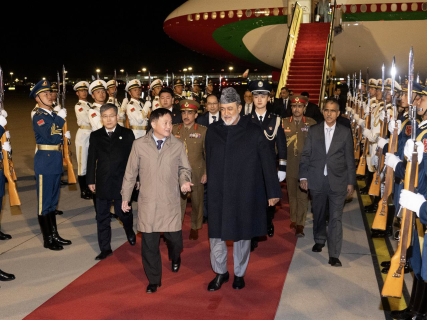

The Sultan of Oman, Haitham Bin Tarik Al Said, has gone down in history as the first Omani head of state to travel officially to China since the start of bilateral diplomatic relations 48 years ago. His trip comes at an extremely delicate moment for the sultanate, caught between the open confrontation between Iran and the United States and, in particular, by the permanent tension in the Strait of Hormuz, a maritime route that Oman shares with the Islamic Republic.
The Omani leader was received this Monday by Chinese President Xi Jinping, with whom he took part in a "ceremony of signing cooperation documents," according to the official agency Xinhua, focused on "energy, investment and high technology." Beyond these agreements, the agenda of both leaders is marked by the situation in Hormuz, conditioned by the political closeness between Beijing and Tehran and by the principle of understanding sealed in mid-August between Oman and Iran on transit corridors in the strait, theoretically ratified about a month ago.
The meeting concluded with a joint statement in which the two delegations "consider that the Strait of Hormuz should be restored to normal and safe navigation" and maintain that the way out of the conflict is to reactivate as soon as possible the Islamabad Memorandum of Understanding, in addition to resuming dialogue and negotiations with a view to a global agreement "including on the nuclear issue," a particularly sensitive point because Iran is trying to disassociate any allusion to its atomic program after accusing the United States of violating said pact.
In the text, the parties also "advocate the resolution of disputes by political and diplomatic means, and urged the United States and Iran to maintain the peaceful track, achieve a comprehensive ceasefire and the cessation of hostilities as soon as possible."
Political commitment between Beijing and Muscat
In this context, Xi Jinping conveyed to the sultan China's willingness to "strengthen communication and coordination with Arab countries, including the Arab states and the countries of the Gulf Cooperation Council (GCC)" in a stage of "unprecedented transformation" marked by multiple "global problems." In the view of the Chinese president, "the Middle East and the Gulf region should not become a stage for rivalries between major powers or for geopolitical conflicts".
Sultan Haitham valued China's "fair stance" on the Middle East dossier and expressed his willingness "to closely coordinate with China to defend international law, adhere to the peaceful resolution of differences and jointly promote regional and global security and stability".
Despite these diplomatic gestures, tension in the Strait of Hormuz remains high: the United States maintains its deployment of military pressure and surveillance, while Iran recurrently reports "explosions" in tankers crossing the area by routes "not authorized" by Tehran. All of this takes place amid speculation about a possible resumption of talks and the threats of United States President Donald Trump about a possible return to open confrontation.