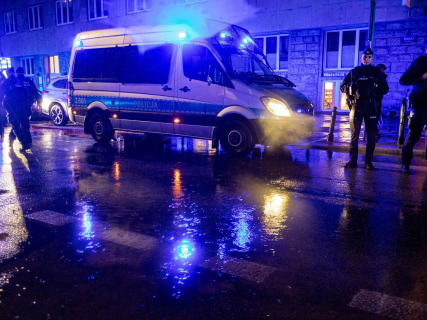

The headquarters of the Constitutional Tribunal of Poland, in Warsaw, was surrounded by a heavy police deployment on the night of this Friday, at the height of an institutional crisis over the composition of the court leadership that has pitted Prime Minister Donald Tusk for months against his two main political adversaries: the leader of Law and Justice and former head of Government, Jaroslaw Kaczinski, and the current president of the country, Karel Nawrocki.
The origin of the conflict dates back to the beginning of this year, when Nawrocki, a close ally of Kaczinski, refused to swear in three of the six magistrates appointed by Parliament. Added to this was the decision of the president of the Constitutional Court, Bogdan Swieczkowski, who refused to allow the judges elected by the current parliamentary majority to take up their posts.
The situation worsened with the proposal before the Chamber of Maciej Berek, the Executive's chief legal adviser under Tusk, as a new judge of the Constitutional Tribunal. President Nawrocki also refused to swear him in, which further heightened the dispute between the Government and the Presidency.
Clash in the Court and police deployment
During the afternoon, the official Polish news agency PAP reported that Swieczkowski and his deputy, Bartlomiej Sochanski, had been suspended for a month and that their names had been removed from the official website of the tribunal by order of judge Anna Korwin-Piotrowska, who appeared on Polish television to announce that she was becoming the new president of the court.
A few minutes after the changes on the institutional page, the court itself stated on its social networks that the site had been the object of an "illegal takeover", that Korwin-Piotrowska does not represent the body, and that anyone involved in these actions "is committing the crime of a coup d'état".
In an initial reaction on social media, Tusk stated that the restoration of the rule of law "is a duty" and that "after years of arbitrariness" a "difficult process, sometimes painful, has begun, which requires determined action" because "there is no other way".
The political escalation immediately moved to the outside of the building. The Warsaw Police confirmed the arrest of three people who were trying to enter the Constitutional Tribunal and launched a security operation in response to "aggressive behavior", given that a group of protesters was "trying to break the fence" that protects the premises.
In light of the seriousness of the situation, Nawrocki decided to cancel his trip to Senegal and announced that he was returning immediately to the country. "At a time like this, the president must be in Poland," he declared, while Kaczinski, also on social media, denounced that the court was being the victim of an "attack" by the "Tusk services" in an unprecedented episode on a "global scale".
"From today on, Poland becomes a police state, and from there there is already a direct path to authoritarianism, and then to totalitarianism. The Tribunal is the guarantee of our freedom and sovereignty. The trampling of the law by Tusk knows no bounds," stated the Law and Justice leader.
The Supreme Court speaks of a coup d'état
The harshest words came from the president of the Supreme Court, Zbigniew Kapinski, who openly stated that what is happening in the Polish capital is "a seizure of power by force that has all the characteristics of a coup d'état".
Kapinski denounced that "both the president and the vice president of the Constitutional have been illegally dismissed from their posts, and a usurper without authority has been installed", in direct reference to Korwin-Piotrowska.
As the hours passed, the crisis spread to other spheres of the State. The ambassador of Poland in China, Jakub Kumoch, made public his resignation considering that the current scenario makes it unfeasible to continue carrying out his diplomatic responsibilities.
Korwin-Piotrowska, for her part, convened a plenary meeting of the judges of the Constitutional Court for November 3 with the aim of addressing the issue of the court's budget, currently blocked by the institutional confrontation.
After admitting that what is being experienced right now in Warsaw "represents a state of constitutional force majeure, he asked President Nawrocki to "calm this escalation" and open a dialogue with the Government "because the solutions that use force are a disaster for the building of society and understanding".