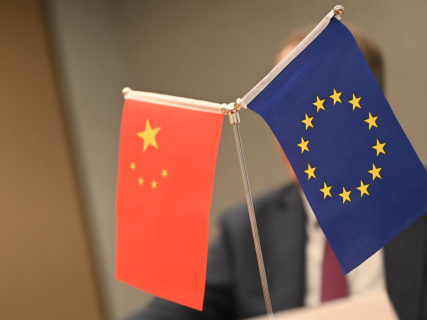

The European Union and China announced this Friday several points of understanding to reduce trade tensions in areas such as electric cars, critical raw materials, and tariff reductions. The advances come after two days of political talks in Beijing, from which, pending details, the European Commissioner for Trade, Maros Sefcovic, has indicated that he hopes will allow for a "halving" of Chinese hybrid vehicle exports to the European Union within four years.
"We have reached a shared understanding to moderate China's exports of hybrid and plug-in hybrid vehicles to the European Union. This opens up a perspective for cutting China's exports by more than half," Sefcovic declared at a press conference in Beijing, where he traveled the day before to hold a meeting with Chinese Commerce Minister Wang Wentao.
The commissioner, who represents the 27 in external trade policy, explained that commonalities have also been identified to improve access for certain European products to the Chinese market through reduced tariffs. Among them, he mentioned olive oil, footwear, and components for the automotive industry, which, he indicated, will allow European companies to "save at least 225 million euros in fees."
The community official also added that both parties have reached an understanding to facilitate the granting of export licenses for rare earths and permanent magnets from China to the European internal market.
"We have never talked about a trade war. I am one of those who think that it is very easy to declare a trade war, or any war, but then it is very difficult to stop it. That is why I emphasized negotiations so much and I am proud to be able to present the results to you now," Sefcovic emphasized, who has been cautious in offering more information about the concrete implementation of the commitments.
The foundations of the understanding will now be examined in Brussels by the President of the European Commission, Ursula von der Leyen, and by the heads of state and government of the 27, who will meet at a European Council at the end of next week.
Brussels and Beijing had announced at the end of June the launch of a "real" dialogue with the aim of achieving "tangible results" by autumn at the latest to reduce tension and rebalance trade relations. Sefcovic and Wang believe that this purpose has been fulfilled in this second meeting of the forum known as 'Trade and Investment Consultations'.
The European Commissioner and the Chinese Minister will meet again in January to assess progress in the areas already agreed upon and analyze possible new areas of cooperation. Sefcovic is confident that a third round of the 'Trade and Investment Consultations' can be held in March.
In a statement, the Ministry of Commerce of China has described the agreement on hybrid vehicles as the result of "intense" discussions, although it has specified that, regarding electric cars, both parties have decided to continue examining commitments on prices and production subsidies in Europe as an alternative to the imposition of tariffs.
At the same time, Beijing has reiterated its willingness to maintain the so-called 'green channel' to expedite the processing of export licenses for rare earths to the EU, in line with the commitment to strengthen the predictability and stability of global supply and industrial chains.
The European Union and China have also agreed to jointly study formulas to lift the limitations on the trade of meat products from member states affected by bluetongue disease.
Regarding the exchange of sanitary articles, the Chinese side has indicated that the EU has received "with satisfaction" the steps taken by the Asian giant to expand the export of such goods to the European market.
Export controls also formed part of the agenda, and both delegations reiterated the need to deepen dialogue and exchange information on their respective regulations, through the publication of policy guides, contact activities between authorities and companies, and the organization of training programs.
"In the framework of the dialogue mechanism on export controls, both parties reached an understanding to make a prior notification before including entities on lists, increase the transparency of the inclusion and exclusion procedures of lists, and support the initiation of exclusion procedures according to their respective legal frameworks," the document released by the Chinese authorities states.