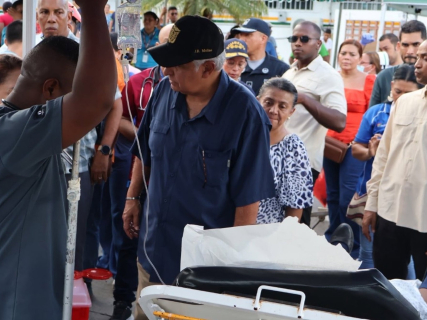

The Panamanian authorities continue evaluating the damages while the country continues registering aftershocks from the seismic movement.
The latest report from the National Civil Protection System (SINAPROC), collected by EFE, confirms damages in nine provinces. Among the affected facilities are 142 homes, 188 educational centers, 20 health facilities, 26 government buildings, 13 churches, seven hotels, and nine bridges, in addition to roads and water treatment plants.
So far, no fatalities or missing persons have been confirmed.
Where was the epicenter of the Panama earthquake
The earthquake occurred on Friday at 12:56 hours in Panama, 19:56 in mainland Spain.
The United States Geological Survey (USGS) has placed its magnitude at 7.7 and has located the epicenter about 12 kilometers west-southwest of Pitaloza Arriba, near the district of Tonosí, in the central-southern part of Panama.
According to the latest review by the American agency, the movement originated at a depth of 12.6 kilometers.
The Geosciences Institute of the University of Panama offered a different measurement, of magnitude 7.5 according to the latest report released by EFE. These differences respond to the methods used by the seismic services and to the successive revisions of the data.
The tremor was felt in wide areas of the country, including Panama City, located more than 200 kilometers from the epicenter.
Coclé and Los Santos, among the most affected provinces
The damages are concentrated especially in the central provinces.
In Coclé, the authorities have counted at least 50 affected homes, two hotels with significant damage, 17 people with minor injuries, and damages in hospitals, schools, churches, and government buildings.
In Penonomé, the provincial capital, one of the towers of the San Juan Bautista cathedral collapsed during the earthquake.
The building of the Coclé Governorship was also severely affected. Part of the structure collapsed and exposed the interior of several offices.
In the province of Los Santos, where Tonosí is located, damages have been recorded in 14 homes, five hotels, four hospitals, 22 educational centers, and other public and religious properties.
About 300 people evacuated and five communities cut off
The earthquake also caused preventive evacuations in areas near the coast.
In Los Santos, around 300 people were moved from a coastal community to higher ground after an increase in sea level was detected.
The authorities also reported five communities cut off due to damage to bridges, road damage, and landslides.
In Coclé, eight families were moved to a shelter as a result of the damage suffered in their homes.
The balance may change in the coming hours as inspections of buildings and infrastructure progress.
Damage to hospitals, schools, and drinking water plants
One of the problems facing Panama after the earthquake is the state of essential services.
According to a government report collected by EFE, almost all the water treatment plants in the country suffered some type of structural damage. The facility that supplies Panama City operated at 20% of its capacity.
The seismic movement also caused damage to hospital facilities in Tonosí and Pedasí, as well as health centers in other provinces.
The figure of 188 affected educational centers requires evaluations to be conducted before resuming normal activity in the buildings that show damage.
The inspections aim to determine which facilities can continue to be used and which require interventions to ensure their safety.
The earthquake caused evacuations in Panama City
Although the most significant damage was located inland, the earthquake was also strongly felt in the capital.
Numerous people left offices, homes, and high-rise buildings due to the intensity and duration of the shaking.
The concentration of skyscrapers in Panama City made the evacuations of workers and residents particularly visible.
According to information gathered by EFE, four residential buildings in the capital showed minor damage.
The Tocumen international airport temporarily suspended its operations to conduct safety checks and later resumed activity. The Panama Canal maintained its operations.
More than 100 aftershocks after the earthquake
The main movement was followed by an intense sequence of tremors.
The Geosciences Institute of the University of Panama reported around 107 aftershocks in the hours following the earthquake, some of sufficient magnitude to be felt by the population.
The specialists continue monitoring seismic activity in the region.
The earthquake also initially triggered a tsunami threat for different countries on the American Pacific coast. The Pacific Tsunami Warning Center subsequently lifted that threat after assessing the available data.
Panamanian authorities are maintaining inspection and assistance efforts for the affected communities while the damage assessment continues.