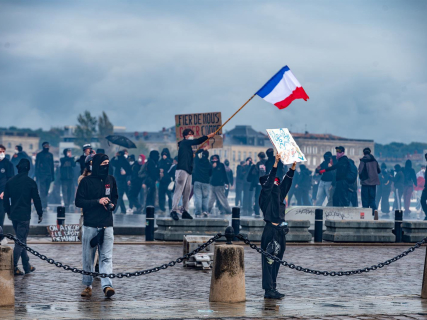
France announces educational reforms to curb the protests, but students consider them insufficient.

The Government of Sébastien Lecornu promises to reform access to university, create 15,000 places, and reduce the number of students per class. Students maintain their mobilizations and prepare a new day of protests for November 5.

fotonoticia 20261025105205 1920

fotonoticia 20261025105205 1920

Add DEMÓCRATA to Google

Ask FREN

Published

Last updated

4 minutes

Most read

Elecciones 29N · Encuestas

La media de las encuestas

Media a 26 de octubre de 2026 · 15 institutos

  • PP31,0 %
  • PSOE27,3 %
  • Vox18,9 %
  • Sumar6,3 %
  • Podemos2,9 %
  • ERC2,3 %
010203040ene 2024jul 2024ene 2025jul 2025ene 2026jul 2026

Media del último estudio de cada instituto en 30 días y su evolución semanal desde el 23J. Partidos con al menos un 2 %.

Todas las encuestas

Elecciones generales del 29 de noviembre · Demócrata

The French Government announced this Monday, October 26, a package of educational reforms aimed at responding to the student protests that have spread across the country in recent weeks. Among the main measures is the replacement of the Parcoursup university access system in 2028, along with the creation of 15,000 additional places in higher education and the reduction of the number of students per classroom. However, student representatives believe that the Government's commitments are insufficient and have confirmed that they will continue the mobilizations.

The announcement comes after almost a month of demonstrations, blockades of educational centers, and clashes with security forces, in a crisis that has transcended the university sphere and incorporated social and economic demands. The Government of Prime Minister Sébastien Lecornu is trying to contain the discontent through educational concessions, although a good part of the announced reforms will not come into effect until 2027 or 2028.

The response from student organizations has been immediate. Despite acknowledging some progress, their representatives believe that the measures do not address the structural problems of the French educational system and maintain the call for a new national day of protests for November 5.

The Government promises to replace Parcoursup in 2028

The main concession from the Government affects Parcoursup, the national platform that manages applications for access to higher education and has become one of the main targets of the protests. Students question the transparency of its selection criteria and denounce the inequalities that, in their view, it generates among candidates for a university place.

The Government has announced that the system will be replaced in 2028, although it plans to introduce modifications starting in 2027. The reform aims to respond to criticisms regarding the functioning of the admission procedure, the transformation of which constitutes one of the main demands of the student movement.

However, the announced timeline has provoked new criticisms among the protesters, who demand more immediate responses. The replacement of Parcoursup would occur in two years, while students believe that the difficulties in accessing higher education require urgent measures.

More university places and fewer students per class

The package presented by the Executive also includes the creation of 15,000 additional places in higher education, distributed among different training modalities. Of these, 10,000 will correspond to higher technical studies, another 4,000 to university technology institutes, and the remaining 1,000 to health education.

The expansion of the educational offer seeks to alleviate the pressure on certain academic pathways and facilitate young people's access to higher studies, especially in areas with high demand.

In secondary education, the Government has announced a reduction in class sizes, with a maximum of 28 students in certain courses. This measure will be accompanied by actions aimed at strengthening teacher replacements and increasing teaching contracts.

The reforms also include an update of scholarships linked to inflation and funding to rehabilitate educational and university centers, two issues related to the economic difficulties reported by students.

Although the Executive presents these initiatives as a response to the demands of the educational sector, their progressive implementation has fueled doubts about the measures' ability to reduce discontent in the short term.

Students maintain protests and call for new mobilizations

Student representatives have received the announcements with skepticism and believe that the Government has not addressed all their demands. Among the main criticisms is the delay in implementing the reforms, especially in the case of Parcoursup, whose replacement is not scheduled until 2028.

Louis Letoublon, one of the representatives of the student movement, has warned after contacts with the Executive that the announced concessions are not enough to end the protests. The organizations maintain their intention to continue mobilizing until they obtain responses they consider satisfactory.

The discontent also reflects problems that go beyond access to university, such as the material conditions of educational centers, the economic difficulties of young people, and the job prospects of those who finish their studies.

The next national day of protests is scheduled for November 5, a call that will allow checking the mobilization capacity of the movement after the concessions announced by the Government.

Macron acknowledges mistakes amid the escalation of protests

The educational crisis has also taken on a political dimension for the French president, Emmanuel Macron, after several weeks of demonstrations and episodes of violence that have forced the reinforcement of security measures.

During an intervention held this Monday in Marseille, Macron acknowledged that the authorities did not adequately anticipate the violence recorded on October 17, although he defended the actions of the security forces during the riots.

The president has also warned of the risks associated with the upcoming mobilizations, in a context of tension between the protesters and the authorities that has complicated the political response of the Executive.

The student protests have developed alongside other expressions of social discontent, with the participation of unions and groups critical of government policies. This confluence has broadened the scope of a crisis that began linked to educational demands and now poses a new challenge for Lecornu's Government.

The response announced by the Executive introduces relevant changes in the French educational system, but has not managed to deactivate the mobilizations. With the replacement of Parcoursup postponed until 2028 and a new day of protests called for November, the French Government continues to seek a way out of a crisis that keeps students in the streets.

More key points, information and questions with FREN

AI-GENERATED CONTENT

What is the necessary parliamentary procedure in France to approve a reform of the university access system such as the replacement of Parcoursup?

A replacement of Parcoursup that changes the legal conditions of university access would require an ordinary law, not an organic law. If only the technological platform were replaced or administrative aspects compatible with current legislation were modified, a regulatory reform might suffice, without new parliamentary approval. The difference depends on the content of the reform, not the name of the system that replaces it.

1. Determine what must be changed by law

The current framework comes from Law No. 2018-166 of March 8, relating to student guidance and success, the Education Code, and its regulatory provisions. Article L. 612-3 is a central reference for access to the first university cycle.

Changing the legal admission conditions, candidates' rights, or essential obligations of universities requires modifying this framework. In contrast, the schedule, applications, and other operational modalities are developed through regulations, as shown by the 2018 Decree. A decree cannot contradict the current law.

2. Initiate the reform

There are two parliamentary routes:

  • Government bill: the Executive prepares the text, obligatorily requests the opinion of the Conseil d’État, and approves it in the Council of Ministers before presenting it to Parliament. This opinion examines its legal coherence but does not replace the parliamentary decision.
  • Parliamentary bill proposal: deputies or senators can present it. It is subject to admissibility rules, including financial limits on parliamentary initiatives. Consultation with the Conseil d’État is not mandatory as in the governmental route.

For a comprehensive replacement, the governmental initiative would facilitate coordinating the law with resources, digital infrastructure, and implementation schedule, although it is not the only legally possible route.

3. Examination by both chambers

The text can be presented in the National Assembly or the Senate. First, it is referred to the competent committee, where it is examined and amendments may be approved. Then it is debated and voted on in plenary session.

The chamber that receives it next also examines it in committee and plenary: it can approve it unchanged, modify it, or reject it. The successive readings between both chambers constitute the navette parlementaire. The goal is to approve an identical text.

4. Resolve a disagreement

If differences persist, a joint committee composed of deputies and senators may meet to draft a common text. The accelerated procedure allows reaching this phase sooner but does not eliminate the examination by both chambers.

If conciliation fails or its text is not approved, the Government may, complying with constitutional conditions, request that the National Assembly decide definitively. Therefore, the Senate intervenes but does not have a definitive veto over an ordinary law of these characteristics.

5. Constitutional control and implementation

Before promulgation, the law may be referred to the Conseil constitutionnel by authorized authorities or by 60 deputies or 60 senators. This prior control is not mandatory for an ordinary law. It may affect, among other issues, equality of access and candidates' guarantees; see the Council's presentation.

After promulgation and publication, the necessary decrees and orders must be approved, with corresponding transitional provisions. In summary: substantive reform, ordinary law, and regulatory development; exclusively technical replacement, possible regulatory route. Parliamentary approval of the new framework does not by itself equate to its operational implementation.

What powers and functions does the French Prime Minister, Sébastien Lecornu, have in education according to French legislation?

Sébastien Lecornu, as French Prime Minister, directs and coordinates the Government's educational policy, guarantees the execution of laws, and exercises the regulatory authority that corresponds to him. He does not have a personal or exclusive educational competence: his powers derive from the office and are exercised alongside the Minister of Education, respecting the attributions of Parliament, the President of the Republic, and territorial collectivities.

1. Direction and coordination of educational policy

The main basis lies in Articles 20 and 21 of the 1958 Constitution. The first assigns the Government the determination and conduct of national policy; the second establishes that the Prime Minister directs government action and guarantees the execution of laws.

In education, this allows Lecornu to set governmental priorities, coordinate their application, and resolve discrepancies between Education and other ministries, such as Finance, Interior, or Higher Education. He can arbitrate on resources, teacher hiring, inclusion, or school security, but always within the legal framework. He does not ordinarily replace the competent minister in managing centers, staff, or programs.

2. Normative development and legislative initiative

Article 21 grants him regulatory authority, with the reservation of presidential powers in Article 13. Together with Article 37, it allows developing by decree educational aspects not reserved for law. According to Article 22, the Prime Minister's acts carry, when appropriate, the countersignature of the ministers responsible for executing them.

  • Bill projects: Article 39 recognizes the Prime Minister's legislative initiative. He can promote educational reforms, whose projects are deliberated in the Council of Ministers.
  • Limits: Article 34 reserves fundamental principles of education to the law. Therefore, a decree cannot freely modify these principles.
  • Ordinances: Article 38 allows the Government to act in legislative matters through parliamentary authorization and under constitutional conditions; it does not constitute an unlimited unilateral power.
3. Budget and political responsibility

Lecornu coordinates budget preparation and arbitrates resource distribution among ministries. In education, he can decide the governmental financing proposal and supervise its execution, but credit approval corresponds to Parliament through the finance law.

He also bears political responsibility for the Government's actions. Article 49.3 allows committing his responsibility on budget projects and, with constitutional limits, on other texts. This power may affect an educational reform but does not grant him additional material competence over education.

4. What corresponds to the minister and territorial administrations

The Minister of Education exercises sectoral competences provided in legislation and his decree of attributions, under the governmental direction of the Prime Minister. He is responsible for specifying and administering school policy: programs, exams, diplomas, teaching staff, inspection, and service organization, within state competences.

The Education Code establishes the substantive framework: national priority of education and equal opportunities —Article L111-1—, compulsory instruction, free education, and secularism. Its provisions on competence distribution reserve educational functions to the State and assign material responsibilities to municipalities, departments, and regions, especially regarding buildings, maintenance, and school equipment. Governmental direction does not eliminate these territorial competences.

5. Relationship with the President of the Republic

The President appoints the Prime Minister and, on his proposal, the ministers —Article 8—; presides over the Council of Ministers —Article 9— and signs the decrees deliberated there and ordinances —Article 13—. His political influence does not equate to an exclusive constitutional competence in education. The legal direction of government action corresponds to the Prime Minister; specialized management, to the competent minister.

What were the results of the latest presidential and parliamentary elections in France?

The latest French presidential elections were in April 2022, in which Emmanuel Macron was re-elected against Marine Le Pen. The latest legislative elections for the National Assembly were held on June 30 and July 7, 2024: the New Popular Front obtained the highest number of seats, but no alliance reached an absolute majority.

2022 Presidential: Macron's victory

The elections were held in two rounds, on April 10 and 24, 2022. In the first, the five candidates with the highest vote percentages were:

  • Emmanuel Macron: 27.85%.
  • Marine Le Pen: 23.15%.
  • Jean-Luc Mélenchon: 21.95%.
  • Éric Zemmour: 7.07%.
  • Valérie Pécresse: 4.78%.

Macron and Le Pen advanced to the second round. Mélenchon came third, 1.20 percentage points behind Le Pen, and did not participate in the final vote. Percentages for both rounds can be consulted in the French electoral archive.

In the second round, on April 24, Macron obtained 58.55% of the votes and Le Pen 41.45%. The difference was 17.10 percentage points. The result allowed Macron to retain the Presidency for a second term.

It was a new victory against the same rival as in 2017, although with a smaller margin: then Macron had obtained 66.1% and Le Pen 33.9%. As explained by Demócrata, the 2022 re-election did not translate into an absolute parliamentary majority for his coalition.

2024 Legislative: no absolute majority

The 2024 early elections renewed the 577 seats of the National Assembly. The absolute majority is 289 deputies. The first round took place on June 30 and the second on July 7.

The distribution by major alliances recorded in the consulted sources was:

  • New Popular Front: 182 seats. It was the alliance with the most deputies but fell 107 short of the absolute majority.
  • Ensemble!, presidential alliance: 168 seats. Finished second, without achieving a majority for Macron.
  • National Rally and its allies: 143 seats. Came third by parliamentary representation.
  • Other candidacies: 84 seats. Completed the Assembly, including The Republicans and candidacies of different affiliations.

These figures correspond to a broad classification by alliances. Other counts separate certain allies and independents and offer lower figures for each group. Therefore, different distributions may be found without changing the fundamental result: no force reached 289 seats. The analysis by The Conversation explains the outcome of these elections.

How to interpret both results

The main distinction is between winning the Presidency and having a majority in the Assembly. Macron won the 2022 presidential elections; the New Popular Front was the alliance with the most seats in the 2024 legislative elections. Neither result alone equates to controlling both institutions.

The early legislative elections came after Macron dissolved the Assembly following the June 2024 European elections. They did not resolve parliamentary fragmentation: they left a Chamber without an absolute majority and forced seeking support among different forces. In summary, the polls kept Macron in the Presidency but did not provide him with his own parliamentary majority.

Play

Test your knowledge with FREN!

How much do you know about this topic? Answer the following 3 questions.

What is one of the main measures announced by the French Government in response to student protests?

Question 1 of 3

How many additional places in higher education does the announced reform package include?

Question 2 of 3

What is one of the main criticisms from students regarding the timeline for implementing the reforms?

Question 3 of 3