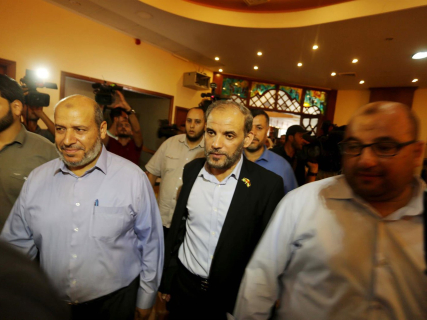

The Islamic Resistance Movement, Hamas, has confirmed this Wednesday that it plans to participate in the legislative elections called in Palestine for November 28, elections that, if they are finally held, will be the first of this kind in about twenty years after a long series of postponements.
"Hamas will participate in the elections within the broadest possible national coalition," said the head of the movement's National Relations office, Husam Badran, in statements to the Al Aqsa television network.
Badran explained that the Islamist group is "collaborating with numerous Palestinian factions to form an electoral bloc that encompasses a wide spectrum of the Palestinian people."
"A month ago, we began to hold meetings and maintain constant communication with various factions across the Palestinian spectrum, with the aim of forming the largest possible national electoral bloc, united by a mutually agreed political platform," the leader added.
The senior official avoided detailing possible vetoes or exclusions in the framework of these conversations, insisting that Hamas rejects "the principle of imposing conditions." "Hamas does not have veto power (...) to reach a minimum consensus on a political program," he emphasized.
However, Badran stressed that the goal of this broad front is to configure a Legislative Council — the Palestinian unicameral chamber created after the Oslo Accords of 1993 — that "represents a national base, believes in participation, and addresses the needs of the Palestinian people."
Among those priorities, he mentioned assistance to the Gaza Strip, support for the West Bank, "addressing the financial situation, combating the expansion of settlements" (...), as well as the restitution of the rights of the "martyrs" and prisoners and the "nationalization" of the education system.
The president of the Palestinian Authority, Mahmoud Abbas, signed a decree at the beginning of July setting November 28 as the date for the legislative elections, calling the population of the West Bank, the Gaza Strip, and East Jerusalem to the polls.
Palestine already held elections on April 25 to renew local councils, an event in which, in the case of the Gaza Strip, voting only took place in Deir al-Balá (center). That electoral day marked the first vote in more than twenty years in the enclave, where a fragile ceasefire has been in effect since October 2025, after more than two years of Israeli military offensive.
The last parliamentary elections date back to 2006 and concluded with the victory of the Change and Reform list, made up of candidates from Hamas, both in Gaza and in the West Bank —including East Jerusalem—. The result was rejected by Israel and the United States, with the backing of the Palestinian Authority itself, which subsequently led to an administrative and territorial split after an internal conflict between Palestinian factions.
Since then, no elections had been organized in Gaza, while in the West Bank only local elections have been held —in 2012, 2017, and 2022—. Presidential and legislative elections have been postponed repeatedly, fueling doubts about the legitimacy of Abbas's mandate, whom his rivals accuse of lacking the authority to represent the Palestinian people.
The Palestinian movement Hamas will participate in the upcoming elections for the Palestinian Legislative Council, a senior official from the movement's political office, Husam Badran, declared this Wednesday.
The president of the Palestinian National Authority (PNA), Mahmoud Abbas, issued a decree on July 9 calling for legislative elections on November 28, 2026.
He also commented that, together with the Palestinian factions, Hamas is working on creating an electoral bloc that will represent the interests of different groups in Palestinian society.
The Palestinian Legislative Council is . In 2018, Mahmoud Abbas officially dissolved the Parliament, and since then no elections have been held nor has the Legislative functioned de facto. (Sputnik)