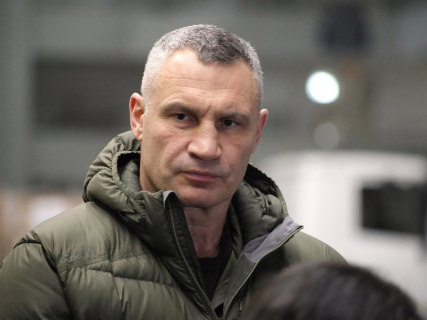

The mayor of Kiev, Vitali Klitschko, defended this Wednesday before the Parliament of Ukraine his work at the head of the capital, emphasizing that he keeps the city running not only against the attacks of the Armed Forces of Russia but also "despite the hard blows that the Government" of President Volodymyr Zelensky "constantly tries to inflict."
"Kiev is the heart of the State that the enemy tries to destroy. But no less terrible are the politicians within the country, who are also, in fact, destroying it," Klitschko stated, who was called by Zelensky's party, Servant of the People, to report on the current situation of the Ukrainian capital.
In his appearance, the mayor questioned the actions of the central Executive and launched several questions about the protection of the city. "Unfortunately, this is precisely what they understand by 'cooperation' (...) Where is the air defense to protect the capital? Where is the protection of the facilities of Ukrenergo (the state electricity company)? Where are the billions that were allocated for this?" he wondered.
Klitschko also accused the central authorities of trying to weaken municipal power throughout the country. "They are trying to destroy local government in Ukraine, and not only in Kiev. They dismiss community leaders for unbelievable reasons. They make absurd accusations, intimidate leaders of small communities with criminal complaints. Why doesn't parliament talk about this?" he insisted.
The mayor shared on social media the video of his speech in the Supreme Rada, where he emphasized that the capital continues to operate under "difficult war conditions" and "constant" Russian attacks that impact all sectors and the daily life of the inhabitants of Kiev.
During his intervention, Klitschko implicitly responded to Zelensky, who the day before had pointed out that Kiev would not have measured up to other regions under harsher circumstances. "Someone comments on how other cities have prepared, says that, unlike Kiev, they have done things. This is not true!" the mayor replied.
According to Klitschko, numerous cities "are bringing to light the problems that the Government created by freezing payments," a decision that, in his opinion, has halted key energy sustainability projects. Meanwhile, from the central Executive, "cynical accusations" and "false campaigns" about the alleged inaction of the Kiev administration would be launched.
"Not only in the capital. This is the situation in many communities, where the suspension of payments is killing the city's economy," he warned, claiming the effort of local authorities to maintain basic services and urban functioning despite the Russian bombings.
"Kiev is working, restoring, repairing, ensuring the functioning of the city. In conditions of worker shortages in public utility companies, of payment suspensions. In conditions where the enemy destroys the city day and night," the mayor emphasized.
A political confrontation aggravated by the Russian invasion
The tension between Klitschko and Zelenski is not new, but the management of the war has deepened the clash between the two. The mayor, in office since 2014 and a consolidated political figure, sees how the central Government is trying to limit the broad power he accumulates in the capital.
Klitschko has publicly accused the president of taking advantage of martial law to concentrate even more powers in the Executive and reduce the autonomy of local administrations and other democratic institutions. In Kiev, the elected mayor's office coexists with the military administration of the City of Kiev, directly appointed by Zelenski.
Unlike the frontline areas, where military administrations have taken over management, in the interior regions, elected authorities coexist with structures imposed by the central Government. This duality, especially visible in the capital, is generating ongoing friction over the distribution of responsibilities and control of the response to the war.