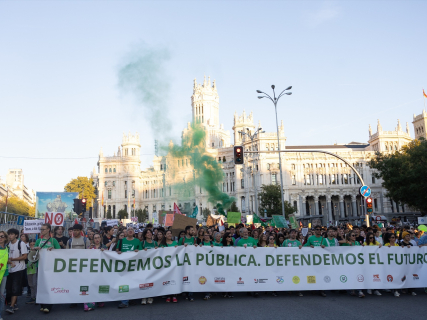
Thousands of people are demonstrating in Madrid in defense of public education on the first day of the strike.

The mobilization has traversed the center of the capital to demand better salaries, fewer students per classroom, and more resources for public centers. The unions estimate the participation in the strike at 70%, compared to 44.6% in the Community of Madrid.

EuropaPress 7845522 decenas personas concentracion motivo huelga indefinida educacion 14

EuropaPress 7845522 decenas personas concentracion motivo huelga indefinida educacion 14

Add DEMÓCRATA to Google

Ask FREN

Published

3 minutes

Most read

Thousands of teachers, students, and families have taken to the streets of Madrid this Wednesday to demand improvements in public education and protest against the educational policies of the Government of Isabel Díaz Ayuso. The demonstration, which started from Atocha at 6:00 PM, coincides with the beginning of an indefinite teachers' strike called to demand better working conditions, greater investment, and the reinforcement of educational resources.

The mobilization has gathered participants from different sectors of the educational community, including primary and secondary teachers, students, and early childhood educators. Under slogans such as "Hands up for education", "Not a step back" and "Mercedes, listen, the public is in struggle", the attendees have directed their criticisms at the regional president and the Minister of Education, Mercedes Zarzalejo.

The Ministry of Education places participation at 44.6%, while Comisiones Obreras raises it to 70%.

Fewer students per classroom, better salaries, and more investment

Among the main demands of the protesters are the reduction of student ratios per classroom, the decrease of teaching hours, the improvement of salaries, and the increase of teaching staff. They also demand more support professionals to attend to students with specific educational needs and greater resources for public centers.

The participants have denounced the difficulties in addressing the diversity of classrooms with the current means. Secondary and Vocational Training teachers have pointed out that the high number of students and the lack of specialized staff complicate teaching and increase the workload outside of teaching hours.
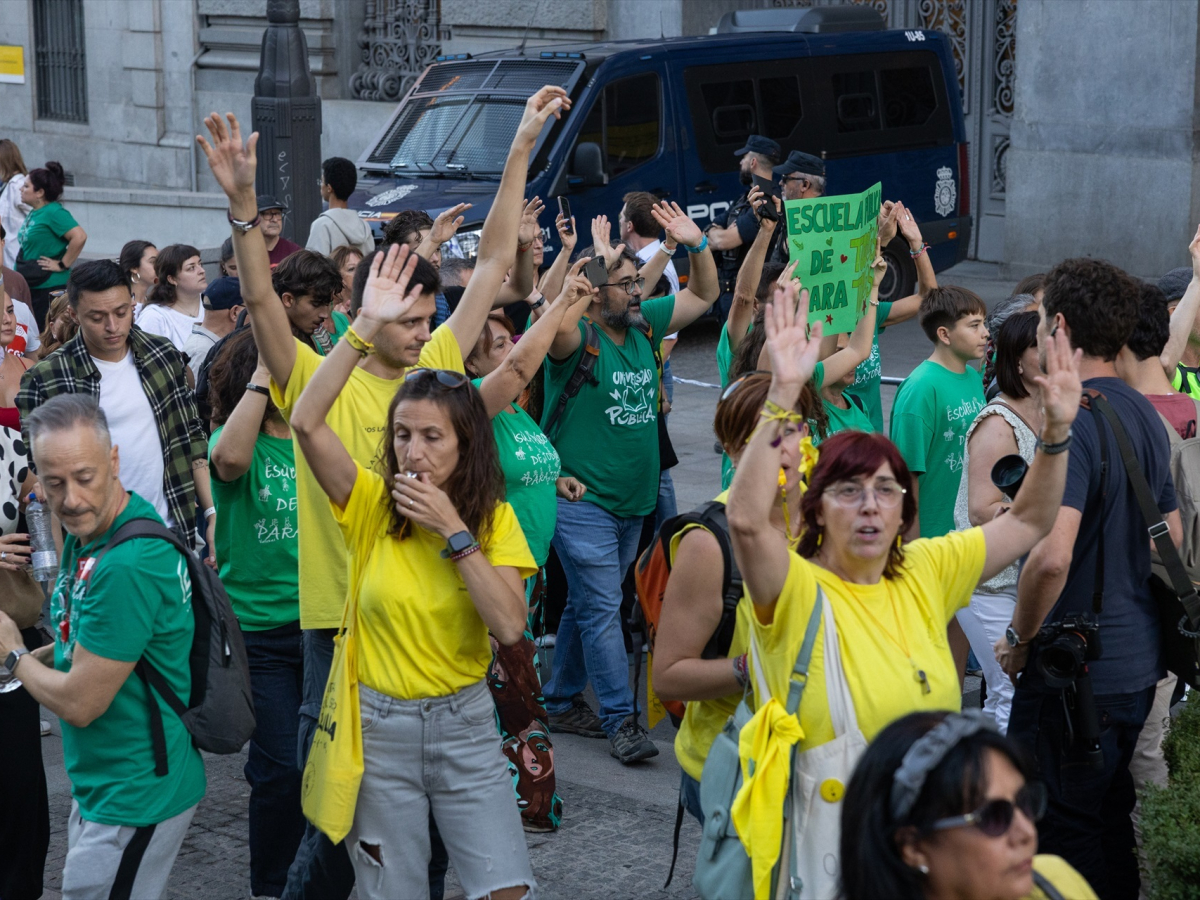
A group of people during a concentration due to the indefinite strike in education | Europa Press
A group of people during a concentration due to the indefinite strike in education | Europa Press -

The salary situation has been another of the issues present in the protest. Teachers have linked their economic demands to the high cost of housing in Madrid, while early childhood educators, who have also participated in the march, maintain their own mobilizations to demand labor and salary improvements.

During the march, slogans such as "More investment in education" and "Fewer penthouses, more education" were heard, in addition to messages in defense of public services.

The Ayuso Government qualifies the strike as "political"

The demonstration has taken place amid the confrontation between the Ministry of Education and the trade union organizations over the reasons for the call.

The minister Mercedes Zarzalejo has accused the organizers of using the strike for political purposes and has argued that their goal is "to heat up the streets," instead of seeking improvements for the Madrid educational system.

The unions reject this interpretation and defend that the protests respond to labor and educational demands raised months ago, before the announcement of the advance of the general elections to November 29.

The general secretary of the Education Federation of Comisiones Obreras, Aída San Millán, has responded that the mobilization questions the educational policies of the Community of Madrid, but does not constitute a partisan protest.

"If they are asking whether it is a political strike, yes, it is against the educational policies of the Community of Madrid, which have been making education suffer for 30 years," she stated in comments to elDiario.es.

San Millán has also criticized the functioning of the negotiation tables with the regional Administration and has accused the Ministry of breaching previous agreements, a valuation that contrasts with the position of the regional Government, which claims to hold periodic meetings with the union representatives.

The police charges at Complutense mark the day

The first day of the strike has also been marked by the police charges against a group of demonstrators at the Complutense University of Madrid, recorded during the morning of this Wednesday.

The incidents have provoked criticism among the participants in the afternoon demonstration, where slogans such as "Less police and more education" have been heard.

Following what happened, the Government delegate in Madrid has requested an urgent investigation into the police action. For its part, Ayuso's Executive has defended the agents' intervention and has linked the incidents to the development of the protests.

More key points, information and questions with FREN

AI-GENERATED CONTENT

What are the legal and administrative steps necessary for an indefinite teachers' strike to be officially recognized in the Community of Madrid?

For an indefinite teachers' strike in non-university public centers in the Community of Madrid to be legally recognized and managed as such, no prior “authorization” is required, but a series of legal and administrative requirements must be met. If respected, the Administration must treat it as a legal strike (pay deductions, minimum services, etc.); if not, it risks being declared illegal.

1. Who can call it and particularities of the teaching staff

The right to strike (art. 28.2 CE) applies both to labor personnel and teaching civil servants, with adaptations derived from the Basic Statute of the Public Employee and the Constitutional Court jurisprudence.

  • Authorized to call: the most representative unions at the state or regional level, unions with sufficient presence in Madrid's public education, works councils or staff boards (in the case of teaching civil servants, the Non-University Teaching Staff Boards) and, in certain cases, workers' assemblies that appoint a strike committee.
  • Civil servants vs. labor personnel: civil servant teachers (teaching bodies) and educational labor personnel share the same basic framework (Royal Decree-Law 17/1977, Law on Trade Union Freedom and EBEP), but the employment relationship and disciplinary regime differ. In practice, the call is usually made by unions present in the Education Sectoral Boards and extends to both groups.
2. Prior notice and competent body

Royal Decree-Law 17/1977 requires written prior notice with a minimum advance, which for essential services rises to 10 calendar days. Public education is considered an essential service, so this is the period that prudently must be respected for an indefinite teachers' strike.

  • Drafting and approval of the prior notice: the union or staff representation decides the strike in its competent body (committee, executive, assembly), approves the call text, and formally appoints the strike committee.
  • Formal communication: in the Community of Madrid it must be sent to:
    • the regional labor authority (General Directorate competent in Labor / Employment); and
    • the affected Administration, usually the Ministry of Education (and, if applicable, other involved employer ministries).
3. Mandatory content of the communication

The prior notice must be very clear, especially when the strike is indefinite:

  • Caller: identification of the union or staff representation calling the strike.
  • Personal scope: affected groups (civil servant and labor teachers, teaching bodies, support staff if included).
  • Territorial scope: entire Community of Madrid or specific Territorial Area Directorates or centers.
  • Start date and time and indefinite nature of the strike.
  • Specific reasons: professional, labor, organizational claims, etc., always linked to the service relationship.
  • Strike committee: nominal identification and contact details of its members.
  • Place for communications and negotiations with the Administration.
4. Minimum services and their challenge

In education, the Community of Madrid usually approves minimum services by order or resolution of the competent ministry, invoking the essential nature of the educational service.

  • The Administration must justify that the minimums are proportional, limited to guaranteeing basic student care and safety in centers, not to empty the right to strike of content.
  • Unions and the strike committee can challenge the minimum services before the contentious-administrative jurisdiction and request precautionary or urgent measures if they consider that the right to strike is violated.
5. Administrative management in DAT and centers

Once the prior notice is communicated, the Ministry and Territorial Area Directorates usually issue internal instructions:

  • Centers inform the faculty and families about the existence of the strike and the established minimum services.
  • Management organizes the coverage of minimum services by nominally designating the staff obliged to cover them.
  • Participation control is kept (who supports the strike) for payroll purposes, usually through daily reports sent to the DAT.
  • Communications with the strike committee are channeled for safety and basic center operation issues.
6. Risks of nullity or illegality

An indefinite teachers' strike can be declared illegal if:

  • the minimum prior notice is not respected or it is not communicated to the labor authority and the employer Administration;
  • the strike committee is not properly identified or is not in a position to negotiate;
  • it has exclusively political objectives without connection to working conditions or the teaching function;
  • attendance of non-strikers or compliance with the minimum services is prevented by coercion;
  • abusive forms of strike are articulated (rotating stoppages, work-to-rule, etc.) that jurisprudence has considered contrary to the right to strike.

Taking care of these aspects in the Community of Madrid is key for the strike to be treated as legal, enjoy constitutional protection, and not expose its promoters and participants to disciplinary sanctions or liability claims.

What are the competencies and functions of the Minister of Education of the Community of Madrid according to regional legislation?

According to Madrid's regional legislation, the competencies and functions of the Minister of Education of the Community of Madrid are determined at three main normative levels: the Statute of Autonomy, Law 1/1983 of December 13 on the Government and Administration of the Community of Madrid, and Decree 248/2023 of October 11 establishing the organic structure of the Ministry of Education, Science and Universities.

1. Statutory framework: educational competence of the Community of Madrid

The Statute of Autonomy (Organic Law 3/1983, February 25, amended by reform organic laws) recognizes the Community of Madrid:

  • Legislative development and execution competence in education matters, "in all its extent, levels and grades, modalities and specialties," in accordance with article 27 of the Constitution and the organic laws that develop it, without prejudice to the competencies that article 149.1.30.a CE reserves to the State (article renumbered in the Statute, today linked to the former art. 30).
  • The obligation to provide information to the State and collaborate in monitoring and evaluating the educational system (same statutory provision).

These provisions set the material framework in which the regional Government acts and, within it, the Ministry of Education: the Community designs and executes educational and university policy in its territory, within the limits of basic state regulations.

2. General functions of any regional minister (Law 1/1983)

Law 1/1983 establishes the regime of the regional Government and its members. The Statute defines the Government as the collegiate body that directs the Community's policy, exercises executive and administrative functions, and regulatory power in its own matters (article 21 of the Statute, included in section 23000-30500). Law 1/1983 develops this and, in particular, attributes to ministers:

  • Participate in directing the Community's policy as members of the Government Council.
  • Ensure compliance with laws and Assembly resolutions regarding their Ministry (article listing ministers' powers, section 30000-37500).
  • Propose and present to the Government Council draft laws and decree projects related to their department and endorse decrees once approved.
  • Propose appointments and dismissals of senior officials of their Ministry to be approved by the Government Council.
  • Prepare and propose the action program of their Ministry, as well as the draft annual budget and the draft annual action program of the economic public sector as it affects them.
  • Exercise superior leadership of personnel and services of the department: direct administrative activity, issue instructions and service orders, and coordinate general directorates and other management bodies (further development of article 41, visible in section 42000-49500).
  • Approve and authorize expenses within the limits set by the Budget Law, order payments through the ministry competent in finance, and enter into contracts related to their matters, with legally required authorizations.
  • Manage the assets assigned to their Ministry, decide on certain disposals within the limits established by the Budget Law, and exercise and desist from legal actions within their competencies, reporting to the Government Council.
  • In general, all powers granted by applicable regulations.

Additionally, Law 1/1983 configures them as senior bodies of the regional Administration, subject to political responsibility before the Assembly through the Government Council and to the incompatibility regime for Executive members.

3. Specific competencies of the Minister of Education (Decree 248/2023)

Decree 248/2023 specifies the material scope of the Ministry of Education, Science and Universities. Its article 1 states that:

  • The head of the Ministry has the competencies of article 41 of Law 1/1983 and other provisions in force; that is, all the general functions of any minister described above.
  • As a senior body of the regional Administration, they are responsible for the general development, coordination, and control of the execution of Government policies in the areas of:
    • Non-university education.
    • Universities.
    • Artistic education.
    • Scientific research and technological innovation, with special reference to the digital context.

The organic structure provided in article 2 (Deputy Ministers of Educational Policy; Universities, Research and Science; and Educational Organization, general directorates and technical general secretariat) shows that the minister:

  • Directs and coordinates the deputy ministries and general directorates responsible for curriculum, academic organization, network of centers, teaching staff, infrastructure, universities, research, and innovation.
  • Promotes the development of regulations and plans in these areas (education organization, university policy, scholarships and aid, educational infrastructure policy, promotion of research and innovation).
  • Politically represents the Community of Madrid in educational and university matters and exercises coordination and cooperation functions with the General State Administration and other administrations, based on the Statute and Law 1/1983.

In summary, the Madrid Minister of Education accumulates: the generic competencies of any member of the regional Government (delegated regulatory power, normative promotion, budget management, personnel and services direction, contracting and asset management) and the specific responsibility to design, coordinate, and execute the Community of Madrid's policy in education, universities, and research, within the constitutional and statutory distribution of competencies.

Could you detail the functions of each of the deputy ministries of the Ministry of Education, Science and Universities according to Decree 248/2023? What limits do the Constitution and basic state legislation impose on the educational competencies of the Community of Madrid as set out in the Statute? How is, according to Law 1/1983, the political and legal responsibility of the Minister of Education articulated before the Assembly of Madrid and the courts?

What has been the evolution of educational investment in the Community of Madrid compared to other Spanish autonomous communities in the last ten years?

In the last decade, the Community of Madrid has appreciably increased its educational spending in absolute terms, but it remains below the Spanish average when measuring relative effort (percentage of GDP) and public spending per student, both in non-university education and, to a lesser extent, university education.

Evolution of spending in the Community of Madrid

According to data series from the Community of Madrid itself and the Public Spending in Education Statistics, Madrid's educational spending (educational administration plus other ministries) has risen from about 4.805 billion euros in 2013 to around 6.733 billion in 2022, representing an increase close to 40% in nominal terms over that period. The rise accelerates from 2017 and is reinforced by pandemic-related funds.

For 2023, Madrid's budget documentation records total education spending of around 7.370 billion euros, of which about 5.051 billion corresponds to non-university education and 2.079 billion to university education, plus about 240 million executed by other ministries. That is, Madrid has continued increasing resources year by year, in line with the general expansion of educational spending in Spain.

State context: general spending growth

Across Spain, the Ministry of Education, Vocational Training and Sports estimates public spending on education at 63.380 billion euros in 2022 (6% more than in 2021) and 67.9379 billion in 2023 (another 7% increase), according to official press releases from 2024 and 2025. Relative to GDP, state educational spending stood around 4.7% in 2022, maintaining a clearly higher proportion than that of the Community of Madrid.

Relative effort: percentage of regional GDP

The main difference of Madrid compared to other communities appears when educational effort is measured as percentage of regional GDP. Comparisons based on the Public Spending in Education Statistics indicate that:

  • Around 2023, the Community of Madrid allocates approximately 2.4% of its GDP to education.
  • The Spanish average is close to 4.6% of GDP.
  • This difference of more than two percentage points places Madrid at the bottom of autonomous communities in relative effort, despite being one of the regions with the highest income.

This data should be read with caution: a very high per capita GDP means that, for the same spending in euros, the percentage of GDP is lower. However, the gap is wide enough to reflect comparatively low budgetary effort in education compared to most regions.

Public spending per student and ratios

Another way to compare investment is public spending per student in non-university public centers. Recent estimates place Madrid at about 4,744 euros per student in 2023, clearly below the national average and among the lowest figures in the country. This is a relevant indicator because it approximates the resources available per student, regardless of GDP size.

Additionally, data from the State Education Indicators System show that, while the Spanish average student-teacher ratio in non-university education is around 11.4, Madrid records one of the highest ratios in public centers (around 12.5 students per teacher). This does not directly equate to the number of students per classroom but suggests a relatively lower teaching staff allocation compared to other communities.

Comparison with other autonomous communities

The combination of these indicators paints a clear pattern:

  • In absolute terms, Madrid is among the communities that spend the most on education by total volume, due to its population and economic size.
  • In relative terms —percentage of GDP and public euros per non-university student— it is below the Spanish average and behind many communities with lower income, which allocate a higher proportion of their economy to the educational system.
  • Organizations such as CCOO or Save the Children, in their reports, often highlight precisely this contrast between nominal growth of Madrid's budget and lower relative effort than other regions, especially in sensitive areas such as early childhood education, educational reinforcement, or reducing inequalities.
Conclusion

In the last ten years, the Community of Madrid's educational investment has grown steadily in current euros and has benefited, like the rest of the country, from the general increase in educational spending. However, comparison with other autonomous communities shows that Madrid maintains a low educational effort profile: it allocates one of the smallest proportions of its GDP to education and presents a public spending per non-university student below the national average. This suggests that, despite the budget increase, there is significant room to strengthen relative investment in education if convergence with the effort levels of other regions is desired.

Can you break down Madrid's educational spending evolution year by year in the last decade, differentiating non-university and university education? Which autonomous communities today have public spending per student clearly higher than Madrid and by what magnitude? How do unions and organizations like Save the Children assess the impact of Madrid's lower educational effort on system equity?

Play

Test your knowledge with FREN!

How much do you know about this topic? Answer the following 3 questions.

Where did the demonstration in defense of public education in Madrid start?

Question 1 of 3

What percentage of participation in the teachers' strike does the Madrid Department of Education report?

Question 2 of 3

What incident marked the day of the educational strike at the Complutense University of Madrid?

Question 3 of 3