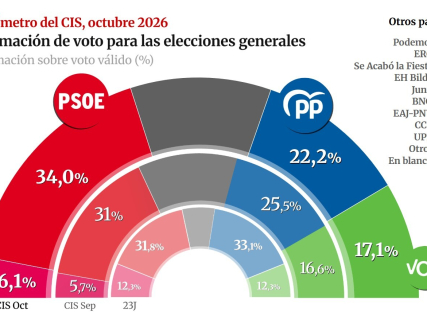
The CIS shoots the PSOE to 34% and gives the PP its worst figure of the entire legislature.

The socialists rise three points and expand their lead over the PP to 11.8 points, which falls to 22.2%. Vox reaches 17.1%, while Sumar improves to 6.1% and Podemos falls back to 3.1%.

EuropaPress 7844383 estimacion voto barometro centro investigaciones sociologicas cis publicado

EuropaPress 7844383 estimacion voto barometro centro investigaciones sociologicas cis publicado

Add DEMÓCRATA to Google

Ask FREN

Published

Last updated

1 minute

Most read

The October CIS, the first since Pedro Sánchez announced the advance of the general elections to November 29, places the PSOE at 34% of estimated votes, three points more than in September, and sinks the PP to 22.2%, its worst figure of the entire legislature.

The barometer, published this Wednesday in the midst of the electoral pre-campaign, expands the advantage of the socialists over the populars to 11.8 points, who lose 3.3 points compared to the previous month. Vox, for its part, improves by five tenths and reaches 17.1%, 5.1 points behind the PP.

Sumar rises and Podemos loses six tenths

In the space to the left of the PSOE, Sumar obtains an estimated vote of 6.1%, four tenths more, while Podemos falls six tenths to 3.1%. Together, both formations total 9.2%, although the survey records their results separately.

ERC also improves by five tenths and reaches 3%, while EH Bildu rises three tenths to 1.6%. Se Acabó la Fiesta (SALF), the formation of Alvise Pérez, remains at 1.8%.

Vote estimation of the CIS

Party Vote estimation Variation
PSOE 34.0% +3.0 points
PP 22.2% -3.3 points
Vox 17.1% +0.5 points
Sumar 6.1% +0.4 points
Podemos 3.1% -0.6 points
ERC 3.0% +0.5 points
SALF 1.8% No changes
EH Bildu 1.6% +0.3 points

Source: advanced data from the CIS. Variations compared to the previous barometer, expressed in percentage points.

More key points, information and questions with FREN

AI-GENERATED CONTENT

At what stage of parliamentary processing is the electoral call announced for November 29?

The call for general elections on November 29, 2026 is not in a usual “parliamentary processing phase”. The decisive step has already been taken at the government level and perfected with its publication in the BOE: we are facing an electoral process already called and underway, not an initiative subject to debate or approval by the Cortes.

1. Which regulation has launched the call

The call has been formalized through Royal Decree 806/2026, of October 5, dissolving the Congress of Deputies and the Senate and calling elections. According to the BOE, this royal decree:

  • Dissolves the Congress and Senate elected on July 23, 2023.
  • Calls elections for Sunday, November 29, 2026 for both Chambers.
  • Sets the electoral campaign from November 13 to 27.
  • Establishes that the new Chambers will convene on December 23, 2026, at 10:00 a.m.
  • Determines the distribution of seats by constituency based on articles 162 and 165 of the LOREG.

The decree was published in the BOE of October 6, 2026 and came into force that same day (reference BOE-A-2026-20742).

2. Nature of the decree and (absence of) parliamentary processing

From a legal point of view, this call is based on Article 115 of the Constitution and Article 42.1 of the LOREG:

  • The Prime Minister may propose the dissolution of the Congress, the Senate, or both Chambers.
  • After the Council of Ministers deliberates, the King issues the royal decree of dissolution and call.
  • The decree is published in the BOE and from that moment the electoral process is called, with elections on the 54th day after publication.

This royal decree is an act of the executive power with a singular regulatory rank, not a legislative initiative. It is not processed as a bill, nor as a legislative proposal, nor as a royal decree-law. Therefore:

  • It is not subject to validation or repeal by the Congress, unlike royal decree-laws.
  • It does not go through phases of consideration, amendments, committee report, or plenary vote.
  • Its control is essentially jurisdictional (possible control by the Constitutional Court) and general political, but not through a parliamentary “processing” with successive stages.

Consequently, to the strict question of “at what stage of parliamentary processing” it is, the technical answer is that there is no proper parliamentary phase: the decision has already been adopted and perfected by the Government and the King, and Parliament is not processing it nor must approve it.

3. Current situation of the Cortes and role of the Permanent Deputation

With the entry into force of Royal Decree 806/2026:

  • The General Courts of the XV Legislature have been dissolved; the mandate of deputies and senators elected in July 2023 ends.
  • The Permanent Deputation of each Chamber remains in function, safeguarding the powers of the institution while it is dissolved or the mandate has expired.

The Congress note on dissolution recalls that, during this period, the Permanent Deputation may, among other things, validate or repeal royal decree-laws and exercise certain powers related to states of alarm, exception, and siege. But all this refers to other Government decisions (for example, royal decree-laws of material content), not to the dissolution and call decree itself, which has already taken full effect.

4. Where we are in the institutional calendar

Since the decree was published in the BOE, the current point is:

  • Electoral period open, with deadlines already running for:
    • Formation of coalitions and submission of candidacies.
    • Request and management of postal voting (according to Demócrata and postal service communications).
    • Formal electoral campaign from November 13 to 27.
  • Voting day set for November 29, 2026.
  • Constitution of the new Chambers scheduled for December 23, 2026, at 10:00 a.m., according to article 68.6 of the Constitution.

All this means that, from the parliamentary perspective, the relevant “file” is not an ongoing initiative, but the consummated dissolution of the Cortes and the preparation of the new legislature. The electoral call does not advance through parliamentary phases, but through milestones of the electoral calendar already set by the royal decree and the LOREG.

What procedural differences exist between this royal decree of dissolution and a royal decree-law that must be validated by the Permanent Deputation? What margin of action does the Government maintain between the dissolution of the Cortes and the November 29 elections? Which specific bills have lapsed due to the dissolution and can no longer be approved before November 29?

What are the powers and political trajectory of Pedro Sánchez as Prime Minister?

Pedro Sánchez Pérez-Castejón has been Prime Minister of Spain since June 2018 and, since 2017, Secretary General of the PSOE (a position he had already held between 2014 and 2016). As Prime Minister, he is the head of the executive power and directs the Government's action within the framework set by the Constitution, laws, parliamentary control, and the European Union. His trajectory combines municipal, parliamentary, and internal leadership experience within the PSOE.

Powers as Prime Minister

According to the Constitution and Government legislation, his powers revolve around several key functions:

  • Political direction of the Executive: the Government is entrusted with directing domestic and foreign policy, civil and military administration, and state defense. Within this framework, the Prime Minister sets the political program, priorities, and major lines of action of the Executive, both domestically and internationally.
  • Coordination of vice presidencies and ministries: he is responsible for coordinating vice presidents and ministers, issuing directives, and resolving conflicts of competence between departments. The management of the Council of Ministers, as a collegiate decision-making body, depends on his ability to set the agenda and arbitrate between portfolios.
  • Nomination and dismissal of the Government: he proposes to the King the appointment and dismissal of vice presidents and ministers; formally, the head of State appoints them, but the political decision is the Prime Minister's. He also decides the Government's structure (creation, suppression, or modification of ministries and high bodies) through royal decrees, within legal limits.
  • Calling and presiding over the Council of Ministers: he convenes, presides over, and sets the agenda for Council of Ministers meetings, where bills, royal decree-laws, and other relevant executive decisions are approved.
  • Institutional representation: he represents the Government before the King, the Cortes Generales, autonomous communities, the European Union, and in international forums such as the G20, where he has defended multilateralism and Spain's role in international cooperation.
  • Relationship with the Cortes: he may raise a vote of confidence on his program or a general policy declaration and propose to the King the dissolution of the Congress, the Senate, or both Chambers and the calling of elections, always respecting constitutional requirements and time limits. The Congress may demand the Government's political responsibility through a constructive vote of no confidence.
  • Other constitutional functions: he endorses acts of the King, proposes consultative referendums with Congress authorization, directs defense policy within the legal framework, and may initiate constitutional appeals defending the Government's position.

In recent practice, these powers have been exercised in a context of coalition or minority governments, which has strengthened the weight of negotiation with other parties and coordination with parliamentary partners. His room for maneuver is conditioned by majorities in the Congress and by political, judicial, and constitutional control of the Executive's decisions.

Political trajectory of Pedro Sánchez

According to the official biography from La Moncloa and other institutional and reference sources, Pedro Sánchez (Madrid, 1972) is an economist who joined the PSOE in 1993. He has developed a career linked to the party and institutions since the 1990s:

  • Initial stage and international experience: before holding elected office, he worked as an advisor in the European Parliament and in the United Nations environment, particularly in Bosnia and Herzegovina, and carried out technical and political tasks linked to the PSOE.
  • Municipal sphere: between 2004 and 2009 he was a councilor of the Madrid City Council for the PSOE, where he began his frontline institutional trajectory.
  • Deputy in the Congress: he was a deputy for Madrid in the Congress in two main periods (2009‑2011 and 2013‑2016), participating in legislative activity and government oversight from the socialist bench.
  • Secretary General of the PSOE and opposition leader: in 2014 he won the PSOE primaries and succeeded Alfredo Pérez Rubalcaba as secretary general, becoming opposition leader. He was the socialist candidate for Prime Minister in the 2015 and 2016 general elections.
  • Internal crisis and return: after a strong internal crisis in 2016, he resigned as secretary general and gave up his seat. In 2017 he regained party leadership by winning primaries again, consolidating the Secretary General position at the 39th Federal Congress.
  • Prime Ministership: in June 2018 he became Prime Minister through a vote of no confidence against Mariano Rajoy, the first successful one in Spanish democracy. Subsequently, he was re-invested after the 2019 and 2023 general elections. Royal Decree 828/2023, of November 16, reappointed him Prime Minister, published in the BOE of November 17, 2023.
  • Coalition governments and successive terms: he first presided over a single-party socialist government and, since 2020, the first state coalition government (PSOE–Unidas Podemos). After the 2023 elections, he was re-invested with support from several parliamentary forces, simultaneously maintaining the PSOE Secretary Generalship.

In summary, Pedro Sánchez's powers as Prime Minister place him at the center of the political direction of the Executive, while his trajectory shows an evolution from party membership and municipal level to PSOE leadership and head of Government, with a decisive weight of internal party dynamics and parliamentary majorities.

Can you detail how Pedro Sánchez has used instruments such as the royal decree-law or the vote of confidence during his terms? What role has Pedro Sánchez's PSOE played in forming coalition governments and parliamentary agreements since 2018? How do the powers of the Prime Minister compare with those of the King and the Cortes Generales in the Spanish constitutional system?

What legal requirements must be met for the CIS to publish voting estimates and electoral barometers?

For the Sociological Research Center (CIS) to prepare and publish surveys, voting estimates, and electoral barometers, it must comply with a set of requirements derived mainly from its own organizational law, its organizational regulations, and the Organic Law of the General Electoral Regime (LOREG), developed by the Central Electoral Board (JEC).

1. Basic framework of the CIS: law and regulations

Law 39/1995, on the Organization of the CIS establishes that the CIS is an autonomous administrative body whose purpose is the scientific study of Spanish society. Its principles of action (arts. 2 and 5) include:

  • Objectivity, neutrality, and impartiality in its actions.
  • Research transparency: informing respondents about the organization conducting the study, its purpose, and data protection guarantees.
  • Voluntariness of responses, especially on political, religious, ideological, or privacy-related questions.
  • Specialty: use of information exclusively for research purposes within its statutory objectives.
  • Protection of personal data and respect for statistical secrecy.

Royal Decree 1214/1997, on the organization of the CIS, develops these principles and specifies that the body acts as an official statistical service, subject to Regulation (EU) 2016/679, Organic Law 3/2018 on data protection, and Law 12/1989 on Public Statistical Function. This implies that electoral surveys must:

  • Anonymize data before exploitation and dissemination.
  • Guarantee representativeness and methodological rigor typical of public statistics.
  • Be entered into the data bank once the technical process is completed, with regulated public access.

Additionally, Law 39/1995 requires the CIS to send the General Courts a provisional advance of survey results on voting intention, party and political leader ratings within a maximum of fifteen days from the end of fieldwork, introducing an obligation of prior or parallel institutional information to public dissemination.

2. Specific requirements during the electoral period (LOREG and JEC)

The special regime during campaigns is set by Law 5/1985, the General Electoral Regime, and developed by Instruction 1/2024 of the Central Electoral Board, which interprets article 69.8 LOREG on voting intention surveys conducted by public bodies — explicitly including the CIS — during electoral periods.

The key requirements are:

  • Prohibition of publication in the last five days: article 69.7 LOREG prohibits publishing or disseminating electoral polls by any means during the five days before voting. The CIS, like any other entity, must respect this “demoscopic silence period.”
  • Strict compliance with what the electoral administration determines: the second additional provision of Law 39/1995 orders that, during electoral periods, the CIS “will adjust its actions to what the electoral administration determines according to the LOREG,” and in particular may only publish polls “under the terms provided in article 69.”
  • Prior communication to the JEC: Instruction 1/2024 requires any public administration-dependent body conducting surveys with questions on voting intention, party or political leader ratings to notify the Central Electoral Board in advance:
    • Start of the study, before fieldwork begins (at least 48 hours prior).
    • Technical characteristics: sampling system, expected sample size, margin of error, representativeness level, selection procedure, survey techniques, field and study completion dates, and draft questionnaire.
  • Equal access for parties and candidacies: article 69.8 LOREG requires that results of voting intention surveys conducted by public bodies, when requested, be made available to political entities competing in the corresponding territorial scope within a maximum of 48 hours. Instruction 1/2024 emphasizes that this duty aims to guarantee equal conditions, avoiding privileged use of information by a single political actor.
3. Transparency, control, and sanctions

Throughout the process, the CIS must respect the demands of transparency and objectivity established by the LOREG. Article 69.2 assigns the JEC the function of ensuring that published polls do not contain deliberate falsifications, omissions, or manipulations and that they include the required methodological specifications (sufficient technical sheet).

In case of non-compliance with these rules, the Electoral Board may correct infractions and impose fines within the electoral sanctioning regime, and, in extreme cases (e.g., deliberate falsification of official data in the electoral process context), criminal offenses provided in the electoral crimes chapter of the LOREG related to the Penal Code could also be activated.

In summary, to publish voting estimates and electoral barometers, the CIS must: act with objectivity and neutrality, respect data protection and statistical secrecy, guarantee methodological transparency, inform the Cortes and parties, submit its studies to prior and continuous control by the Electoral Board during the electoral period, and strictly observe the prohibition of dissemination in the five days prior to voting.

Play

Test your knowledge with FREN!

How much do you know about this topic? Answer the following 3 questions.

What is the vote estimate for PSOE according to the October CIS barometer?

Question 1 of 3

Which party shows the highest vote loyalty according to the October CIS?

Question 2 of 3

How much has the PP vote estimate dropped compared to the previous month according to the CIS?

Question 3 of 3