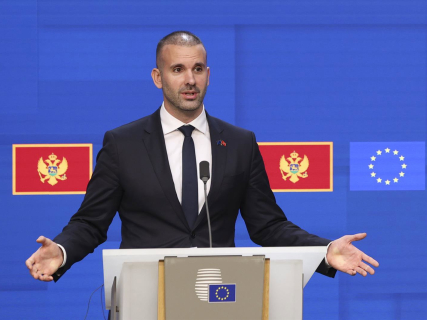

The Prime Minister of Montenegro, Milojko Spajic, has this Friday committed himself to continue working to resolve the bilateral disputes that his country maintains with Croatia, after Zagreb has set a series of conditions that Podgorica must meet before giving its definitive approval to its accession as a new member state of the European Union.
"We are working tirelessly, our teams from the Ministry of Foreign Affairs of Montenegro and those of Croatia, to resolve any possible bilateral issue that we may have," Spajic assured at a press conference in Brussels, after taking part in the 30th intergovernmental conference, in which Montenegro has managed to provisionally close two more negotiation chapters for its access to the EU bloc.
The head of the Montenegrin Government has insisted that his Executive "will not leave any stone unturned" until reaching "a European-style compromise" on all the matters that still separate the two Balkan countries, and he has underlined that the accession process to the bloc represents "a great opportunity" to bring their positions closer together.
For his part, Thomas Byrne, Minister for European Affairs and Defence of Ireland— a country that holds the presidency of the EU Council—, has expressed himself confident that the divergences between Montenegro and Croatia "will be able to be resolved," after meeting with the Croatian State Secretary for European Affairs, Andreja Metelko-Zgombic.
"I am very grateful for the work of the Croatian Government and for allowing us to achieve such substantial progress," Byrne indicated, who has admitted the existence of bilateral disputes between the two countries, although he has stressed that it is a "normal" situation between neighboring states.
Croatia, a brake for the most advanced candidate
Relations between Montenegro and Croatia continue to be one of the main political challenges that Podgorica must face on its path toward accession to the European Union, since Zagreb has the capacity to block any progress of the process, which requires the unanimous approval of all member states.
Croatia has put eight bilateral matters still pending with Montenegro on the table, related, among other points, to war crimes during the disintegration of Yugoslavia and to territorial and heritage conflicts. Although in recent months both countries have managed to close two of these issues, several discrepancies are still left open.
Among Croatia’s demands is compensation for prisoners at the Morinj camp (Montenegro), where more than 300 Croatian citizens were held between 1991 and 1992, as well as the preservation of the existing commemorative plaque at the site, without it being covered by other structures.
Likewise, Zagreb is demanding a name change for the municipal pool in Kotor, which currently bears the name of the water polo player Zoran Gopcevic, who, according to Croatia, would have acted as a guard at the Morinj camp. This is added to by the demand to clarify the whereabouts of 14 missing Croatian citizens.
Another of the conditions that Croatia links to Montenegro’s entry into the EU is the prosecution of war crimes, including cases relating to command responsibility, as well as the resolution of disputes over property belonging to Croatian families, among them 51 families from Tivat and other residents in the Bay of Kotor.
Finally, Zagreb is demanding the return of the training ship "Jadran", which it considers to be its property under the agreements regarding the succession of the former Yugoslavia, as well as the closing of the border dispute by recognizing the former dividing line between the two republics and signing an agreement on the land border.
Montenegro faces the final phase of accession
Spajic’s words come after the European Commission this week placed Montenegro in the decisive phase of its accession process, with the goal of concluding the negotiations before the end of 2026, signing the accession treaty in 2027, and allowing the Balkan country to become the twenty-eighth Member State of the European Union in 2028.
This Friday, Montenegro has advanced one more step toward that objective by provisionally closing two additional negotiation chapters, those relating to the free movement of goods and food safety, as well as veterinary and phytosanitary policies.
With these progressions, the Balkan country now totals 23 of the 33 negotiation chapters closed provisionally, so it still has ten to complete before it can consider the accession talks concluded.