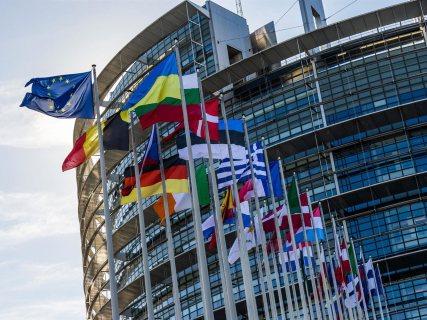

The European Parliament has urged this Thursday the Member States to analyze whether certain entities and individuals linked to the Islamist organization Muslim Brotherhood should be added to the European list of terrorist organizations, within a package of actions to curb the infiltration of these networks into democratic institutions and strengthen the oversight of their funding and activities in Union territory.
The resolution, approved in the plenary session in Strasbourg (France) with 381 votes in favor, 167 against, and 15 abstentions, condemns the tactics of Islamist infiltration aimed at undermining European values, the rule of law, equality between men and women, and fundamental freedoms, and warns of the danger that these groups may use institutions and public resources to expand their influence.
In this context, the Eurochamber maintains that Europe must continue to be a "free, open, and true to its principles" society, but emphasizes that it cannot continue "financing, consulting, or legitimizing networks that use its language, its procedures, and its funding to weaken its values from within."
Members of the European Parliament also ask the community institutions to tighten controls prior to any cooperation with entities potentially involved in these strategies, explicitly citing the European Forum of Muslim Youth and Student Organizations (FEMYSO) and other structures related to the Muslim Brotherhood.
Evaluate their inclusion in the list of terrorist organizations
One of the central axes of the text is the request to the Council (the governments) to examine whether certain entities or individuals connected with the Muslim Brotherhood meet the conditions to be included in the European list of terrorist organizations, which would entail the imposition of sanctions.
For this evaluation, the Parliament demands that it not be limited to "the formal structures" of the organization, but also extend to associated entities, front organizations, financial intermediaries, youth networks, and individuals with leadership or coordination responsibilities.
In the financial sphere, the MEPs demand greater traceability of European funds and "stricter" controls over the organizations that receive community aid. Furthermore, they ask the European Commission for a detailed report on the resources granted to individuals or entities suspected of having ties to the Muslim Brotherhood or political Islam.
The text also calls for strengthening oversight of foreign funding and transnational associations, particularly those involving actors linked to Qatar or Turkey, as well as enhancing cooperation among member states, Europol, and Eurojust to identify possible influence networks.
Support for banning the burka and niqab in public spaces
On the other hand, the European Parliament supports national measures that prohibit the use of full veils (niqab or burka) in public places, considering that this practice constitutes "an unacceptable challenge to public safety and law enforcement."
The MEPs justify these restrictions as a tool to promote "social cohesion" and safeguard "the fundamental rights and freedoms of others, especially those of women."
The resolution also calls for the creation of a European list of hate preachers, following the example of initiatives already in place in some member states, with the aim of tightening controls on the granting of visas and residence permits to individuals included in that register.
At the same time, the Parliament emphasizes that the response to Islamist infiltration must be accompanied by specific measures to protect Muslim citizens from discrimination, which it qualifies as a "democratic obligation," and requests support for civil society organizations and Muslim representatives who defend democratic values and oppose Islamist pressures.