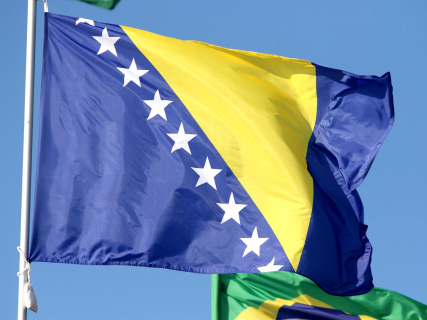

The nationalist parties have once again strengthened their control over the political scene of Bosnia and Herzegovina after the elections held this Sunday in the country, in which Denis Becirovic, Darijana Filipovic, and Zeljka Cvijanovic have been chosen to integrate the tripartite presidency representing the Bosniak, Croatian, and Serbian communities.
In the Bosniak sector, Becirovic, candidate of the coalition United for the State of Bosnia and Herzegovina, has renewed his mandate with 208,027 ballots, 26.75%, ahead of Bakir Izetbegovic (23.82%), Semir Efendic (18.04%), and Fahrudin Radoncic (1.5%), according to the still provisional official data corresponding to 93% of the count.
On the Croatian side, Filipovic has achieved 48.2% of the votes as a candidate of the Croatian Democratic Union of Bosnia and Herzegovina (HDZ BiH), thus surpassing the representative of the Democratic Front, Slaven Kovacevic (28.8%), and the independent Zdenko Lucic, becoming the new Croatian representative in the Presidency.
The third member of the Bosnian Presidency, on behalf of the Serbian community, will again be Cvijanovic, candidate of the Alliance of Independent Social Democrats (SNSD), after obtaining 55.33% of the votes. In second place was Marinko Bozovic, of the Serbian Democratic Party (SDS), with 26.55%, followed by Nebojsa Vukanovic, of For Justice and Order, with 18.1%.
Participation was at 41.5%, the lowest record to date and well below the 51.5% reached in 2022, according to figures released by the Central Election Commission (CIK). In addition, 3.36% of ballots were counted as blank and 1% as invalid votes.
On this day, the regional and federal parliaments were also elected, although the complexity of the institutional framework prevents drawing clear conclusions immediately and will require the usual negotiations of several months to form the different executives.
Bosnia has a Muslim Bosniak majority that represents approximately half of the population, while Orthodox Serbs account for about a third and Catholic Croats around 15%. The current model of power sharing derives from the agreements that ended the 1992-1995 war, triggered by the disintegration of Yugoslavia and which left around 100,000 dead and more than two million displaced as a result of ethnic cleansing.
Bosnia and Herzegovina is structured in the Federation of Bosnia and Herzegovina, made up of Croats and Bosniaks, and the Republika Srpska with a Serbian majority. The Serbian representative in the tripartite Presidency is elected by the Serbian community, while the Bosniak and Croat representatives are elected separately by all voters of the Federation.