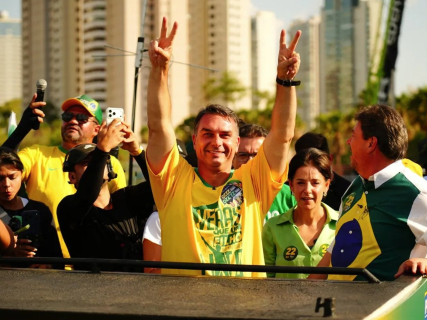
Elections in Brazil: Lula outpaced Bolsonaro by six million votes in 2022 and ended up winning by two

Brazil enters the last hour of voting pending who finishes first and if someone surpasses 50%. The precedent of the previous presidential elections explains why the distance between the candidates will be one of the keys of the night.

2 minutes

fotonoticia 20261004142056 1920

fotonoticia 20261004142056 1920

Add DEMÓCRATA to Google

Ask FREN

Published

Last updated

2 minutes

Most read

Brazil approaches the closing of the polls with two different questions: who will get the most votes and whether any of the candidates will gather enough to avoid a second round. At 21:00 in peninsular Spain, 16:00 in Brasília, voting continues. The dissemination of the presidential count is scheduled to start at 22:00, according to the calendar of the Superior Electoral Court.

When the results start to arrive, the first position will concentrate attention. But the margin between the candidates will also have a political reading. The 2022 elections left an eloquent precedent: Lula finished the first round with more than six million votes ahead of Jair Bolsonaro and won the second by just over two million.

Now he faces Flávio Bolsonaro. The change of candidate and context prevents mechanically transferring that result, although it allows recalling that a favorable first round does not resolve the Presidency.

From 6.18 million advantage to 2.14 million

In the first round of 2022, Lula received 57,259,504 votes, 48.43% of the valid ones. Jair Bolsonaro obtained 51,072,345, 43.20%. The difference was 6,187,159 votes and 5.23 percentage points. Neither reached the majority needed to win without a new vote.

In the second round, Lula rose to 60,345,999 votes and Bolsonaro reached 58,206,354. The final result was 50.90% against 49.10%: a distance of 2,139,645 ballots, equivalent to 1.80 points.

Both candidates gained support, but Bolsonaro grew more between the two dates. Lula's advantage was reduced by about four million votes.

What it means to finish first tonight

To win the Presidency in the first round, it is necessary to surpass half of the valid votes. Blank and null votes do not count in that calculation. If no one reaches that threshold, the top two will go to the second round on October 25.

In that scenario, finishing first would offer a favorable position for the next campaign, but no additional votes: the second round begins with a new vote.

The difference between the finalists will allow measuring the distance that the one who finishes second would have to recover. It will also matter how much support the eliminated candidacies have gathered, without assuming that their voters will automatically follow the recommendations of their leaders.

A provisional advantage is not a definitive result either

Before interpreting those margins, we will have to wait for the totalization to progress. The TSE will incorporate the data as it receives and processes the reports from the ballot boxes; the first figures do not equate to the result of the entire country.

The lesson from 2022 is not that the same evolution will repeat itself. It is that even a lead of millions of votes can narrow considerably between two rounds. Tonight Brazil will decide whether to elect a president or to open another three weeks of campaigning.

More key points, information and questions with FREN

AI-GENERATED CONTENT

What are the procedures and deadlines established by Brazilian electoral legislation for the official proclamation of presidential election results?

Brazilian electoral legislation assigns the Superior Electoral Court (TSE) the authority to nationally totalize the votes of the presidential election and officially proclaim the winning ticket. The 1988 Constitution sets the institutional framework of the Electoral Justice, while the Electoral Code, the Election Law, and specific TSE resolutions detail the procedure for scrutiny, totalization, and proclamation. The decisive factor is not a fixed deadline of “X days,” but the approval of the final totalization report.

1. Phases of scrutiny and totalization

The process is structured in several linked levels, from the electoral section to the national count:

  • Scrutiny at the electoral section (polling station): at the close of voting, each electronic ballot box calculates the votes recorded and prints the ballot box report, a document that records the local result of that section. Several copies are generated, and one of them is publicly displayed at the door of the room used as the electoral section, allowing social control and verification by parties and observers.
  • Data transmission to the Electoral Justice: the results stored in the ballot box are transmitted through a dedicated channel to the Electoral Justice systems. The ballot box is not connected to the internet; before incorporating the file into the count, the system verifies the authenticity and integrity of the data, including the digital signature, to confirm its legitimate origin.
  • Totalization in intermediate constituencies: regional courts and electoral boards consolidate the votes within their jurisdiction (states, Federal District, and abroad), generating general totalization records. These records contain the complete result of the constituency and serve as the basis for the national count.
  • National totalization of the presidential election: the TSE performs the final totalization of the presidential election by combining data sent by all regional courts and sections abroad. The legal basis is found in the Electoral Code (explicitly cited in resolutions, for example Article 205) and the Election Law, complemented by resolutions such as Res. TSE No. 23,669/2021 and others regarding totalization systems.
  • Real-time publication of results: as the TSE incorporates processed sections, it publishes on the Results Portal and its official app percentages of votes per candidacy, number of sections totalized, and participation. These data are progressive and provisional until totalization is closed.

2. Official proclamation of the result

The official proclamation is reserved for the TSE and occurs in the final stage of the process:

  • Once the presidential totalization is completed, the TSE prepares a final totalization report detailing the consolidated results nationwide, including votes cast abroad.
  • After the approval of this report by the full TSE, the Court proclaims the election result, declaring which ticket has obtained the absolute majority of valid votes (as required by the Constitution and the Election Law) or, if no one achieves it, which two candidacies proceed to the second round.
  • The proclamation decision is officially published in the dissemination media of the Electoral Justice; recent TSE resolutions on presidential elections confirm that the proclamation of president and vice president is the exclusive competence of this Court.

3. Deadlines and relation to the second round

The texts and resolutions consulted do not set a single uniform deadline (for example, “within 48 hours”) to move from the close of voting to the definitive proclamation. The central criterion of the regulation is that:

  • The publication of results on election night begins from a time set by the TSE (typically, 5:00 p.m. Brasília time), from which partial results including votes from abroad can be disseminated.
  • The official proclamation can only occur when the TSE approves the final totalization report; that is, once all sections are incorporated and necessary incidents resolved. The legislation does not translate this into a single numeric deadline but links it to the effective closure of scrutiny.
  • When no candidate reaches more than 50 % of valid votes in the first round, the TSE must immediately proclaim the provisional result (which two candidacies proceed to the second round) and “immediately activate” the measures to organize the second round, according to the doctrine adopted by the Electoral Justice itself.

In summary, the Brazilian model combines very fast scrutiny, supported by electronic ballot boxes and secure data transmission, with a clear legal rule: the president and vice president are only officially considered elected when the TSE approves the national totalization report and issues the proclamation resolution, within the framework of the 1988 Constitution, the Electoral Code, the Election Law, and specific resolutions of the Court itself.

What powers and functions does the Superior Electoral Court of Brazil have according to the Constitution and current legislation?

The Superior Electoral Court of Brazil (Tribunal Superior Eleitoral, TSE) is the highest body of the Brazilian Electoral Justice. It exercises jurisdictional, normative, administrative, and control functions over the electoral process throughout the national territory. Its foundations are found in the 1988 Federal Constitution and are mainly developed in the Electoral Code (Law No. 4,737/1965), the Election Law (Law No. 9,504/1997), the Political Parties Law, and the Complementary Law on Ineligibilities (LC No. 64/1990).

1. Constitutional basis

The Federal Constitution integrates the TSE within the Judiciary as part of the Electoral Justice:

  • Art. 118 CF: organizes the Electoral Justice and mentions the Superior Electoral Court as its top body, along with the Regional Electoral Courts, judges, and electoral boards.
  • Art. 119 CF: establishes the composition of the TSE (at least seven members among judges of the Supreme Federal Court, the Superior Court of Justice, and jurists of renowned legal knowledge) and internally and rotationally elects its presidency and vice presidency.
  • Art. 121 CF: provides that the organization and competence of the Electoral Justice will be defined by complementary law and that, as a rule, TSE decisions are unappealable, except in exceptional cases provided in the Constitution itself.

In summary, the Constitution defines the TSE as a specialized judicial body, with national scope, with the ultimate function of guaranteeing the regularity and legitimacy of elections.

2. Competences according to the Electoral Code

The Electoral Code (Law No. 4,737/1965) details the role of the TSE within the Electoral Justice:

  • Arts. 12 and following: recognize the TSE as a body with jurisdiction throughout the country and a superior position in the structure of the Electoral Justice.
  • Art. 22: assigns the TSE the superior jurisdictional competence in electoral matters, particularly to hear and judge appeals and electoral conflicts in cases provided by law.
  • Art. 23: lists its exclusive competences, among which stand out:
    • Issuing instructions for the faithful execution of electoral and party legislation.
    • Answering queries on electoral matters submitted by authorized authorities.
    • Judging appeals against decisions of the Regional Electoral Courts and other instances when the law provides.
    • Declaring the nullity of acts and elections in cases provided by legislation.
    • Approving its internal regulations and exercising the superior direction of the Electoral Justice.
  • Art. 205: entrusts the TSE with the general counting (national totalization) of the results of the election of President and Vice President of the Republic, based on data sent by the Regional Electoral Courts.

Thus, the TSE unifies the interpretation of electoral law, sets binding criteria for the entire Electoral Justice, and performs the national totalization of presidential elections.

3. Functions derived from the Election Law

The Election Law (Law No. 9,504/1997) regulates the organization of elections, campaigns, propaganda, electoral financing, and candidate registration. On this basis:

  • The TSE regulates and operationalizes the law by issuing resolutions and general instructions for each electoral process, supported by Art. 23 of the Electoral Code.
  • It supervises electoral propaganda, including that carried out in traditional media and digital environments, being able to order the suspension of irregular content or practices and sanction candidates and parties when they violate the rules.
  • It acts as the superior instance in disputes over candidate registration, financing, and campaign accountability, reviewing decisions of the Regional Electoral Courts.

4. Application of the Political Parties Law and the Ineligibility Law

The Political Parties Law grants the Electoral Justice, and ultimately the TSE, competences over:

  • The national registration of parties before the Electoral Justice.
  • The oversight of their functioning and party accounting.
  • The resolution of disputes over party loyalty, mergers, splits, and dissolutions when the impact is national.

The Complementary Law No. 64/1990, known as the Ineligibility Law, develops Art. 14, § 9, of the Constitution and sets the cases in which a person is ineligible and the deadlines for cessation of that condition. The TSE:

  • Applies this law in candidate registration processes, evaluating whether causes of ineligibility exist.
  • Judges appeals and disputes on eligibility and ineligibility, setting criteria of national scope.

5. Functional summary

Altogether, according to the Constitution (Arts. 118, 119, and 121), the Electoral Code (especially Arts. 12, 22, 23, and 205), the Election Law, the Political Parties Law, and the Ineligibility Law, the TSE:

  • Is the highest body of the Electoral Justice in Brazil.
  • Unifies the interpretation of electoral and party law.
  • Issues instructions and resolutions of national scope.
  • Judges the main electoral appeals and ineligibility issues.
  • Performs the national totalization of presidential elections.
  • Oversees the regularity of the electoral process and the conduct of parties and candidates throughout the country.

What has been Flávio Bolsonaro's political and professional trajectory before becoming a presidential candidate?

Flávio Nantes Bolsonaro, eldest son of former Brazilian president Jair Bolsonaro, built a career marked by a gradual rise from local politics in Rio de Janeiro to the federal Senate, combined with intense media exposure and a succession of judicial controversies. Until being proclaimed presidential candidate by the Liberal Party (PL) in July 2026, his trajectory can be read as that of a political heir of Bolsonarism who professionalizes in the legislature and is strongly conditioned by criminal investigations and questions about his assets.

Born in 1981 in Resende (state of Rio de Janeiro), Flávio Bolsonaro studied Law and very early oriented himself towards political activity, linked to his father's environment. Before consolidating as a professional politician, he developed activity in the business and commercial sphere, participating in family businesses and investments related to retail and the real estate sector. The Brazilian press has repeatedly highlighted this combination of business facet and parliamentary life as a defining feature of his public profile.

His effective entry into institutional life occurred in 2002, when, at just over 20 years old, he was elected state deputy in the Legislative Assembly of Rio de Janeiro (Alerj). He took office in 2003 and was reelected consecutively, completing four terms until 2019. During those sixteen years, he specialized in regional politics of Rio de Janeiro state, building his own electoral base in conservative segments of the state and projecting himself as a reference figure of Bolsonarism in Rio.

His political projection was not limited to the state parliament. In 2016 he ran for mayor of the city of Rio de Janeiro, although unsuccessfully. The candidacy, however, reinforced his visibility and consolidated him as a well-known face of the Rio right-wing. Two years later, in the 2018 electoral cycle, he capitalized on the wave that brought Jair Bolsonaro to the presidency and made the leap to national politics: he was elected senator for the state of Rio de Janeiro, already presented as one of the main exponents of Bolsonarism in the National Congress.

Throughout this trajectory, Flávio moved through different right-wing and center-right parties in Brazil. He passed through parties such as Progressives (PP), the Social Christian Party (PSC), the Social Liberal Party (PSL), Republicans, or Patriota, until finally settling in the Liberal Party (PL). It was precisely with the PSL that he ran for the Senate in 2018, and later joined the PL, which would become the main organic vehicle of Bolsonarism after his father's presidential term.

Regarding his areas of activity, as a state deputy he focused mainly on public security, order, and conservative agenda issues, in line with the classic discourse of Bolsonarism. Already in the Senate, his activity aligned with hard-right banners: penal toughening, defense of security forces, and questioning of left-wing adversaries, while acting as one of the main political and media spokespeople of the Bolsonaro family.

His professional and political trajectory, however, was strongly marked by a series of criminal investigations. The most relevant was the so-called “rachadinha” case in his Alerj office. From 2018, reports from financial control bodies detected suspicious movements in the account of his former advisor Fabrício Queiroz, which led the Public Prosecutor's Office of Rio de Janeiro to open an investigation for an alleged scheme of diverting part of the advisors' salaries. In 2020, the Prosecutor's Office charged him with alleged criminal organization, embezzlement, and money laundering, arguing that for years he would have appropriated part of the remuneration of his office staff. Subsequent judicial decisions annulled evidence and weakened the case, but the case consolidated the association of his name with illicit political financing practices.

At the same time, various journalistic reports point to atypical real estate operations, patrimonial increases difficult to explain solely by public remuneration, and indirect links with Rio de Janeiro militia figures, including Adriano da Nóbrega. Although these connections do not always result in convictions, they feed a narrative of proximity between his political environment and illegal armed groups, which will be used by adversaries such as Luiz Inácio Lula da Silva to question his “work experience” and social support.

In the months immediately prior to his proclamation as presidential candidate by the PL, his name reappeared in new investigations, such as the “Dark Horse” case, about the alleged irregular financing of a biographical film about Jair Bolsonaro, connected with the “Banco Master” plot. Again, his figure is associated with the intersection between private business, opaque financial resources, and the family political project.

In sum, before making the leap to the presidential candidacy, Flávio Bolsonaro arrives as a senator with long legislative experience and weight within the Brazilian right, but also as a politician whose image is deeply marked by corruption investigations, suspicions about his alliances in Rio de Janeiro, and doubts regarding the origin and management of his assets.

Can you now make me a year-by-year chronology of the main milestones of Flávio Bolsonaro's career up to 2026? What role did the “rachadinha” and Banco Master cases play in shaping the public perception of Flávio Bolsonaro before his presidential candidacy? How does Flávio Bolsonaro's previous trajectory compare with that of other recent Brazilian presidential candidates, such as Lula or his own father?

Play

Test your knowledge with FREN!

How much do you know about this topic? Answer the following 3 questions.

What percentage of valid votes did Lula obtain in the first round of the 2022 Brazilian presidential elections?

Question 1 of 3

What happens if no candidate surpasses 50% of the valid votes in the first round of the presidential election in Brazil?

Question 2 of 3

How many votes difference separated Lula and Bolsonaro in the 2022 second round?

Question 3 of 3