
The definitive count of the elections held this Tuesday in Israel has ratified the Likud of the prime minister, Benjamin Netanyahu, as the most-voted list. However, neither his bloc nor the one headed by Gadi Eisenkot has reached the key barrier of 61 seats in the Knesset, according to the updated data from the Central Electoral Commission, which anticipates a long phase of talks to try to avoid new elections.
Netanyahu and his partners, the far-right Itamar Ben Gvir and Bezalel Smotrich, together with the ultra-Orthodox parties Shas and United Torah Judaism, total 53 deputies, 27 of them from the Likud, which improves the forecasts of last week's polls. On the other side, Yashar, the formation of former Chief of the General Staff Eisenkot, obtains 21 seats and, with its allies from Together -- the party of Naftali Bennet and Yair Lapid--, The Democrats -- alliance of Labor and Meretz-- and Israel Beitenu of Avigdor Lieberman, reaches 48 seats.
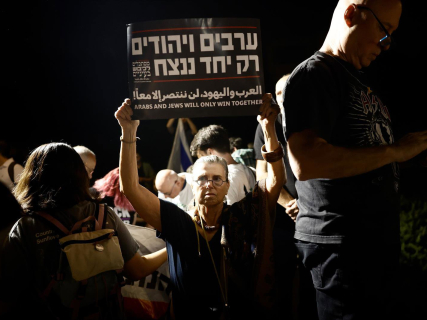
The big leap has been taken by the Arab parties, which post their best result so far with 19 parliamentarians --11 for the Joint List and 8 for the United Arab List--, leaving them in a position to decide governability. The high turnout of this electorate, which represents 20% of the Israeli population, has been decisive, something Netanyahu and the Likud have questioned.
In this context, Israel woke up on Thursday to the news that the Shin Bet, the internal security service, is investigating possible foreign interference in favor of the Arab lists. Attention has been directed mainly to Qatar and the United Arab List, which already supported in 2021 the so-called Bennet and Lapid change government and whose leader, Mansur Abbas, was a minister in that Executive.
Later, the Electoral Commission, whose president requested the investigation, specified that the "integrity" of the elections has not been compromised and ruled out that the case could alter the final result or force a repeat of the elections. In turn, the Shin Bet stressed that the investigation was "focused and limited in scope" and warned that an entire group that "went out to vote democratically and legally" cannot be blamed.
Eisenkot has lashed out against Netanyahu and Likud, accusing them of "an organized campaign to delegitimize the result" because "they have lost" and has promised that he will not allow the swearing-in of the new Knesset deputies to be blocked, scheduled for November 10. In addition, he has reiterated that the opposition is already working on a law to force ultra-Orthodox young men to serve in the Army and on the creation of a commission of inquiry into the Hamas attack of October 7, 2023.
Herzog's key role in the formation of Government
In this scenario, the president of Israel, Isaac Herzog, now takes on a decisive role. Starting on November 4, he will begin the round of consultations with the leaders of the different formations, who will have to tell him whom they consider suitable as the next prime minister. With those recommendations, Herzog will designate the candidate who, in his view, has the best chances of gathering support, without necessarily having to be the leader of the most-voted party, that is, Netanyahu.
The chosen person will have 28 days to present his Government, with the possibility of receiving an extension of 14 additional days. At the end of that period, the candidate and his cabinet will have to submit themselves to the confidence of the Knesset, where it will be enough to obtain more favorable votes than against. If he does not achieve it, Herzog may entrust the attempt to another deputy -- predictably the leader of the rival bloc--, who will have 28 days without extension to form Government, or inform the president of the Parliament that he does not see it viable for any member of the chamber to achieve it.
If this second attempt fails or the president concludes that there is no room to form an Executive, the Knesset will have 21 days for 61 deputies to agree to propose their own candidate. If this route also does not prosper, the country will return to the polls within a maximum period of 90 days.
The opposition coordinates and explores alliances
Meanwhile, the opposition bloc has begun to move this Thursday to coordinate positions. Eisenkot has met with Bennet, while the leader of Los Demócratas, Yair Golan, has held meetings both with the leader of Yashar and with Lapid and has promised that he will not leave "stone unturned" to "save Israel" together with his allies.
Golan, the only one of the main opposition figures who has openly shown himself in favor of including Arab-Israelis in the future Executive, has also met with the leader of the United Arab List. "It is time to act. Our responsibility is not to lose the opportunity for change and save Israel," he has argued.
In parallel, Lieberman, another of the pillars of the opposition bloc, has made it clear that he does not contemplate working with either the Arab parties or with Netanyahu, of whom he was a minister in the past, after reports suggested that he was not answering his partners' calls and there was fear of a possible change of side. "The only coalition we would consider would be one composed exclusively of Zionist parties, including Likud but without Bibi," he has specified.
Open scenarios and possible combinations
On paper, Netanyahu has it difficult to gather more supports than rejections, since both the Eisenkot bloc and the Arab lists would vote against, unless the prime minister managed to break the discipline of some of the opposition parties. Bennet and Lieberman, both right-wing leaders, collaborated with him in the past.
For the opposition, the main option is to attract the United Arab List, whose 8 seats would allow them to reach 56 and thus surpass the 53 deputies aligned with Netanyahu, giving rise to a minority Government. In this scheme they could count, at least externally and punctually, on the support of the Joint List.
In addition, from United Torah Judaism the possibility has been raised of breaking with Netanyahu and backing Eisenkot, provided that he renounces his plans to impose military service on ultra-Orthodox youths, one of the red lines set by the former Chief of Staff, according to Ynet. This move would add 7 seats to the opposition bloc, which would thus stand at 55.
The other alternative on the table, which for now the leaders of both blocs reject, is a Government of unity in which Likud and Yashar would participate and, predictably, the parties of Bennet and Lieberman, with the ultra-Orthodox and the ultra-nationalists left out. The main obstacle in this case would be deciding who would first occupy the head of Government in a possible rotation system.