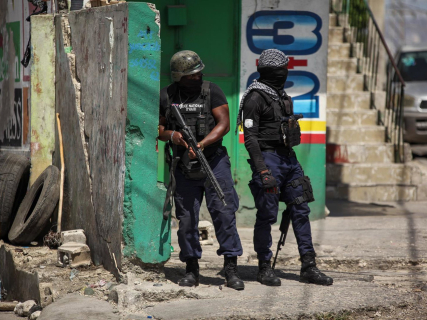

More than 1,400 people have lost their lives in Haiti between April and June 2026 as a result of the violence unleashed by gangs. The United Nations warned this Wednesday that this criminal spiral is "geographically spreading" across the country, just as the authorities intensify their offensive against these groups in Port-au-Prince, the capital.
In its latest report, the United Nations Integrated Office in Haiti (BINUH, for its acronym in French) places the number of those killed at least 1,408 and the injured at 656 during the second quarter of the year. Although these figures represent a decrease of nearly 14% compared to the previous three months, the UN warns that this "modest" drop "hides very different realities depending on the regions."
According to BINUH, "more than half are attributed to the gangs," while "around 40%" occurred within the framework of operations by Haitian security forces and five percent are linked to self-defense groups and episodes of "popular justice."
"These figures demonstrate that the population continues to pay an unacceptable price for violence," stated the UN's highest representative in Haiti, Carlos Ruiz Massieu, in a statement accompanying the report.
In parallel, this same week armed gangs carried out an attack in Kenscoff, on the outskirts of Port-au-Prince, which left 47 dead, including 22 people who were "executed" inside a church where they had taken refuge.
The pressure on the gangs shifts the focus of violence
The integrated office warns that, although security operations "have reduced gang activity in some parts of the metropolitan area of Port-au-Prince, especially in Delmas and Tabarre," this "pressure" has in many cases caused a "displacement" of violence to other areas instead of its elimination.
This is what happens in the Cul-de-Sac plain and the commune of Ciudad Soleil, in the capital, where rival gangs have maintained "extremely violent" confrontations for territorial control and illicit activities. These clashes have caused 463 deaths, in addition to hundreds of people "injured or raped" and "more than 18,000 residents" forced to leave their homes.
The report attributes part of this intensity "to the security operations carried out in other parts of the capital, which have pushed gang members towards the Cul-de-Sac Plain," an area considered "strategic" due to its location on two key axes connecting the container port of Port-au-Prince and the Varreux oil terminal with the north of the country.
Outside the capital, the UN notes that gangs "have continued to gain ground." The document cites the case of Artibonite, a significant agricultural region in the northwest, where armed groups have burst into various localities, murdering neighbors in their homes and farmers while they worked on their lands.
New incursions further south by the Village de Dieu gang around Séguin have also been detected, an area that until now had largely remained outside this violence. For BINUH, these actions "could reflect a desire to find new sources of income, especially by controlling the roads leading to the port of Marigot."
Risks and abuses in the State's armed response
The United Nations analysis emphasizes that "while the authorities intensify their campaign, civilians are also caught up in the operations aimed at dislodging the gangs."
In this context, BINUH points out that "more than 800 people have died or been injured" during the quarter in the framework of interventions by security forces, in which even the use of explosive drones has been resorted to by a government special force made up of Haitian police and members of a foreign private military company.
Of that group of victims, at least 95 "had no ties to the gangs," warns the report, which also emphasizes that the UN "has not received any information indicating that the authorities have opened investigations into the dead and injured caused during security operations, including those involving the private military company."
The violence documented by BINUH shows that the challenge in Haiti "is no longer just about recovering neighborhoods in Port-au-Prince," as gangs "adapt to pressure, seek new territories and new sources of income, while the methods used against them put civilians at risk."
The United Nations Office's reference to a "private military company" could point to Vectus Global, created by the founder of the controversial Blackwater, Erik Prince, and which in 2025 signed a collaboration agreement with the Haitian authorities.
In March 2026, the NGO Human Rights Watch (HRW), when denouncing the deaths caused by drones in operations of the Haitian Executive, identified one of these "private companies" that cooperates with the Government as Vectus Global, which has a license for the export of defense services in the country, as confirmed by the United States ambassador to Haiti, Henry Wooster.