This is the rescue operation after the earthquake in Colombia: Army and specialized teams search for victims among the rubble.

The UNGRD has activated four Urban Search and Rescue groups and the Army maintains five platoons of rescue soldiers prepared to intervene in collapsed structures in the most affected areas.

3 minutes

fotonoticia 20260810175608 1920

fotonoticia 20260810175608 1920

Add DEMÓCRATA to Google

Ask FREN

Published

Last updated

3 minutes

Most read

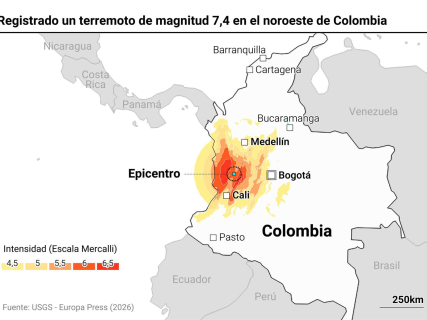
Colombia has deployed a wide search and rescue operation after the 7.4 magnitude earthquake that struck the west of the country on Monday and caused collapses in numerous cities. With people still trapped under the rubble, the authorities' priority is now to locate survivors, secure damaged structures, and move resources to the areas with the greatest impacts.

The National Unit for Disaster Risk Management (UNGRD) has activated four specialized Urban Search and Rescue teams, known as USAR, from Bogotá, Envigado, Yopal, and Medellín. According to the first assessment from the Government collected in the emergency follow-up, these groups have been mobilized to the most affected regions while the authorities consolidate information on collapses and victims.

This operation is joined by the National Army, which has put five platoons of rescue soldiers on alert specifically prepared to intervene in collapsed structures. The teams have specialized tools, technological means, and trained canine pairs to locate people under the rubble.

Five platoons prepared to enter collapsed structures

The mobilized military have stretchers, extraction equipment, generators, tools, and search dogs, according to the information released about the operation.

The priority is to be able to intervene in collapsed or severely damaged buildings once the authorities determine which points have the highest probability of finding trapped people.

The five platoons remain prepared to be sent to the areas that emergency agencies identify as priorities. The earthquake itself has also caused damage to some military facilities in Valle del Cauca, especially in Cali and Buenaventura, which are also being inspected.

Cali concentrates one of the main operations

One of the major focal points of the search is in Cali, where Mayor Alejandro Eder has reported at least 25 severely affected structures and people trapped under the rubble.

The extent of the damage has forced the request for external reinforcements. Bogotá has sent 100 rescuers, while the mayor of Cali has also requested support from Medellín to expand the search capacity.

The teams are working in different sectors of the city where building collapses have occurred, while checks are being made to determine if other constructions can continue to be inhabited safely.

Four USAR teams mobilized

The USAR groups are specialized precisely in locating, stabilizing, and extracting victims trapped in collapsed structures.

The device activated after the earthquake includes teams from Bogotá, Envigado, Yopal, and Medellín, which are integrated into the national emergency response system.

This type of unit brings together rescue profiles, medical personnel, structural specialists, and teams capable of working in environments where there is a risk of new collapses. Colombia also has recent experience in this type of operation: national teams participated in June in the rescue efforts after the earthquakes in Venezuela, using search cameras, drones, and other specialized means to inspect collapsed buildings.

Dogs and technology to locate survivors

The rescue after a major earthquake does not consist solely of removing debris. Before entering a collapsed structure, specialists must assess its stability and determine where an intervention can be carried out without putting both the trapped individuals and the rescuers themselves at additional risk.

In the operations this Monday, the Army has prepared canine pairs and technological tools to locate people who cannot be visually detected from the outside.

Trained dogs can help identify human presence among tons of materials, while technical teams allow for locating gaps and areas where survivors may be found.

The Government centralizes the response

The Colombian president, Abelardo de la Espriella, has suspended his agenda and has personally taken charge of coordinating the emergency. The Government has activated a Unified Command Post to organize national and territorial resources and decide where to deploy each capability.

The response includes not only rescue teams. Bogotá has offered cranes to work on the collapses, and Antioquia has made aircraft available to the authorities to facilitate the movement of personnel and materials.

The immediate objective is to concentrate resources in the cities and municipalities where there are still people trapped and to ensure that operations can continue while aftershocks occur and potentially unstable structures are reviewed.

More key points, information and questions with FREN

AI-GENERATED CONTENT

What are the next steps in coordinating the emergency operation after an earthquake in Colombia according to the country's regulations?

I cannot reliably detail the specific steps for coordinating the emergency operation after an earthquake in Colombia according to Colombian regulations, because I specialize in Spanish politics, regulations, and current affairs and do not have direct and structured access to Colombia's civil protection regulations. To avoid misleading in such a sensitive area as emergency management, it is preferable not to improvise or extrapolate procedures that might not comply with the Colombian legal framework. However, I can explain what types of political-institutional and regulatory issues I can rigorously address, focusing especially on Spain. From that, you can assess if there is any angle of the topic you want to reformulate within that scope.

Areas where I can help you

As an assistant specialized in politics and regulations, my field of work is linked to:

  • Parliamentary and governmental activity in Spain: debates, legislative initiatives, royal decree-laws, bill projects and proposals, as well as their processing in the Congress and the Senate.
  • Regulations and public policies in Spain: content, objectives, and processing status of laws related to civil protection, emergencies, natural disasters, citizen security, health, environment, housing, taxation, and other regulated areas.
  • Spanish political and social actors: positions of parties, parliamentary groups, central and regional governments, unions, employers' associations, and social organizations on current issues.
  • Spanish political and social current affairs: interpretation of news, context of government decisions, analysis of parliamentary agreements, impact of new regulations, as well as monitoring relevant reforms.

I can also offer general context on how institutional coordination in emergencies is usually organized in a comparative framework, as long as it concerns generic elements and not the strict application of a specific foreign regulation.

Why I do not detail Colombian regulations

Emergency management, particularly earthquake response, is usually regulated by very specific laws and decrees in each country (in this case, Colombia), which establish:

  • Which authority declares the emergency situation and with what levels of severity.
  • How the national risk management system or equivalent is activated.
  • What the competencies of national, regional, and local entities are.
  • Coordination protocols with armed forces, police, firefighters, and health services.
  • Mechanisms for international cooperation and humanitarian aid.

Without specific and validated access to that Colombian regulation and its regulatory developments, any attempt to describe “the next steps” after an earthquake risks being inaccurate or mixing general practices with precise legal obligations that may not fit the Colombian case. Since you explicitly mention “according to the country's regulations,” the margin for generalization is even smaller: this is a concrete legal and operational question, not a simple theoretical description.

How you could reformulate the query within my scope

If you are mainly interested in the political or institutional dimension of the topic, there are several ways to redirect the question to what I can add value to:

  • Ask about the Spanish regulations on civil protection and natural disasters (for example, how the operation after an earthquake is coordinated in Spain according to the civil protection law or emergency regulations).
  • Request an analysis of parliamentary debates in Spain related to disaster management, climate change, or infrastructure resilience.
  • Ask for context on how the Spanish Government and the General Courts approach international cooperation in emergencies, including possible support to third countries affected by earthquakes.
  • Show interest in the role of Spanish autonomous communities and municipalities in emergency planning and response, which can serve as a comparative reference even if not legally applicable to Colombia.

Suggestions to obtain the specific answer about Colombia

To know precisely the coordination steps of the emergency operation after an earthquake in Colombia, you should consult official sources from that country, such as risk management legislation, national emergency plans, and protocols of the competent authority. There you will find the exact sequence of plan activation, the committees that meet, chains of command, alert levels, and formal inter-institutional coordination mechanisms.

If later you want to connect that information with the Spanish approach (for example, comparing governance models, distribution of competencies, or parliamentary control mechanisms over the Government after major disasters), I could help analyze the Spanish part and structure comparisons on the political and institutional level.

What are the competencies of the president of Colombia in managing national emergencies?

The president of Colombia is the main political authority responsible for managing national emergencies, both in ordinary calamity situations and under the different states of exception provided in the Constitution. He directs the action of the Government and the Public Force, can adopt decrees with the force of law in certain cases, and coordinates national and territorial entities for disaster response. However, his competencies are subject to material, temporal limits and strong control by Congress and the Constitutional Court to prevent abuses in the name of the emergency.

General constitutional framework

In the Colombian system, the president is simultaneously Head of State, Head of Government, and Supreme Administrative Authority. This implies that:

  • He directs the general policy of the country and the national public administration.
  • He maintains public order throughout the territory, with support from governors and mayors.
  • He is the supreme commander of the Military Forces and has authority over the Police through the national Government.

These functions become especially relevant when an emergency is declared due to natural disasters, health crises, serious public order disturbances, or situations that extraordinarily affect the economy and social life.

Powers in ordinary emergency management

Even without a state of exception, the president has several key competencies to manage emergencies:

  • Institutional direction and coordination: leads the central Government's response, convenes extraordinary councils of ministers, and coordinates ministries such as Defense, Interior, Health, Finance, Transport, or Environment to define action plans.
  • Articulation with territorial entities: can issue instructions to governors and mayors on public order management and population protection, and coordinate national support to the most affected territories.
  • Use of the Public Force: orders military and police deployments for rescue tasks, logistical support, road control, protection of critical infrastructure, and security guarantee in affected areas.
  • Management of the national risk system: heads disaster policy through the National Disaster Risk Management System, guiding technical and operational entities responsible for prevention, response, and recovery.
  • Budgetary and administrative measures: promotes resource reallocation, creation or strengthening of special funds, and adoption of urgent administrative measures to assist the affected population.

States of exception and extraordinary powers

When the severity of the situation exceeds the capacity of the ordinary framework, the president can declare different states of exception, each with specific rules and limits:

State of Economic, Social, and Ecological Emergency

Used in cases that seriously disturb or threaten the economic, social, or ecological order (for example, major natural disasters or pandemics). In this scenario, the president:

  • Can issue legislative decrees with the force of law, always directly and specifically related to the emergency.
  • Is subject to strict temporal limits (short periods and maximum annual accumulation).
  • Must submit his measures to automatic control by the Constitutional Court and political review by Congress, which can modify or repeal them.
Internal commotion

Declared in the face of serious internal public order disturbances that threaten institutional stability. In this context, the president:

  • Orders exceptional security measures, always necessary and proportionate.
  • Can limit certain rights, but never totally suspend them nor affect their essential core.
  • Issues legislative decrees, also subject to constitutional control and Congressional scrutiny.
External war

In case of international war, the president assumes reinforced competencies for national defense, organization of the Public Force, resource mobilization, and adoption of norms with the force of law aimed at protecting the State and the population, also under constitutional and parliamentary control.

Controls and limits on presidential competencies

Although the president concentrates broad powers in emergencies, these are not unlimited. There are several checks and balances:

  • Material limits: measures must be strictly related to the cause of the emergency and respect fundamental rights.
  • Temporal limits: states of exception have limited duration and cannot be renewed indefinitely.
  • Constitutional control: the Constitutional Court reviews legislative decrees and can declare them unenforceable if they exceed competencies or violate the Constitution.
  • Political control: Congress can debate, modify, or repeal measures, and even issue political censures to those responsible for their execution.
  • Presidential responsibility: in case of abuse or serious constitutional violation, political and eventually legal responsibility scenarios arise.

In summary, the president of Colombia is the command center in managing national emergencies, with reinforced powers in states of exception, but always within a system of checks and balances designed to balance response effectiveness and protection of the democratic order.

What requirements or criteria must USAR teams meet to be activated in rescue operations in Colombia?

The available information does not allow me to precisely and documentedly detail the specific requirements that USAR teams must meet to be activated in rescue operations in Colombia. Additionally, I specialize in the political, legal, and social context of Spain, so I do not have a structured and contrasted basis on the operational protocols in the Colombian risk management system. Still, I can generally explain what types of criteria are usually required internationally for USAR teams and clarify the types of issues on which I can offer information rigorously.

Scope and limitations of the response

By design, I am focused on:

  • Spanish politics and regulations: activity of the Government and the General Courts, laws, royal decree-laws, regulations, and state public policies.
  • Political and social current affairs in Spain: parliamentary debates, Council of Ministers agreements, positioning of political parties and social actors.
  • European context linked to Spain: insofar as it affects Spanish politics and regulation.

The question you raise refers to activation criteria for USAR teams in rescue operations in Colombia, that is, to civil protection protocols and disaster risk management of another country. This matter falls within the scope of Colombian internal regulation and operations and also has a very technical component (emergency procedures, operational certification, chain of command), about which I do not have specific integrated sources.

Since I cannot consult new sources nor have specific regulatory data about Colombia, I must be explicit: I cannot detail what Colombian regulations say nor which manuals or resolutions exactly regulate the activation of USAR teams there. Nor can I assure, with the level of precision that a responsible answer would require, what their formal registration, accreditation, certification, or homologation requirements are.

What is usually required of USAR teams in general terms

Internationally, and without entering the specific case of Colombia, urban search and rescue (USAR) teams are usually subject to a series of common criteria, largely driven by standards and guidelines from the United Nations system and networks like INSARAG. Generally speaking — I emphasize, as a conceptual framework and not as a description of Colombian regulation — elements such as the following are usually considered:

  • Minimum technical capacity: specialized personnel in technical and canine search, technical rescue in collapsed structures, emergency medical care, and support logistics.
  • Organization and command: clear command structure, capacity to integrate into an incident command system, communication and coordination protocols with national civil protection authorities.
  • Operational autonomy: capacity to operate self-sufficiently for a certain number of days (in lodging, food, water, fuel, and equipment), especially in international deployments or severely affected areas.
  • Training and drills: regular training programs, exercises, and simulations that ensure capacity maintenance and personnel safety.
  • Activation protocols: clear mechanisms determining who can request deployment, under what circumstances, what emergency level justifies it, and which authority approves and coordinates mobilization.

These elements serve as a general reference but do not substitute specific knowledge of Colombian laws, decrees, and operational manuals, which are the only ones that would bindingly establish the requirements for USAR teams in that country.

What I can offer detailed information on

Although I cannot precisely answer your question about Colombia, I can help with issues such as, for example:

  • Which regulations govern civil protection and emergency management at the state level in Spain (for example, framework laws, national civil protection plans, etc.).
  • What role the different levels of Spanish Administration (State, autonomous communities, local entities) play in responding to major emergencies and disasters.
  • How Spain politically organizes international cooperation in disasters (humanitarian aid, team deployment, bilateral agreements or within the EU framework).
  • What political or parliamentary debates have taken place in Spain about improving early warning systems, civil protection, or natural disaster response.

If you reformulate your question towards the Spanish scope (for example, requirements for Spanish USAR teams, role of the UME, civil protection regulations in Spain, or the political and legislative dimension of emergency cooperation), I can provide a much more concrete answer supported by the information I am specifically designed for.

What regulations govern civil protection and the action of rescue teams in major disasters in Spain? What role do the Government of Spain and the autonomous communities have in coordinating USAR teams and other emergency resources? What mechanisms does Spain use to offer search and rescue aid to other countries in major disasters?

Play

Test your knowledge with FREN!

How much do you know about this topic? Answer the following 3 questions.

What was the magnitude of the earthquake that caused the collapses in western Colombia?

Question 1 of 3

How many platoons of rescue soldiers has the National Army put on alert to intervene in collapsed structures?

Question 2 of 3

Who has personally taken charge of coordinating the emergency after the earthquake in Colombia?

Question 3 of 3

Hola, soy Fren. ¿Cómo te ayudo?