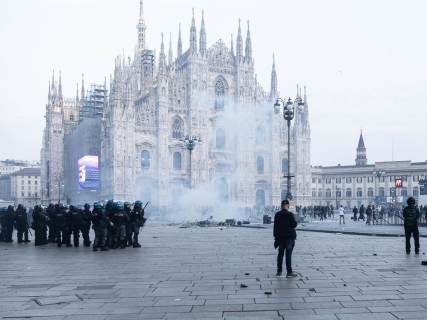
The truckers' strike leaves supermarkets empty and triggers panic buying in Italy

The protest of the transporters spreads across Italy and causes shortages in supermarkets, gas stations, and factories. The Government prepares new aid while the blockades threaten food production.

fotonoticia 20261018140002 1920

fotonoticia 20261018140002 1920

Add DEMÓCRATA to Google

Ask FREN

Published

Last updated

3 minutes

Most read

Elecciones 29N · Encuestas

La media de las encuestas

Media a 21 de octubre de 2026 · 15 institutos

  • PP31,6 %
  • PSOE26,9 %
  • Vox18,7 %
  • Sumar6,3 %
  • Podemos3,1 %
  • ERC2,2 %
010203040ene 2024jul 2024ene 2025jul 2025ene 2026jul 2026

Media del último estudio de cada instituto en 30 días y su evolución semanal desde el 23J. Partidos con al menos un 2 %.

Todas las encuestas

Elecciones generales del 29 de noviembre · Demócrata

The supermarkets with empty shelves, the gas stations without fuel, and the trucks blocking roads have become some of the images of the crisis shaking Italy. The protests of the transporters against the rising cost of diesel have caused supply problems in several regions of the country, especially in the south, while the Government of Giorgia Meloni tries to contain a mobilization that threatens to extend its consequences to the entire Italian economy.

The situation is especially complicated in Naples and Sicily, where the interruption of deliveries has left many establishments out of stock. Panic buying and stockpiling of basic products by some consumers have worsened the shortage, which mainly affects fresh food, pasta, meat, cheese, and vegetables.

The mobilizations began last week in the south of the country and have spread to other areas. The transporters denounce that the increase in fuel prices, driven by the war in Iran, is making their activity unsustainable. Diesel costs approximately one third more than before the conflict, despite the fiscal measures approved by the Italian Executive.

Blocked roads and depleted supermarkets

The supply problems are concentrated in Campania, Calabria, Apulia, Sicily, and other regions in the south. Truck drivers have blocked access to distribution centers, roads, and strategic points for the transport of goods, which has prevented the arrival of products to numerous establishments.

In some supermarkets in Naples, notices have been placed to inform customers that certain items may not be temporarily available. In Sicily, there are also numerous empty shelves and difficulties in restocking food, a situation worsened by the increase in purchases due to fears that the blockades will continue.

The crisis is also affecting the airports of Crotone and Reggio Calabria, which have suffered fuel supply problems for airplanes. The Italian air navigation agency ENAV has warned that aircraft must plan refueling at other airports due to the lack of stocks.

The strike threatens the production of pasta and mozzarella

The consequences of the protests are already affecting two of the most representative products of the Italian food industry: pasta and mozzarella.

Companies like Rummo, in Campania, and La Molisana, in Molise, have had to reduce or interrupt part of their activity due to difficulties in receiving raw materials. The blockades also prevent the distribution of finished products, with the consequent economic impact for manufacturers and suppliers.

The production of buffalo mozzarella from Campania has also been severely disrupted. According to the consortium that groups its producers, the interruption of milk deliveries has caused stoppages and losses estimated at three million euros daily.

Trade associations also warn that large quantities of fruits, vegetables, milk, and meat remain immobilized in trucks and warehouses, with the risk of deteriorating before reaching consumers.

Meloni prepares new aid to curb protests

The government of Giorgia Meloni has intensified contacts with transport representatives to try to put an end to the blockades. The Vice President and Minister of Transport, Matteo Salvini, has proposed new economic support measures, including tax credits to offset the rise in diesel prices.

The Executive has around 1 billion euros allocated to support road transport, including measures against rising costs and aid to renew older vehicles. Meloni has called for a Council of Ministers this Thursday with the aim of approving new actions aimed also at the agricultural sector.

However, transport organizations are divided. While some associations have positively evaluated the government's commitments and demand the lifting of the blockades, other groups maintain the mobilizations and threaten to extend them until October 27.

The crisis poses a new challenge for the Italian Executive, which must respond to the discontent of transporters without compromising the supply of food and fuel.

More key points, information and questions with FREN

AI-GENERATED CONTENT

What are the competencies of the Minister of Transport in Italy according to current legislation?

In Italy, the competent holder is the Minister of Infrastructure and Transport: their powers cover both mobility policies and state public infrastructures. Their main function is to politically lead the ministry, plan investments, and exercise the regulatory and supervisory powers provided by law; they do not personally manage all sector files.

The general framework is formed by Legislative Decree No. 300/1999, on the organization of ministries, D.P.C.M. of October 30, 2023, No. 186, on the organization of the ministry, and sector legislation, especially the Codice della Strada. The ministry gathers its normative references and publishes the organizational regulation.

Main areas of competence

  • Infrastructure and public works. It directs state policies on roads, highways, railways, ports, airports, hydraulic works, and strategic infrastructures. It participates in their planning, financial programming, monitoring, and supervision, respecting territorial competences and public procurement procedures.
  • Land transport and logistics. It includes passenger and freight transport by road, rail transport, intermodality, and state functions related to local public transport. It includes regulation, programming, oversight, and coordination, without absorbing regional powers or those of specialized bodies.
  • Vehicles, drivers, and road safety. The ministerial scope includes approvals, technical requirements, vehicle inspections, driver training and licensing, civil motorization, and accident prevention. Specific decisions correspond to the minister or administrative bodies as established by each provision.
  • Navigation and maritime transport. It covers merchant marine, maritime and inland navigation, navigation safety, ports, services, and state concessions. It includes oversight of port system authorities and international relations in these matters.
  • Civil aviation. It includes political guidance, planning, general regulation, and institutional oversight of the sector and its infrastructures. Technical functions are distributed with specialized bodies, especially ENAC; they do not fully correspond to the minister.

These matters are distributed among the ministry's departments and directorates; their transport functions and ministerial organization can be consulted.

What the minister can decide

Political direction. Defines objectives, priorities, and programs; issues general guidelines; directs resource allocation and controls results. Ordinary management —such as contracts, authorizations, or sanctions— normally corresponds to administrative managers, unless expressly legally attributed to the minister.

Normative development. Can adopt ministerial and interministerial decrees, technical provisions, and regulations when legal authorization exists. Can also approve plans or projects when sectoral law assigns that decision. A ministerial decree cannot modify a law nor replace a decision reserved for the Government.

Programming, financing, and supervision. Participates in investment programs, prioritizes actions within the authorized budget, and monitors projects financed with state or European resources. Exercises oversight over entities and bodies in the sector and can make appointments or proposals when applicable legislation allows.

Limits of their powers

The minister is not the sole authority of Italian transport. They must respect the constitutional distribution of competences, European Union law, the powers of other ministries, and the autonomy of regulatory authorities and technical bodies. Oversight of an entity does not necessarily imply the power to direct all its decisions.

They also do not replace municipalities, regions, or autonomous provinces in local traffic regulation or their transport services. The very organization of the territorial directorates requires respecting those powers. Consequently, to determine who signs an authorization, sets a technical condition, or approves a specific infrastructure, the corresponding sectoral norm must also be considered.

What were the results of the last general elections in Italy and which parties form the current government?

I cannot provide you with precise data on the results of the last general elections in Italy nor detail which parties currently form its government, because I specialize in the Spanish political and institutional system and my consultation tools are focused on Spain (Congress, Senate, BOE, regional bulletins, regional governments and parliaments, Spanish political actors, etc.). I do not have equivalent, structured, and reliable access for Italian politics that would allow me to offer figures and government compositions with the same precision and traceability with which I work in the Spanish context.

This means, in practice, that any answer I tried to give you about vote percentages, seat distribution among Italian parties, electoral participation, constituencies, as well as the exact composition of the Italian Council of Ministers, its coalitions, and the programmatic agreements supporting them, would rely on conjectures or unverified information within the technical framework for which I was designed. And precisely the idea is to avoid that kind of answers: my goal is to provide you with verifiable and explained information, not a mix of vague memories or data without verifiable basis.

On the other hand, I can help you understand very well how the Spanish political system works and, from there, offer conceptual comparisons that serve as a reference. For example, if you are interested in Italy because you want to compare it with Spain, I can:

  • Explain in detail how general elections are held in Spain: type of electoral system, constituencies, seat allocation method, implicit thresholds, role of small provinces, etc.
  • Describe how the government is formed in Spain after elections: investiture of the president by the Congress, majorities required in first and second votes, role of coalition or external support agreements, and the margin the Head of State has in the process.
  • Analyze how coalitions are configured and maintained in Spain, what types of legislative pacts are usually signed, the weight of minority partners, and mechanisms used to resolve conflicts within the government.
  • Present the map of relevant Spanish parties and their positions on the main axes of public debate: economy, territorial model, social policies, environment, Europe, etc.
  • Detail what has happened in recent Spanish electoral cycles: dissolutions of the Cortes, early elections, general results, party system fragmentation, and how all this has affected government stability.

If what you seek is to make a comparison between Spain and Italy (or between Spain and any other country), a practical way to proceed is to first focus well on the Spanish part and then you contrast with specific sources from Italy. For example, we could work together on:

  • A comparative scheme of institutions: what the Congress of Deputies is, what the Spanish Senate is, how they relate to the Government, what powers each has, and then you put it in parallel with the Italian Chamber of Deputies and Senate using specialized sources on Italy.
  • An explanation of how coalitions and minority governments work in Spain, which helps you better interpret news about unstable or fragmented government coalitions in other European countries.
  • An analysis of typical instruments in Spain (royal decrees, motions of no confidence, votes of confidence, general state budgets) so you see what role they play in political life and can compare their Italian equivalents with appropriate sources.

I can also guide you on how to read and assess electoral results in general, even if I cannot provide you with Italy's specifics: which indicators to look at (turnout, volatility, vote for new formations, vote concentration in each political bloc), how to interpret the gap between popular vote and seats, or how electoral geography conditions possible coalitions. All this is quite generally applicable to European parliamentary democracies, provided it is then complemented with the specific data of the country you are interested in.

If you want, you can reformulate your question focusing on Spain (for example, on the last Spanish general elections, the composition of the current Spanish government, or how coalitions are built) and there I can give you a very detailed answer, with contextual explanations and, when appropriate, references to official Spanish sources that support the information.

What legal requirements must Italian transporters meet to receive state aid for fuel price increases?

Italian transporters must meet the requirements of the specific call: establishment in Italy, authorized transport activity, eligible vehicles and fuel, accredited expenses, and application within the deadline. It is not enough to demonstrate that fuel prices have increased: the extraordinary aids examined are mainly granted through tax credits and are subject to national and European conditions.

It is important to distinguish programs linked to diesel purchases from 2022 from the measure announced in March 2026. The requirements of the former should not be automatically transferred to the latter.

1. Admitted company and activity

The programs examined required having a registered office or permanent establishment in Italy. The driver's nationality does not replace this requirement. Also, a distinction must be made between:

  • Transport on behalf of third parties: companies that transport goods for clients and carry out activities included in Article 24-ter, paragraph 2, letter a), number 1, of Legislative Decree 504/1995.
  • Transport on own account: companies that transport goods from their own activity, with the corresponding license and registration required by the measure.

This second modality had a specific line, developed through the interministerial decree of August 4, 2023. Its conditions can be consulted at the Italian Ministry of Transport and in the Official Gazette.

2. Vehicles, fuel, and expenses

The historical lines analyzed required diesel vehicles Euro V or higher and, in modalities that established that threshold, a maximum authorized mass of at least 7.5 tons. The diesel had to be destined for the subsidized transport activity.

The company had to prove purchases through invoices and keep documentation linking the fuel to the vehicles: license plates, environmental category, and accounting receipts. When the calculation was made on net cost, VAT was excluded. Gasoline, LNG, or other fuels could not be included if the call covered only diesel.

3. Period, amount, and application

Decree-Law 50/2022, of May 17, introduced a 28% credit for certain purchases in the first quarter of 2022. The separate line for own-account transport also contemplated a maximum of 28%, with an allocation of 85 million euros.

Other programs covered the second quarter of 2022; the 2024 Budget Law extended that coverage to July 2022, as explained by FiscoOggi. That extension did not create a permanent aid for subsequent consumption.

It was mandatory to submit the application through the enabled channel, within the deadline and with the required documentation. The credit was used through compensation of tax obligations and contributions, via the F24 form, not as an automatic cash payment. For the first quarter line cited by the Italian Tax Agency, the usage deadline ended on December 31, 2023.

4. European compatibility and 2026 measure

The aids must comply with Articles 107 and 108 of the Treaty on the Functioning of the EU and the applicable European regime: limits per company, accumulation with other aids, transparency, and absence of overcompensation. European authorization does not eliminate national conditions.

In March 2026, another credit was announced to compensate the cost increase in March, April, and May compared to February, according to Demócrata. The sources consulted do not detail its definitive access requirements. Therefore, for applying for that aid, the percentages, vehicles, or deadlines of the 2022 programs should not be automatically considered applicable.

Play

Test your knowledge with FREN!

How much do you know about this topic? Answer the following 3 questions.

What is the main cause of the truck drivers' strike in Italy?

Question 1 of 3

Which products have suffered the most shortage in Italian supermarkets due to the strike?

Question 2 of 3

What measure has the Italian government announced to try to end the transporters' blockades?

Question 3 of 3