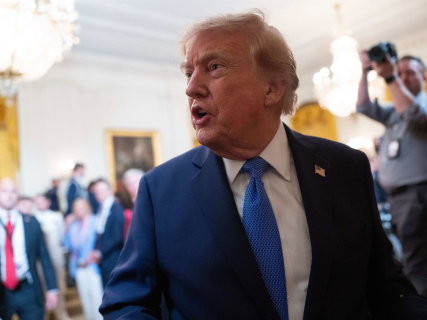

The president of the United States, Donald Trump, has demanded that Iran pay "compensation" for the Americans killed or injured over the past decades and has ordered that this claim be part of any future negotiations with Tehran.
The new condition comes after Iran raised its own demands to Washington to allow the reopening of the Strait of Hormuz, including compensation for the damages suffered during the war. The exchange of claims further complicates the chances of reaching an agreement that would restore normalcy in one of the world's main energy arteries.
Trump has responded to the Iranian request through Truth Social, where he described Tehran's proposal as "an interesting idea" before making his own claim.
"I also demand compensation for all the people they have killed and seriously injured with their bombs placed on the roads and in the numerous conflicts for which they are famous," he stated.
Trump makes compensation a condition for future talks
The U.S. president has assured that the issue of compensation had not been part of previous discussions and has explained that he has given "instructions" to his representatives to incorporate his new demands "firmly in each and every future negotiation".
Trump has subsequently extended his claim beyond American victims and has argued that Iran should also take responsibility for the "damages and deaths caused to the populations of Lebanon, Syria, Yemen, and Gaza".
Among the episodes cited by the U.S. president is the attack carried out in 2000 against the USS Cole destroyer, in which 17 American servicemen died. Trump has also demanded compensation for the families of protesters killed in Iran over the past decades.
Iran also demands compensation from the United States
Washington's diplomatic offensive comes after Tehran issued six demands on Saturday that it considers necessary to reopen maritime traffic through the Strait of Hormuz, closed in response to the conflict with the United States and Israel.
Among the Iranian conditions are compensation for the damages caused by the war, the lifting of the naval blockade and sanctions, and the release of blocked Iranian assets.
"Until the U.S. corrects its behavior, the Strait of Hormuz will not be opened," assured the secretary of the Iranian Supreme National Security Council, Mohamad Baqer Zolgadr, according to the state agency IRNA.
The blockade keeps the international energy market under pressure. Before the conflict, about one-fifth of the world's oil and liquefied natural gas passed through the Strait of Hormuz, while U.S. forces maintain restrictions on traffic to Iranian ports.
The reopening of the Strait of Hormuz moves further away
The new conditions posed by both countries come as Oman tries to keep a mediation channel open. Iran assured this Sunday that the agreement with Muscat to establish new maritime routes was in its "final phase", although it made clear that the complete reopening of Hormuz depends on the fulfillment of other conditions by Washington.
Oman has described the exchanges with Tehran as "positive," but has warned that attacks on ships in the area could harm the talks.
The Iranian Foreign Minister, Abbas Araghchi, has also ruled out that there is currently a formal negotiation with the United States. Although he has acknowledged a "exchange of messages through intermediaries," he maintains that the contacts cannot be considered negotiations while those that Tehran considers violations of the memorandum reached in June continue.
The United States declared the understanding terminated on July 8, which contemplated the cessation of hostilities, the reopening of Hormuz, and a 60-day period to try to reach a definitive agreement.
Trump acknowledged this Sunday in an interview with Axios that Washington and Tehran "are only negotiating halfway" and assured that his Administration is observing the Iranian economic deterioration while maintaining pressure on the Islamic Republic.
The crossing of new demands thus leaves a complete agreement to fully reopen the Strait of Hormuz further away, while Washington and Tehran maintain indirect contacts without, for now, having resumed a formal negotiation.