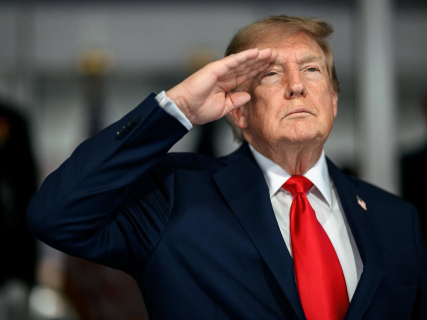
Trump suggests that he could withdraw US support for British sovereignty over the Falklands.

The American president assures that "he always reviews all positions" after reports pointing to possible pressure on London to increase its defense spending.

1 minute

fotonoticia 20260831212657 1920

fotonoticia 20260831212657 1920

Add DEMÓCRATA to Google

Ask FREN

Published

Last updated

1 minute

Most read

The president of the United States, Donald Trump, has left open this Monday the possibility of reviewing Washington's position on British sovereignty over the Falkland Islands, territory historically claimed by Argentina.

Trump has responded this way to a question from journalists in the Oval Office after several British media reported that his Administration would be studying withdrawing U.S. support for the United Kingdom's sovereignty over the archipelago as a pressure mechanism for London to increase its defense spending.

"I always review all positions. That is just one among many," Trump replied when directly asked about this possibility, according to EFE.

The response of the U.S. president does not imply an announcement of a change in policy, but it does leave open the review of a particularly sensitive issue for the United Kingdom and Argentina.

An historical issue between Argentina and the United Kingdom

The Falkland Islands have been under British administration since 1833, although Argentina maintains a claim of sovereignty over the archipelago. The dispute led to the Falklands War of 1982, when both countries faced each other for 74 days.

The conflict ended with a British military victory and the islands remaining under the administration of the United Kingdom. Since then, Buenos Aires has maintained its territorial claim and London argues that the inhabitants of the islands have the right to decide their own future.

The position of the United States on the dispute has traditionally been relevant due to its relationship with both the United Kingdom and Argentina. A potential change from Washington would therefore represent a movement of special diplomatic significance, although Trump has not confirmed that it will occur.

More key points, information and questions with FREN

AI-GENERATED CONTENT

What is the current official stance of the United States regarding the sovereignty of the Falkland Islands in Congress or the U.S. Administration?

As of 2026, the official stance of the United States regarding the sovereignty of the Falkland Islands/Malvinas remains to recognize them as territory under British sovereignty, administered by the United Kingdom, although the U.S. Administration acknowledges that there is an ongoing sovereignty dispute between London and Buenos Aires. There is no record, in the sources consulted, of a formal change in doctrine or a Congressional resolution that has modified this framework.

Position of the U.S. Administration

A recent analysis published by the Democratic newspaper on the evolution of the dispute explicitly states that currently, the U.S. Department of State “maintains that the sovereignty of the Falklands belongs to the United Kingdom,” while recognizing that the controversy over the territory’s ownership between Argentina and the United Kingdom remains open. This formulation combines two elements:

  • On one hand, recognition of British sovereignty over the archipelago and its consideration as a British overseas territory.
  • On the other, recognition that there is a sovereignty dispute, consistent with the fact that the United Nations, through General Assembly Resolution 2065, has acknowledged that there is a pending conflict between Argentina and the United Kingdom and has urged a peaceful negotiation.

This dual approach implies that Washington does not declare itself “neutral” in the strict sense of being equidistant between the claims of both States: it legally aligns with the British position but admits the disputed nature of the territory at the international level and supports the negotiation process.

Internal debate and signs of possible review

In 2026, information has been disseminated about internal debates within the U.S. Administration that indirectly affect the Falklands issue. Democratic reports a leak of an internal Department of Defense email that “reopens the debate” by suggesting that Washington might reconsider its support for British sovereignty over the islands as part of a pressure strategy against London, in the context of disagreements over the Iran war.

In another article, the same newspaper refers to a Pentagon memorandum that places the review of “U.S. diplomatic support for territories such as the Falkland Islands” among the tools of political pressure on certain European allies. These references indicate:

  • That at strategic defense levels, the theoretical possibility of using the position on the Falklands as a diplomatic lever has been considered.
  • But they do not describe a decision already made, rather scenarios of retaliation or negotiation that are being considered and whose main objective is not the dispute itself, but other crises (for example, British involvement in the Middle East).

In the pieces consulted, there is no official note from the Department of State announcing a change in recognition, nor a formal communication to Argentina or the United Kingdom in that regard; the discussion is always about a “possible shift” or scenarios that “could” be considered.

Role of the U.S. Congress

Regarding the U.S. Congress, the information found focuses on resolutions and debates about other scenarios (Venezuela, Iran, Greenland, etc.), without highlighting a recent and specific resolution on the sovereignty of the Falklands between 2010 and 2026.

This suggests that:

  • The line on the Falklands is mainly shaped by the Executive Branch (Department of State, White House, Department of Defense), within the overall policy towards the United Kingdom, Latin America, and the South Atlantic.
  • Congress, at least in the analyzed period, has not promoted a regulatory change or a major breaking resolution regarding traditional policy, which would continue to be support for British sovereignty and general backing for a negotiated solution.

Assessment of the current state

Based on the available sources, the current state of the U.S. stance can be summarized as follows:

  • Recognizes the sovereignty of the United Kingdom over the Falkland Islands and treats them as a British overseas territory.
  • Recognizes that there is a sovereignty dispute between Argentina and the United Kingdom, in line with the United Nations formulation, and does not present the issue as completely closed at the international level.
  • Does not maintain strict neutrality: its baseline position favors London, although framed within a discourse of respect for international law and peaceful resolution methods.
  • There are internal debates within the Administration (especially in Defense) about the possibility of reviewing that support as a diplomatic pressure tool, but, as far as the information published by Democratic up to August 2026 goes, no official change has materialized.
  • Congress does not appear as a leading actor in this issue in recent years; no new major resolutions redirecting policy towards the Falklands have been identified.

In summary, the underlying doctrine remains favorable to British sovereignty, with nuances about the existence of a dispute and with the novelty that, in the current context, some sectors in Washington explore whether that position can be used as a pressure variable in other crises, without this having yet translated into a public or legislative shift.

What are the powers of the President of the United States in foreign policy according to U.S. legislation?

In the U.S. constitutional system, the president holds very broad power in foreign policy, but not absolute. His powers derive mainly from the U.S. Constitution (especially Article II), federal laws passed by Congress, and constitutional practice consolidated over more than two centuries.

Basic constitutional foundation

Article II of the Constitution establishes the president as:

  • Head of State abroad, representing the United States internationally.
  • Head of the Executive, responsible for “ensuring the faithful execution” of laws, including those related to foreign policy.
  • Commander in Chief of the Armed Forces.

Although the Constitution is relatively brief, the interpretation of these clauses, plus legislation and practice, have shaped a very powerful presidency in foreign affairs.

Direction of foreign policy and diplomatic relations

The president sets the broad lines of foreign policy and coordinates all federal external action. Among his powers are:

  • Conducting diplomatic relations: decides the general orientation with other States and international organizations, sets priorities (alliances, strategic rivals, priority regions), and defines strategies.
  • Appointment of ambassadors: appoints ambassadors and senior diplomatic officials, with the consent of the Senate. This power allows him to reward political loyalties and place profiles aligned with his foreign vision.
  • Reception of foreign ambassadors: the power to “receive ambassadors and other public ministers” has been interpreted as the competence to officially recognize governments and States.

Treaties, agreements, and international trade

The president negotiates treaties and international agreements, but with different degrees of Senate control:

  • Formal treaties: the president or his delegates negotiate treaties, which only acquire full force with the approval of two-thirds of the Senate. Classic examples are security or arms control treaties.
  • Executive agreements: the president can conclude international agreements without Senate ratification, based on his own powers or prior laws. They are massively used for military, cooperation, or trade matters.
  • Trade policy: the Constitution grants Congress the power to regulate foreign commerce, but Congress has delegated broad powers to the president (for example, to negotiate trade agreements or impose certain tariffs), giving him great negotiating leeway.

Military and security powers

As Commander in Chief, the president directs the Armed Forces and intelligence services:

  • He can order military operations, troop deployments, and covert actions.
  • Makes high-level operational decisions and sets military and national security doctrine.
  • Appoints the military and intelligence leadership (Secretary of Defense, agency directors, senior commanders), with Senate consent.

However, the Constitution reserves to Congress the power to declare war and to fund the Armed Forces. To limit presidential interventions without authorization, Congress passed the War Powers Resolution of 1973, which:

  • Requires the president to inform Congress when deploying troops in hostilities.
  • Sets deadlines (generally 60 days, briefly extendable) to withdraw forces if Congress does not authorize the action.

In practice, many presidents have operated at the edge of this law, relying on prior authorizations or broad interpretations of self-defense and their power as commander in chief.

Limits and checks on presidential power

The president’s powers in foreign policy are conditioned by several checks and balances:

  • Congress: declares war, approves treaties, controls the budget (including military and foreign aid), enacts regulations governing sanctions, trade, and aid programs, and can revoke delegations of power.
  • Federal courts: can review whether presidential actions violate the Constitution or laws, although the judiciary tends to be deferential in matters of security and foreign relations.
  • Public opinion and domestic politics: reelection, the balance of power in Congress, and pressure from interest groups limit the president’s real freedom of action.

In summary, the President of the United States is the main architect and executor of foreign policy, with broad powers to direct the country’s diplomatic, military, and negotiating action. However, these powers operate within a framework of separation of powers and cross-checks in which Congress, the courts, and the internal political dynamics constantly condition his margin of action.

What was Donald Trump's political and professional trajectory before becoming president?

Donald John Trump, born in New York on June 14, 1946, developed a mainly business and media career before fully entering institutional politics and reaching the presidency of the United States in 2017. His public profile was built over decades as a real estate developer, entertainment figure, and political commentator, long before formally running as a candidate.

Son of Fred Trump, a major real estate developer in middle-class neighborhoods of New York, Donald grew up in a wealthy environment closely tied to the family business. He studied at the New York Military Academy and later attended Fordham University and the Wharton School of the University of Pennsylvania, where he specialized in economics. In the late 1960s and early 1970s, he gradually joined the family business, then focused on rental housing in peripheral areas.

From the 1970s, Trump took a leading role and reoriented the business toward higher-profile projects in Manhattan. In 1971 he assumed leadership of the company, which he later renamed The Trump Organization. Among his first notable achievements was the renovation of the Commodore Hotel, converted into the Grand Hyatt, and the development of Trump Tower on Fifth Avenue, inaugurated in 1983, which became a symbol of his personal brand: ostentatious luxury, marble, gold accents, and his surname presiding over facades and buildings.

During the 1980s, he expanded his activity to casinos and hotel complexes in Atlantic City, as well as investments in airlines (the brief Trump Shuttle) and other businesses. This stage was characterized by intensive use of debt and a constant self-promotion strategy in the New York press, where he cultivated the image of a successful and flamboyant magnate. However, in the early 1990s, he faced serious financial difficulties: several of his casinos and real estate projects went into crisis, underwent debt restructurings, and some ended in bankruptcy proceedings. Despite this, Trump managed to remain a public figure thanks to agreements with creditors and an aggressive defense of his personal brand.

At the same time, he was consolidating as a media personality. He frequently appeared on television and radio programs, gave interviews, and cultivated a mutually dependent relationship with tabloids. He published business self-help and image-building books, the best known being The Art of the Deal (1987), where he presented himself as a relentless and visionary negotiator. This narrative of a “self-made man,” although debated due to the central role of family fortune, was essential for his later political discourse.

In the late 1990s and early 2000s, he reinforced his television facet. In 2004, he premiered the reality show The Apprentice, in which he played the role of a strict boss judging aspiring executives, popularizing his catchphrase “You’re fired.” The success of the format, aired for several seasons and with spin-offs like The Celebrity Apprentice, greatly amplified his national notoriety and fixed in popular culture the image of Trump as a tough, direct, and successful businessman.

Regarding a strictly political trajectory, before his presidential candidacy he did not hold elected office nor perform functions in public administration. However, for decades he flirted with politics: he made donations to candidates from both parties, registered and deregistered with different parties (Republicans, Reform Party, even brief periods as an independent Democrat), and on several occasions hinted at his interest in running for president without concretizing it.

From 2011, he intensified his presence in political debate by becoming one of the most visible voices of the so-called “birther” movement, which baselessly questioned Barack Obama’s nationality and legitimacy. He used the social network Twitter very actively to spread opinions, controversies, and criticisms of the traditional political class, consolidating a direct, confrontational, and unconventional communication style. Many of the arguments he later used in his campaign—skepticism toward trade agreements, criticism of illegal immigration, denunciation of “elites” and “political correctness”—were already present in this prior phase.

The decisive step toward institutional politics came on June 16, 2015, when he formally announced his candidacy for the Republican nomination for the 2016 presidential elections. Despite initial skepticism from analysts and leaders of his own party, he managed to prevail in a very crowded primary thanks to a combination of great media visibility, a disruptive discourse with the traditional Republican line on some issues, and strong appeal among segments of the electorate dissatisfied with globalization and conventional politics. In November 2016, he won the elections against Democratic candidate Hillary Clinton, thus culminating a prior political and professional trajectory centered on business, self-promotion, and media spectacle, but without previous experience in public office.

Play

Test your knowledge with FREN!

How much do you know about this topic? Answer the following 3 questions.

What has Donald Trump suggested about the United States' position regarding the sovereignty of the Falkland Islands?

Question 1 of 3

Which armed conflict is mentioned in relation to the dispute over the Falkland Islands?

Question 2 of 3

Since when have the Falkland Islands been under British administration?

Question 3 of 3

Hola, soy Fren. ¿Cómo te ayudo?